Truck and Motorcycle Collision in Hai Phong Village Road Highlights Rural Traffic Safety Concerns

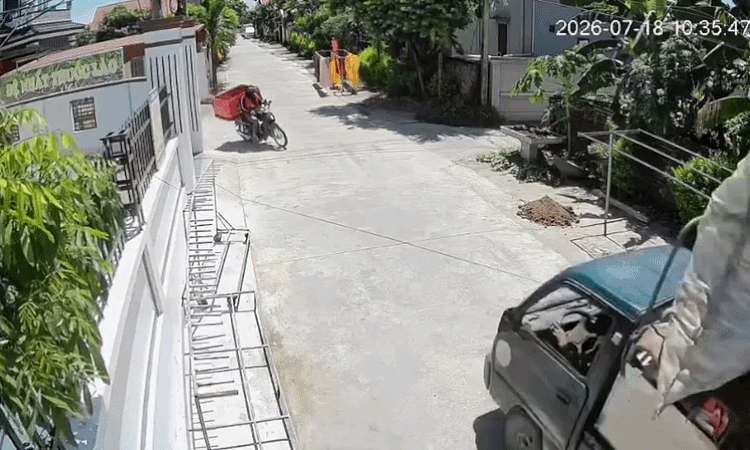
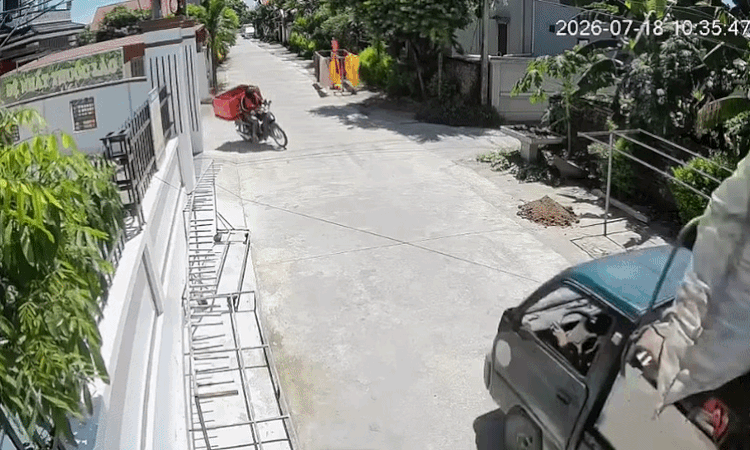
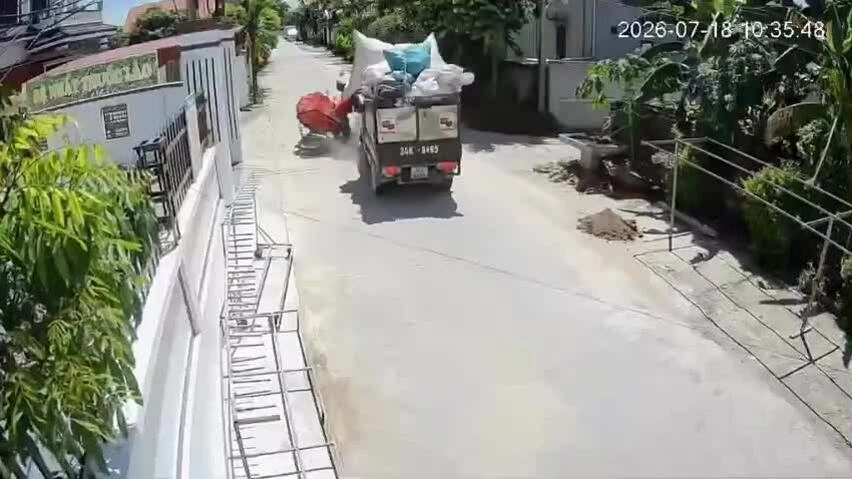
A serious traffic incident occurred on July 18 in Hai Phong when a small truck and a motorcycle collided at a high-speed intersection within a narrow village road, underscoring the persistent dangers of rural infrastructure and driver negligence in Vietnam. The accident, which was captured on a local security camera, shows a motorcycle emerging from a small alleyway directly into the path of an oncoming light commercial vehicle. The resulting impact sent the motorcyclist tumbling across the pavement, though witnesses and initial reports indicate the individual was miraculously able to stand up shortly after the collision. While the physical injuries in this specific instance may have been non-life-threatening, the event has reignited a national conversation regarding the safety of "blind" intersections and the lack of speed regulation in residential zones.
The incident took place in a setting typical of many Vietnamese rural districts: a narrow thoroughfare flanked by high brick walls and dense vegetation, which severely limits the peripheral vision of all road users. According to the footage and eyewitness accounts, the small truck was traveling at a significant speed—arguably too high for the restricted space of a village road—when it approached a junction where a side alley meets the main path. Simultaneously, a motorcyclist exited the alley without coming to a complete stop or sufficiently checking for oncoming traffic. The combination of the truck’s velocity and the motorcycle’s sudden appearance meant that neither party had the necessary reaction time to apply brakes effectively, leading to a direct, head-on collision.
Detailed Chronology of the Event
The timeline of the accident highlights how quickly such events unfold, often leaving no room for error. At approximately the mid-morning hours of July 18, the small truck was navigating a straight stretch of the village road in Hai Phong. Based on the visual evidence, the truck maintained a constant speed despite the presence of numerous residential gates and alleyway exits. At the same time, the motorcyclist began to emerge from a left-hand branch of the road.
As the truck reached the mouth of the alley, the motorcycle crossed the invisible "stop line" of the intersection. The two vehicles occupied the same space in a fraction of a second. The front-left corner of the truck struck the motorcycle, causing the rider to be thrown from the seat. The motorcycle was dragged a short distance before the truck came to a full stop. For several seconds, the rider remained on the ground, a sight that often signals severe trauma. However, in a display of fortunate resilience, the rider was able to regain their footing, though they appeared visibly shaken and likely suffered various contusions and soft-tissue injuries.
The Context of Traffic Safety in Hai Phong
Hai Phong, as one of Vietnam’s major industrial and port cities, experiences a unique blend of heavy logistical traffic and traditional rural transport. While the city center boasts modern boulevards, the surrounding districts are characterized by "inter-village" roads that were originally designed for foot traffic, bicycles, and slow-moving agricultural machinery. In recent years, the rapid motorization of these areas—with an influx of light trucks and high-powered motorbikes—has outpaced the development of the infrastructure.
The specific location of this accident is emblematic of the "blind alley" phenomenon. In many parts of Hai Phong, property owners build walls right up to the edge of the public right-of-way to maximize land use. This creates a "canyon" effect where a driver on the main road cannot see a vehicle in an alley until it has already entered the roadway. Without mirrors installed at these corners or painted stop lines, the safety of the intersection relies entirely on the cautious behavior of the drivers—a factor that was notably absent in the July 18 incident.
National Statistics and Supporting Data
This collision is far from an isolated event. According to data from the National Traffic Safety Committee of Vietnam, a significant percentage of road accidents occur on rural and provincial roads rather than major highways. In the first half of 2024, Vietnam recorded thousands of traffic-related fatalities, with motorcycle riders accounting for over 60% of the victims.
Experts point to several recurring factors in these statistics:
- Speeding in Residential Zones: Small trucks and delivery vehicles often exceed the 30–40 km/h recommended limits for village roads to meet tight schedules.
- Lack of Defensive Driving: A large portion of riders in rural areas do not practice the "stop, look, and listen" protocol when exiting alleys.
- Infrastructure Deficiencies: Over 70% of rural intersections in Vietnam lack basic signage, lighting, or mirrors to assist with visibility.
In Hai Phong specifically, the transition of the local economy toward logistics has increased the number of "xe tải nhỏ" (small trucks) on the road. These vehicles are often used to transport goods from large shipping containers to smaller inland warehouses, frequently utilizing village shortcuts to avoid tolls or main-road congestion.
Official Responses and Inferred Reactions
While local police in Hai Phong continue to investigate the specifics of the July 18 crash, the incident has prompted a response from community leaders. It is expected that local authorities will conduct a review of the intersection to determine if additional safety measures, such as speed bumps or convex mirrors, are required.
In similar past cases, the Ministry of Transport has emphasized that the responsibility for safety at intersections lies primarily with the vehicle entering from a subordinate road. However, the "excessive speed" of the truck in this scenario could lead to a shared liability ruling. Legal experts suggest that if the truck was found to be exceeding the local speed limit for a residential area, the driver could face administrative fines or a suspension of their commercial license, regardless of the motorcyclist’s failure to yield.
Social media reactions from the Hai Phong community have been a mix of relief and frustration. Many residents have called for stricter enforcement of speed limits within village limits, noting that children and the elderly are particularly at risk from "shortcut-seeking" commercial drivers.
Technical Analysis of Driving Skills
The July 18 accident serves as a textbook example of why defensive driving is essential in the Vietnamese context. Road safety experts highlight two critical failures in this event that, if corrected, could prevent future tragedies.
For Truck and Car Drivers:
When navigating village roads (đường làng) or narrow alleys (ngõ nhỏ), drivers must maintain a "moderate and controllable" speed. The primary danger in these environments is the "unseen variable"—a child running out, a dog crossing, or, as in this case, a motorcycle emerging from a blind spot. Experts recommend that drivers stay as far to the right as possible and use their horn (moderately) when approaching blind corners to alert others of their presence. Furthermore, the foot should hover over the brake pedal (covering the brake) whenever passing an alley entrance.
For Motorcyclists:
The "stop-and-observe" rule is paramount. When moving from a small alley into a larger road, the rider must treat the junction as a "Stop" sign, even if one is not physically present. Motorcyclists are advised to inch forward slowly until they have a clear line of sight in both directions. Only when the road is confirmed to be vacant should they commit to the turn or crossing. In the Hai Phong incident, the motorcyclist’s decision to maintain momentum while exiting the alley was the primary catalyst for the collision.
Broader Implications for Infrastructure and Policy
This accident highlights a critical need for "Traffic Calming" measures in Vietnam’s rapidly developing rural-urban fringes. Relying solely on driver behavior is often insufficient. Urban planners suggest that the following steps could drastically reduce the frequency of such collisions:
- Convex Mirrors: Installing mirrors at every T-junction and blind corner in village settings would allow drivers to see around walls and fences.
- Speed Bumps: Physical interventions like speed humps or "rumble strips" are the most effective way to force commercial vehicles to slow down in residential zones.
- Public Education: Increased "Village Level" safety campaigns, perhaps organized by local Women’s Unions or Youth Unions, could educate residents on the specific dangers of their local geography.
The economic impact of these accidents is also substantial. Beyond the immediate medical costs and vehicle repairs, traffic accidents contribute to significant productivity losses and can push families into poverty, especially if the primary breadwinner is injured. In a city like Hai Phong, which is a pillar of Vietnam’s GDP, improving road safety is not just a social issue but an economic necessity.
Conclusion
The collision on July 18 in Hai Phong ended with a stroke of luck—the motorcyclist walked away. However, the video of the event remains a chilling reminder of how close many road users come to tragedy every day. It serves as a call to action for both the public and the authorities. For drivers, it is a reminder that speed must always be dictated by the environment, not just the speed limit. For the government, it is a signal that the infrastructure of "Old Vietnam"—the narrow alleys and high-walled village roads—must be adapted with modern safety tools to accommodate the "New Vietnam" of high-speed motorization. As Hai Phong continues to grow, the lessons learned from this small village road must be integrated into the city’s broader safety strategy to ensure that the next collision does not end in a far more somber headline.
Related posts: