Gold Prices Experience Significant Fluctuations on July 22, 2026, Amidst Global Economic Headwinds and Geopolitical Developments

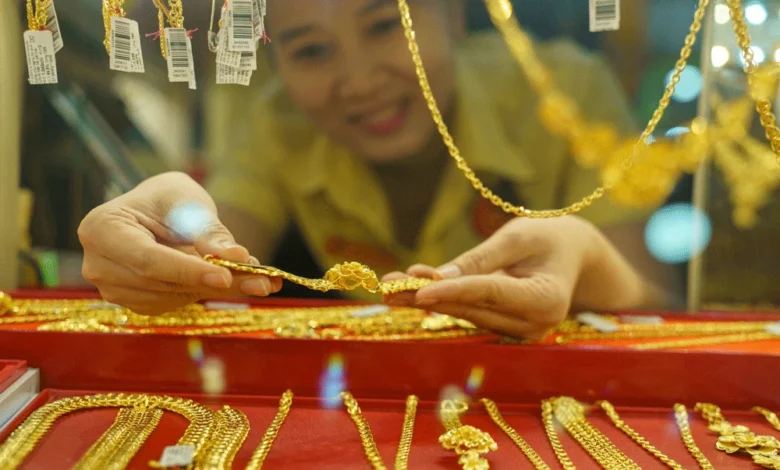
The Vietnamese domestic gold market witnessed significant volatility on July 22, 2026, as SJC gold bar prices, after an initial morning surge, reversed sharply to close lower, reflecting a complex interplay of international market trends and local demand dynamics. By the close of trading, SJC gold bars were listed at 142-146 million VND per tael (buy-sell), marking a substantial daily decrease of 1.4 million VND per tael on the buy side and 400,000 VND per tael on the sell side compared to yesterday’s closing figures. This dramatic shift underscores the inherent sensitivity of gold prices to both macroeconomic indicators and speculative trading activities.
Domestic Gold Market: A Day of Sharp Reversals
The trading day for gold in Vietnam began with an optimistic outlook, building on the momentum from the previous session. At the opening of trading on July 22, SJC gold bars were listed at 144-147 million VND per tael (buy-sell). This represented a notable increase of 600,000 VND per tael for both buying and selling prices compared to the previous day’s close, signaling strong initial demand. Similarly, SJC 1-5 tael gold rings also saw an increase of 600,000 VND per tael on both sides, trading at 142.5-146 million VND per tael. Doji’s 9999 gold rings followed suit, rising by 1.3 million VND per tael to 144.5-147.5 million VND per tael. Bao Tin Minh Chau’s plain gold rings also adjusted upwards, increasing by 700,000 VND per tael on the buy side and 800,000 VND per tael on the sell side, reaching 143.7-147.5 million VND per tael. This initial bullish sentiment suggested a continuation of the upward trend observed on July 21.
However, the afternoon session brought a swift and pronounced reversal. By 2:27 PM on July 22, SJC gold bars were adjusted downwards to 142-146 million VND per tael (buy-sell). This constituted a significant drop of 2 million VND per tael on the buy side and 1 million VND per tael on the sell side compared to the morning’s initial quoted prices. The SJC 1-5 tael gold rings mirrored this decline, falling to 141-145 million VND per tael (buy-sell), a decrease of 1.5 million VND per tael on the buy side and over 1 million VND per tael on the sell side compared to their opening prices. Doji’s 9999 gold rings experienced an even steeper decline, plunging by 2.5 million VND per tael on the buy side and 1.5 million VND per tael on the sell side, settling at 142-146 million VND per tael. Bao Tin Minh Chau’s plain gold rings also saw a reduction, dropping 300,000 VND per tael on both buy and sell sides to 143.4-147.2 million VND per tael by the afternoon.
The closing figures confirmed the dramatic shift. SJC gold bars ended the day at 142-146 million VND per tael (buy-sell), reflecting a 1.4 million VND/tael decrease on the buy side and a 400,000 VND/tael decrease on the sell side compared to yesterday’s closing. Similarly, SJC 1-5 tael gold rings closed at 141-145 million VND per tael, down 900,000 VND/tael on the buy side and over 400,000 VND/tael on the sell side. Doji’s 9999 gold rings also recorded a significant decline, closing at 142-146 million VND per tael, a drop of 1.2 million VND/tael on the buy side and over 200,000 VND/tael on the sell side. In contrast to the general downward trend, Bao Tin Minh Chau’s plain gold rings surprisingly ended the day higher than yesterday’s close, at 143.4-147.2 million VND per tael, marking an increase of 400,000 VND/tael on the buy side and 500,000 VND/tael on the sell side. This divergence highlights the varied pricing strategies and market segments among different gold retailers.
Prior Day’s Performance (July 21, 2026)
The fluctuations on July 22 were preceded by a generally upward trend on July 21. SJC gold bars saw an increase of approximately 400,000 VND per tael, mirroring global price movements. By the end of trading on July 21, SJC gold bars were quoted at 143.4-146.4 million VND per tael (buy-sell), up 400,000 VND on both sides from the previous session. SJC 1-5 tael gold rings also increased by 400,000 VND on both sides, reaching 141.9-145.4 million VND per tael. Bao Tin Manh Hai, another prominent gold dealer, listed its 1-5 tael gold rings at 143.4-146.4 million VND per tael (buy-sell). The USD/VND exchange rate on the interbank market on July 21 was stable at 26,290 VND/USD (buy) and 26,330 VND/USD (sell), providing a relatively stable backdrop for the domestic gold market.
Global Gold Market: A Cautious Recovery Amidst Headwinds
The international gold market on July 22, 2026, presented a picture of cautious recovery, despite strong opposing forces. As of 8:30 PM on July 21 (Vietnam time), spot gold on the international market was trading at 4,052 USD per ounce, while August 2026 gold futures on the Comex New York exchange registered at 4,054 USD per ounce. This marked a gain of nearly 1.1% for spot gold on the US market on July 21, pushing it to $4,052 despite a resilient US dollar and persistently high US Treasury yields.

Year-to-date, the global gold price has seen a significant decline of 6.5%, equivalent to a drop of 283 USD per ounce since the beginning of 2026. When converted to VND at the bank exchange rate and including taxes and fees, international gold prices stood at approximately 129 million VND per tael. This indicates a substantial premium for domestic gold, with Vietnamese prices being roughly 17.4 million VND per tael higher than international prices by the end of July 21. This large discrepancy often fuels smuggling and creates arbitrage opportunities, complicating the Vietnamese market’s stability.
The recent rebound in global gold prices, now in its third consecutive session after hitting a two-week low of $4,024 per ounce, is partly attributed to investors temporarily reducing their concerns about short-term inflation following the release of some positive US economic data. This "buying the dip" behavior suggests a underlying confidence in gold as a long-term store of value, even in the face of immediate pressures.
Macroeconomic and Geopolitical Influences
Several key factors are currently shaping the global gold market:
- US Inflation and Economic Data: Recent US data has indicated a moderation in inflation. However, consumer spending, the labor market, and manufacturing output continue to show resilience. This mixed economic picture complicates the Federal Reserve’s monetary policy decisions. While the latest Consumer Price Index (CPI) showed a slight decrease to 3.2% year-on-year, core inflation remained sticky at 3.9%. Retail sales figures, conversely, indicated a robust 0.7% month-over-month increase, showcasing consumer strength. This data reinforces the likelihood that the Fed will maintain its current interest rate stance in its July meeting and might not be quick to ease its tight monetary policy.
- Federal Reserve Policy: The market remains heavily focused on the Federal Reserve’s tightening cycle. The strong US dollar (DXY index above 101 points) and high US Treasury yields (10-year yield around 4.6%) continue to exert downward pressure on gold, which is a non-yielding asset. Market expectations heavily lean towards the Fed maintaining its hawkish stance, with a probability of approximately 64% for a further rate hike in September. This persistent expectation of higher interest rates makes holding gold less attractive compared to interest-bearing assets.
- Geopolitical Developments: Positive signals have emerged on the diplomatic front, particularly regarding US-Iran relations. Reports indicate that Iran has received de-escalation proposals through intermediaries and has expressed willingness to resume negotiations. The possibility of a temporary cessation of sanctions is being considered. Such developments, if they lead to a reduction in geopolitical tensions, could diminish gold’s appeal as a safe-haven asset. However, the risk of supply disruptions in critical shipping lanes like the Strait of Hormuz or the Red Sea, especially if sanctions were to escalate, remains a significant concern that could provide underlying support for gold prices.
- Energy Prices: On the periphery, crude oil prices have shown minor declines. Nymex WTI crude oil was trading around 84 USD per barrel, while Brent crude was near 91.2 USD per barrel. While not directly driving gold, stable or falling oil prices can alleviate inflationary pressures, indirectly influencing central bank policies and investor sentiment towards inflation hedges like gold.
Expert Outlook and Technical Analysis

Market analysts are closely monitoring communications from the Fed, anticipating the trajectory of interest rate hikes, particularly in September. Concurrently, the progress of US-Iran negotiations and the potential for shipping disruptions remain critical geopolitical factors.
From a technical perspective, gold is currently oscillating around its 20-day Moving Average (MA20). If gold manages to break above the resistance level of 4,064 USD per ounce, it could target the 4,264 USD per ounce region (MA50). Conversely, a breach below the support level of 4,021 USD per ounce could see gold retesting the psychological threshold of 4,000 USD per ounce. However, analysts note that the recent gains are primarily technical recoveries rather than strong fundamental shifts. A significant concern is the potential formation of a "death cross," where the 100-day Simple Moving Average (SMA100) is approaching the 200-day Simple Moving Average (SMA200). If this technical pattern materializes, it would signal a confirmed medium-term downtrend for gold prices, potentially exacerbating current volatility and challenging the recent recovery.
The current market environment for gold is characterized by conflicting signals. While some positive economic data from the US has temporarily eased inflation fears, and geopolitical tensions show signs of de-escalation, the underlying strength of the USD and the hawkish stance of the Federal Reserve continue to cast a shadow over gold’s prospects. Investors are advised to remain vigilant, as the interplay of monetary policy, geopolitical events, and technical indicators will continue to dictate gold’s direction in the near term. The significant premium of domestic gold prices over international rates also adds another layer of complexity for Vietnamese investors, requiring careful consideration of local market dynamics alongside global trends.
Related posts: