Gold prices surge past 4,100 USD per ounce following the US midterm election results as domestic markets track global volatility

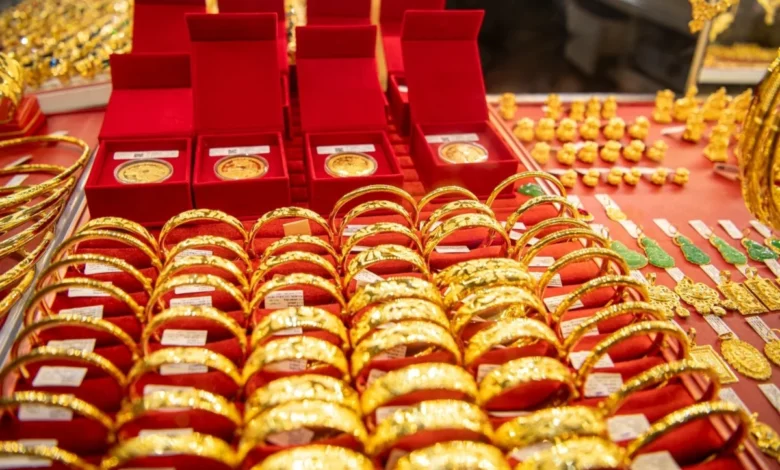
The global precious metals market has witnessed a significant transformation in recent hours, with gold prices decisively breaching the psychological threshold of 4,100 USD per ounce. This bullish momentum follows the conclusion of the United States midterm elections, where the decisive performance of the Democratic Party has recalibrated investor expectations regarding fiscal policy and economic management. As of the early hours of November 6, 2026, international markets responded with a sharp pivot toward safe-haven assets, reflecting broader concerns about debt sustainability and the future trajectory of monetary policy in the world’s largest economy.
In the Vietnamese domestic market, the impact of these global movements was immediate. Major bullion retailers reported substantial price adjustments. SJC gold in Ho Chi Minh City recorded an increase of 1.5 million VND per tael, while Bảo Tín Mạnh Hải and Bảo Tín Minh Châu adjusted their listings upward by 1.7 million VND and 1.6 million VND per tael, respectively. These shifts represent a significant reaction to the cooling of the US dollar and a corresponding decline in government bond yields, which have historically functioned as the primary inverse drivers for gold valuation.
Chronology of Market Movements
The current surge did not occur in isolation but followed a sequence of high-stakes economic indicators and political developments. On November 5, 2026, as election returns began to crystallize, market sentiment underwent a rapid shift. By 9:00 PM (Vietnam time), spot gold was trading near 4,127 USD per ounce, representing a gain of approximately 66 USD from the previous session. Concurrently, futures contracts for December 2026 delivery were observed trading at 4,132 USD per ounce.
The timeline of this rally is intrinsically linked to the release of macroeconomic data throughout the week. Earlier in the month, the ADP employment report highlighted that the private sector added 86,000 jobs in October, surpassing market expectations of 67,000. While this suggested labor market resilience, it was immediately tempered by the ISM services index, which dipped from 54.9 in September to 54.5 in October. This mixed bag of economic signals created a period of uncertainty, which was eventually broken by the election results, providing investors with a clear signal to hedge against potential policy shifts.
Supporting Data and Comparative Analysis
To understand the magnitude of this rally, one must look at the bond market performance. The yield on the 10-year US Treasury note, a critical benchmark for global risk-free rates, retreated to 4.89%—the lowest level recorded in nearly two months. Similarly, the 2-year Treasury note yield declined to approximately 4.55%. As these yields fell, the opportunity cost of holding non-yielding assets like gold decreased, providing a structural tailwind for the metal.
The following table summarizes the domestic market price fluctuations as of November 6, 2026:
| Product (Million VND/Tael) | Today (Nov 6) Buy | Today (Nov 6) Sell | Yesterday (Nov 5) Buy | Yesterday (Nov 5) Sell |
|---|---|---|---|---|
| SJC TPHCM | 139.5 | 142.5 | 139.5 | 142.5 |
| BTMH Kim Gia Bảo | 138.8 | 142.8 | 138.8 | 142.8 |
| Doji TPHCM | 138.5 | 142.5 | 138.5 | 142.5 |
These figures reflect a market that is pricing in a period of extended fiscal stimulus. Trade deficit figures for the US in September also provided context, showing a narrowing to 105 billion USD from the adjusted 105.7 billion USD in August. Export growth of 1.9% to 321.5 billion USD, contrasted with a 1.2% increase in imports to 426.6 billion USD, paints a complex picture of a trade environment that remains highly sensitive to geopolitical shifts.
Global Central Bank Responses
The volatility is not limited to the United States. In the United Kingdom, the Bank of England (BoE) recently opted to increase interest rates by 25 basis points, bringing the benchmark rate to 4%. This decision was underscored by the bank’s internal forecasts, which anticipate inflation peaking at 5% by mid-2027. The BoE has maintained a hawkish posture, signaling that it will continue to assess incoming economic data to guide future policy adjustments, with an ultimate goal of steering inflation back toward the 2% medium-term target.
The global divergence in monetary policy—with the US potentially slowing its rate hikes due to debt pressures and the UK maintaining its tightening cycle—has created a fragmented landscape for gold investors. Gold remains the primary beneficiary of this fragmentation, serving as a neutral store of value when sovereign currencies and debt instruments face systemic risks.
Expert Analysis and Long-Term Implications
Carsten Fritsch, a prominent commodity analyst at Commerzbank, has noted that the factors supporting gold in the long term remain intact, regardless of short-term election-related noise. The primary driver, according to Fritsch, is the precarious state of US fiscal health. With the federal budget deficit exceeding 6% of GDP and the debt-to-GDP ratio reaching the 100% threshold, the Federal Reserve faces a narrow path.
"The burden of debt makes it increasingly difficult for the Federal Reserve to continue aggressive interest rate hikes, even if inflationary pressures remain elevated," Fritsch remarked in a recent briefing. "When the central bank is constrained by the fiscal reality of the government, real interest rates are suppressed. This is the classic environment where gold thrives."
The implications of this environment are twofold. First, for retail investors, the current price volatility suggests that gold is returning to its role as a primary hedge against currency devaluation. Second, for institutional players, the focus has shifted toward the sustainability of the current debt trajectory. If the US government continues to prioritize stimulus despite high debt-to-GDP levels, the downward pressure on the US dollar may become a permanent feature of the market, effectively establishing a new "floor" for gold prices at higher levels than previously anticipated.
Market Outlook
As the market digests the election results, attention will shift toward the upcoming meeting of the Federal Open Market Committee (FOMC). Analysts are looking for clues on whether the committee will acknowledge the fiscal implications of the election outcome. Any indication that the Fed is concerned about the long-term viability of current deficit spending could catalyze another leg up for gold.
Furthermore, the strength of the manufacturing and services sectors will be monitored closely. While current data suggests continued expansion, the cooling of the new orders index—which dropped from 59.8 to 55.9—is a cautionary indicator. If this trend persists, it could point toward a slowing economy, further justifying the shift of capital into gold as a defensive strategy.
In conclusion, the breach of the 4,100 USD/ounce mark is more than a technical milestone; it is a reflection of a global financial system grappling with the intersection of electoral outcomes, fiscal overextension, and the shifting mandates of central banks. While domestic markets in regions like Vietnam may experience localized price corrections, the primary drivers remain deeply rooted in the structural challenges facing the world’s major economies. Investors are advised to maintain a long-term perspective, as the fundamental pressures—sovereign debt, inflationary risks, and policy uncertainty—are unlikely to dissipate in the immediate future. As the global economic landscape continues to evolve, gold is expected to maintain its position as a central pillar in risk management strategies worldwide.
Related posts: