Vingroup stocks defy market sell-off as foreign investors aggressively acquire shares amid Pham Nhat Vuong’s wealth surge


The Vietnamese stock market faced a challenging session on November 11, marked by a palpable sense of caution among domestic investors. As liquidity plummeted to a four-week low, the benchmark VN-Index struggled against a tide of selling pressure driven by lingering concerns over high deposit interest rates, inflationary headwinds, and the potential for further monetary policy tightening by the United States Federal Reserve. Despite this bearish environment, shares within the Vingroup ecosystem demonstrated remarkable resilience, acting as a crucial anchor for the market and propelling the VN-Index to a gain of 3.83 points, closing at 1,746.9 points.
The divergence between the broader market and Vingroup stocks was underpinned by aggressive accumulation from foreign investors. Vingroup (VIC) emerged as the primary target for foreign capital, recording a net purchase value of approximately 139 billion VND. This robust buying interest extended to other major tickers within the group and the wider market, including Vinhomes (VHM), Power Generation Corporation 3 (POW), HDBank (HDB), TienPhong Bank (TPB), Hoa Phat Group (HPG), Masan Group (MSN), and PetroVietnam Gas (GAS). Conversely, the selling pressure was most concentrated on FPT Corporation, which saw a net outflow of roughly 48 billion VND, alongside divestments from Novaland (NVL) and Asia Commercial Bank (ACB) amounting to 39 billion VND and 35 billion VND, respectively.
The Wealth Surge of Pham Nhat Vuong
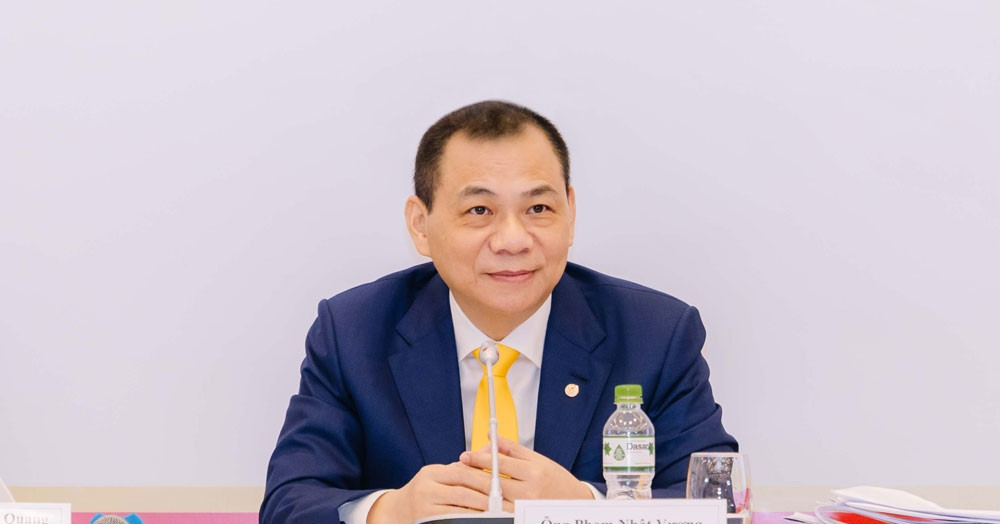
The positive price action for Vingroup shares had a direct impact on the net worth of its founder and chairman, Pham Nhat Vuong. According to real-time data from Forbes, Mr. Vuong’s personal wealth increased by an estimated 1.5 billion USD on November 11 alone, bringing his total valuation to 38.7 billion USD. This uptick solidified his position as the 56th wealthiest individual globally.
Within the Southeast Asian landscape, Mr. Vuong’s financial standing remains significantly ahead of regional counterparts. For comparison, Singaporean tycoon Jason Chang maintains an estimated net worth of 20 billion USD, ranking 133rd globally, while Philippines-based billionaire Enrique Razon Jr. holds approximately 18 billion USD, placing him at 155th. This disparity highlights the massive scale of the Vingroup conglomerate and the market’s continued sensitivity to its performance.
A Chronology of Strategic Expansion
To understand the current investor interest in Vingroup, one must examine the group’s rapid diversification strategy over the last decade. Vingroup has evolved from its origins in real estate to a multifaceted ecosystem spanning automotive manufacturing, green transportation, high-tech research, and large-scale infrastructure development.
The foundation of this growth lies in a period of intense operational scaling. Following a successful internal restructuring, Vingroup reported a nearly twofold increase in revenue over the first nine months of the current fiscal year, with net profit exceeding the annual target by 25%. VinFast, the group’s automotive arm, has become the global face of this expansion, reaching a production milestone of over 211,000 electric vehicles (EVs) globally—a 91% increase compared to the same period in the previous year. This growth is accompanied by strategic market entries in the United States, Indonesia, and the Philippines, positioning the company as a credible player in the global EV transition.
In the real estate sector, Vinhomes continues to serve as a bedrock for revenue generation. As of the end of the third quarter, the company reported sales revenue of nearly 219.6 trillion VND, representing a 35% growth. Furthermore, the value of products sold but not yet handed over reached 185.6 trillion VND, creating a significant revenue backlog that promises to bolster financial performance in subsequent quarters.
Infrastructure and Tech Synergy
Beyond real estate and automotive ventures, Vingroup has aggressively entered the infrastructure and high-tech sectors. A notable development is the collaboration between VinSpeed and Siemens Mobility to supply rolling stock and operational systems for high-speed rail projects connecting Hanoi to Quang Ninh and Ho Chi Minh City to Can Tho. Additionally, a joint venture between Vinhomes and SGC has outlined plans for five metro lines in Hanoi, with an estimated investment of nearly 900 trillion VND.
The group’s technological footprint is further evidenced by its partnership with Danieli (Italy) to develop ray steel production in Ha Tinh. This, coupled with investments in robotics and the planned launch of the VinSat-4 satellite in April 2027, suggests a long-term commitment to high-value industrial manufacturing. This strategy is designed to create a "virtuous cycle" where the group’s various segments—infrastructure, materials, and technology—support each other, allowing Vingroup to participate more deeply in the value chain of large-scale national projects.
Financial Implications and Capital Pressures
However, this ambitious expansion comes with significant capital requirements. By September 30, Vingroup’s total assets had reached approximately 1.6 quadrillion VND, a nearly 50% increase from the start of the year. While this indicates massive growth in scale, it also necessitates careful management of liquidity and debt. Current short-term financial investments stand at 106.8 trillion VND, while total debt obligations are approximately 390 trillion VND.
Over the past 12 months, the conglomerate has raised over 2.3 billion USD through international bonds, preferred shares, and syndicated loan facilities. While this funding allows the group to execute its project pipeline, it also heightens the pressure on cash flow management. High interest rates, the risk of currency fluctuations, and long-term project lifecycles are factors that could impact future investment efficiency.

Market Outlook and Expert Analysis
The ongoing interest from foreign investors suggests a degree of confidence in Vingroup’s long-term transformation strategy. Analysts note that the company’s ability to convert large-scale projects into consistent revenue, profit, and robust cash flow will be the primary determinant of its stock performance in the coming years.
The current market volatility serves as a test for the group’s financial resilience. While the domestic market remains sensitive to macroeconomic indicators, the inflow of foreign capital into Vingroup suggests that institutional investors are looking beyond short-term market noise, focusing instead on the potential for the group to dominate emerging sectors in Southeast Asia.
The fundamental challenge for Vingroup remains balancing its aggressive growth ambitions with the need for sustainable debt ratios. As the group moves into more capital-intensive industries like infrastructure and aerospace, the efficacy of its capital deployment will be scrutinized more than ever. For now, the resilience of VIC and VHM in the face of a broader market downturn highlights the group’s unique position in the Vietnamese economy—a conglomerate that is simultaneously a bellwether for national growth and a complex entity navigating the global challenges of high-cost development.
In conclusion, the market’s reaction on November 11 reflects a broader narrative regarding Vingroup: the company is currently in a phase of heavy capital investment intended to secure long-term leadership in multiple high-growth sectors. While the risks associated with this expansion are substantial, the persistent interest from foreign investors indicates a belief that the long-term value created by this ecosystem will eventually outweigh the short-term pressures of high debt and volatile market conditions. As Vingroup continues its trajectory, the focus will inevitably remain on its ability to execute on these promises and maintain its competitive edge in both domestic and international arenas.
Related posts: