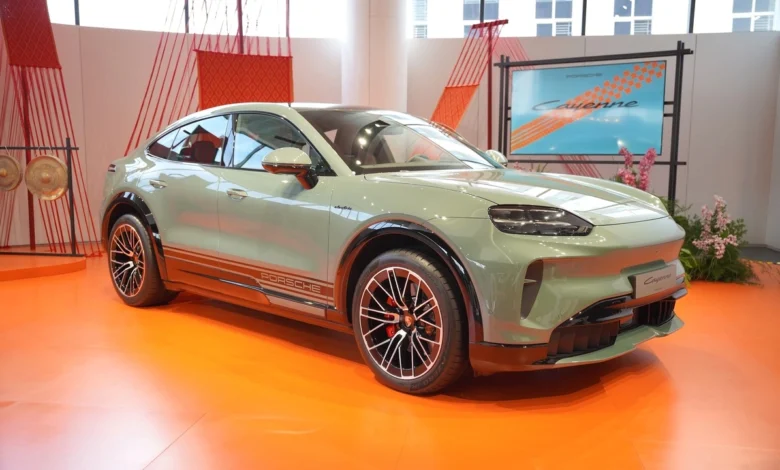
Porsche has officially introduced its most powerful production vehicle in history to the Vietnamese market, unveiling the all-electric Porsche Cayenne EV at a special launch event held at Porsche Centre Saigon. With prices starting at 4.72 billion VND, the arrival of the battery-powered luxury SUV marks a monumental shift for the Stuttgart-based manufacturer as it accelerates its global electrification strategy. Imported directly from Germany, the new flagship EV lineup is offered in both traditional SUV and sleek Coupe body styles, catering to the upper echelons of luxury performance vehicle buyers in Vietnam.
Main Facts and Model Lineup Overview
The newly launched Porsche Cayenne EV arrives with a comprehensive tier structure, giving customers three distinct performance configurations to choose from: Standard, S, and Turbo. In the Vietnamese market, the pricing begins at 4.72 billion VND for the entry-level Standard SUV, scaling up to 6.41 billion VND for the range-topping Turbo Coupe.
Below is the complete pricing structure for the Porsche Cayenne EV lineup in Vietnam:
| Version | SUV (VND) | Coupe (VND) |
|---|---|---|
| Standard | 4.72 billion | 4.82 billion |
| S | 4.93 billion | 5.04 billion |
| Turbo | 6.32 billion | 6.41 billion |
Strategically, the all-electric Cayenne will be sold alongside the existing internal combustion engine (ICE) third-generation Cayenne, mirroring the commercial rollout strategy previously deployed for the smaller Macan EV. Porsche has not yet announced a definitive timeline for phasing out the combustion-engine variants, ensuring that traditionalists and early EV adopters alike have immediate access to their preferred powertrain choices.
Chronology and Development Background
The debut of the Cayenne EV follows a rigorous global development cycle spearheaded by Porsche engineers aiming to redefine the electric luxury performance segment. Built upon the advanced Premium Platform Electric (PPE) architecture—a modular EV-dedicated framework co-developed within the Volkswagen Group—the Cayenne EV benefits from sophisticated underpinnings previously utilized by the Macan EV. However, for the flagship Cayenne, engineers extended the wheelbase significantly by 130 mm to reach 3,020 mm. This dimensional adjustment makes the electric variant approximately 125 mm longer in wheelbase than its internal combustion predecessor, maximizing interior cabin real estate and battery packaging efficiency.
The global reveal of the vehicle took place globally on November 21, quickly followed by its Southeast Asian introduction in Vietnam, demonstrating Porsche’s commitment to rapidly deploying its cutting-edge electric portfolio in high-growth luxury markets.
Exterior Design and Aerodynamics
The design language of the Porsche Cayenne EV represents a futuristic evolution of the brand’s iconic styling DNA. Both the SUV and Coupe variants exhibit lower hood lines, razor-thin matrix LED headlights, and frameless doors that give the vehicle an aggressive yet sophisticated stance. The Coupe variant distinctively differentiates itself with a sweeping roofline that tapers dramatically toward the rear, resulting in a slightly lower overall height compared to its SUV sibling.
Aerodynamic efficiency played a critical role in the development of the Cayenne EV. Porsche achieved an exceptionally low drag coefficient of 0.25 Cd for the SUV and 0.23 Cd for the Coupe, positioning them among the most aerodynamic SUVs in their class. This stellar performance is aided by an active aerodynamics suite featuring controllable cooling air flaps, smart roof spoilers, and dynamic front and rear air dams. According to Porsche engineers, the system continuously adapts to vehicle speed and dynamic load, automatically deploying to enhance downcutting grip during high-speed cornering or retracting to minimize drag when maximum efficiency is required. Furthermore, Turbo Electric variants are distinguished by exclusive Turbonite accent colors and sophisticated contrasting details.
Interior Innovations and Digital Cockpit
Stepping inside the cabin, the Cayenne EV presents a heavily digitized environment that sharply contrasts with its combustion-powered predecessor. The interior is anchored by dual curved touchscreens that sweep seamlessly across the dashboard and transition into the center console, complemented by an optional 14.9-inch passenger display.
Thanks to the extended wheelbase, rear occupants enjoy substantially more legroom, supplemented by power-adjustable, heated seats. One of the cabin’s standout technological features is a massive 87-inch head-up display that incorporates augmented reality (AR) navigation overlays, projecting critical driving data and directional cues directly into the driver’s natural line of sight. Moreover, the vehicle introduces a sophisticated AI-powered voice control system, natively integrated streaming services, and pre-installed gaming capabilities. Natural light flooding into the cabin is managed by a panoramic glass roof equipped with liquid crystal light-control technology, allowing passengers to electrically adjust the roof’s opacity at the touch of a button.
Powertrain Performance and Charging Architecture
Performance remains the cornerstone of the Porsche brand, and the Cayenne EV shatters expectations for what an electric SUV can achieve. All variants utilize a high-capacity 113 kWh battery pack, delivering impressive driving ranges across the lineup. For the SUV configurations, the maximum driving range reaches up to 653 km for the Standard model, 642 km for the S, and 623 km for the Turbo. The Coupe configurations yield slightly reduced ranges—typically 8 to 38 km less depending on the specific trim—due to aerodynamic variations.
Leveraging an 800-volt electrical architecture, the Cayenne EV supports DC fast-charging capabilities of up to 400 kW. This ultra-fast charging ecosystem enables the vehicle to replenish its battery from 10% to 80% in just 16 minutes, or secure up to 315 km of range in a mere 10-minute charging session.
Power outputs vary significantly across the three tiers:
- Standard: Generates 408 horsepower, or up to 442 horsepower with Launch Control engaged. It achieves a 0-100 km/h sprint in 4.8 seconds and reaches a top speed of 230 km/h.
- S: Delivers 544 horsepower, escalating to 666 horsepower with Launch Control. The 0-100 km/h acceleration time drops to 3.8 seconds, with a top speed capped at 250 km/h.
- Turbo: The crown jewel of the lineup and the most powerful production car in Porsche’s history. It produces a staggering 857 horsepower continuously, surging to an incredible 1,156 horsepower and 1,500 Nm of torque when Launch Control is activated. This allows the heavy luxury SUV to rocket from 0 to 100 km/h in an astonishing 2.5 seconds.
To manage this immense power, every Cayenne EV comes equipped with standard adaptive air suspension. The Turbo variant further adds the Porsche Torque Vectoring Plus (PTV Plus) differential. Additional optional chassis enhancements include rear-axle steering (offering up to 5 degrees of steering angle) and the revolutionary Porsche Active Ride active suspension system.
Market Implications and Competitive Analysis
The arrival of the Porsche Cayenne EV in Vietnam reshapes the upper tier of the luxury electric vehicle market. Industry analysts note that while traditional competitors such as Maserati Levante currently lack a pure electric counterpart in their local portfolios, the Cayenne EV will face direct competition from alternative luxury battery-powered imports like the Lotus Eletre, which retails between 4.448 billion and 7.188 billion VND.
By introducing a high-performance EV that matches—and in many configurations surpasses—the capabilities of its combustion engine stablemates, Porsche is signaling to the Vietnamese luxury automotive sector that electrification no longer requires a compromise on performance, heritage, or prestige. As charging infrastructure continues to expand nationwide, the Cayenne EV is well-positioned to capture significant market share among affluent consumers looking to transition toward sustainable mobility without sacrificing the driving dynamics synonymous with the Stuttgart marque.