Drivers Defy Death on the Collapsed Palaiopyrgos Bridge as Greece Struggles with Infrastructure Recovery Post-Storm Daniel

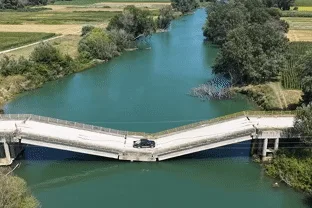
In the heart of the Thessaly region in central Greece, near the city of Larissa, a harrowing scene plays out daily that defies both logic and safety regulations. For many local residents and farmers, the Palaiopyrgos Bridge, which spans the Pineios River, remains a vital artery despite the fact that it is structurally shattered. While most drivers complain about minor inconveniences like potholes or speed bumps, the commuters of Larissa are navigating a bridge that has literally buckled in the middle, its tarmac dipping dangerously close to the flowing waters below. This act of defiance highlights a growing crisis in Greek infrastructure, where the slow pace of reconstruction following catastrophic weather events has forced citizens to choose between life-threatening shortcuts and economic ruin.
The Catastrophe of Storm Daniel: A Catalyst for Ruin
The current state of the Palaiopyrgos Bridge is a direct consequence of Storm Daniel, a Mediterranean hurricane-like system—often referred to as a "medicane"—that battered the region in September 2023. Meteorologists described the storm as a once-in-a- millennium event, dropping more rain in 24 hours than some parts of Greece receive in an entire year. The deluge transformed the Thessaly plain, the nation’s agricultural heartland, into a vast inland sea.
The impact was global in its severity. Storm Daniel did not just affect Greece; it swept across Bulgaria, Turkey, and eventually Libya, where it caused the catastrophic failure of dams in Derna, leading to thousands of deaths. In Greece, the storm claimed 17 lives and caused billions of euros in damages. However, the most lasting "silent" victim of the storm was the regional infrastructure. Bridges, roads, and railway lines that had stood for decades were swept away or rendered structurally unsound by the sheer volume of water and debris carried by the surging rivers.
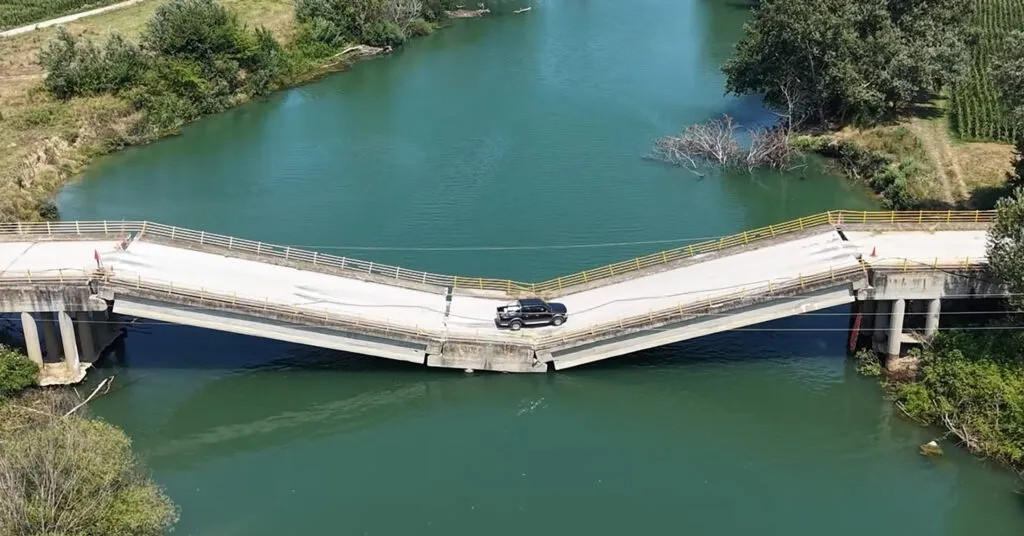
In the Thessaly region alone, official assessments following the storm identified 79 bridges that had either collapsed entirely or suffered severe structural damage. The Palaiopyrgos Bridge was among the most critically hit. The force of the Pineios River undermined the central supports of the bridge, causing the middle section to sag into a steep "V" shape. From a distance, the structure looks less like a bridge and more like a discarded piece of ribbon draped across the water.
A Daily Gamble: The Psychology of Local Defiance
Despite the clear and present danger, a steady stream of vehicles—ranging from heavy-duty pickup trucks and SUVs to agricultural tractors—continues to use the bridge. A recently circulated drone video captured by the local news outlet LarissaNet has brought international attention to this phenomenon. The footage shows a white Ford Ranger carefully descending the steep incline of the broken bridge, reaching the bottom of the sag, and then powering up the opposite slope to reach the other side. The maneuver looks more like an extreme off-road challenge than a standard commute.
The reason for this dangerous behavior is rooted in economic necessity. The Palaiopyrgos Bridge serves as a primary link for farmers moving between their fields and local markets or processing facilities. Since the bridge’s official closure, the alternative route requires a detour onto the national highway, adding dozens of kilometers to every trip.
For a local farmer, this detour represents more than just lost time; it is a significant financial burden. In an era of high fuel prices and thin profit margins, adding 30 to 50 kilometers of travel per day can result in hundreds of extra euros in monthly operating costs. Furthermore, many agricultural vehicles are not legally permitted or mechanically suited for high-speed travel on national highways, leaving farmers with few options. This has created a culture of calculated risk, where locals rely on their familiarity with the bridge’s "stable" sections to justify their passage.
The Navigation Trap: When Technology Leads to Danger
While locals may understand the risks they are taking, the Palaiopyrgos Bridge presents a different kind of threat to outsiders, tourists, and delivery drivers. One of the most significant issues identified by regional authorities is the failure of digital mapping services to update road closures in real-time.
Reports have surfaced of GPS systems—including Google Maps and various in-car navigation units—still routing traffic across the Palaiopyrgos Bridge. For a driver unfamiliar with the area, especially at night or during inclement weather, following a digital map could lead to a fatal error. There have been numerous accounts of drivers reaching the edge of the bridge and having to slam on their brakes or perform dangerous U-turns after realizing the "road" ahead has collapsed.
The lack of robust physical barriers exacerbates this problem. While simple warning signs and plastic tape were initially installed, they have often been moved, ignored, or destroyed. Without permanent concrete barriers or 24-hour monitoring, the bridge remains accessible to anyone willing to ignore a sign. This highlights a critical gap in emergency management: the disconnect between physical infrastructure failure and digital navigation accuracy.
The Broader Impact on the Thessaly "Breadbasket"
The situation at Palaiopyrgos is emblematic of the broader struggles facing Thessaly. As the primary producer of Greece’s grains, dairy, and meat, the region’s stability is essential for national food security. The destruction of 79 bridges has fractured the logistics chain of the entire region.
The economic implications are multi-layered:
- Increased Logistics Costs: Every detour taken by a logistics truck increases the shelf price of goods, contributing to inflation within the Greek economy.
- Delayed Harvests: Inaccessible roads prevent heavy machinery from reaching fields during critical harvest windows, leading to crop loss.
- Depopulation Risks: There is a growing concern that if infrastructure is not restored quickly, younger generations of farmers will abandon the region for urban centers, leading to a long-term decline in Greek agricultural output.
Government Response and the Funding Gap
The Greek government, led by Prime Minister Kyriakos Mitsotakis, has pledged billions of euros toward the reconstruction of Thessaly. The European Union has also stepped in, providing aid through the EU Solidarity Fund. However, the scale of the task is monumental.
The delay in repairing bridges like the one at Palaiopyrgos is often attributed to three main factors:
- Engineering Complexity: Repairing a buckled bridge is often more complicated than building a new one from scratch. Engineers must conduct extensive soil stability tests to ensure that the riverbed can support new pillars, especially given the changing climate patterns.
- Bureaucracy: The process of tendering contracts for 79 different bridge projects involves a massive amount of administrative work, environmental impact assessments, and legal oversight to prevent corruption.
- Prioritization: With so many failures, the government has had to prioritize major arteries and bridges that connect large population centers, often leaving smaller rural bridges like Palaiopyrgos at the bottom of the list.
Regional officials in Larissa have expressed frustration, noting that while they understand the frustration of the farmers, they cannot endorse the use of the bridge. "The bridge is a crime scene of nature," one local official noted anonymously. "Every time a car crosses it, we are one vibration away from a tragedy."
Analysis: Infrastructure Resilience in the Climate Change Era
The saga of the Palaiopyrgos Bridge serves as a cautionary tale for the rest of Europe and the world. As climate change increases the frequency and intensity of extreme weather events, existing infrastructure—much of it built 40 to 60 years ago—is being pushed beyond its design limits.
The "V" shape of the Palaiopyrgos Bridge is a visual metaphor for the "resilience gap." Bridges designed for the weather patterns of the 1970s cannot withstand the "Medicanes" of the 2020s. Moving forward, the reconstruction of Thessaly cannot simply be a matter of replacing what was lost. It requires "building back better"—using advanced materials, deeper foundations, and hydraulic designs that can accommodate much higher water flow rates.
Furthermore, there is a clear need for better integration between local governments and tech companies. If a bridge is collapsed, it should be "geofenced" in navigation apps within minutes, not months. The fact that GPS systems are still leading drivers to a broken bridge nearly a year after the storm is a systemic failure of the digital age.
Conclusion: A Tragedy Waiting to Happen
For now, the Palaiopyrgos Bridge remains a monument to both human resilience and human recklessness. Every day that the bridge remains open to "illegal" traffic is a day that the Greek authorities gamble with the lives of their citizens. While the farmers’ economic plight is undeniable, the physical reality of a buckled bridge is unforgiving.
The viral footage of the Ford Ranger crossing the abyss has served as a wake-up call. There are now renewed calls for the Greek Ministry of Infrastructure and Transport to install permanent, impassable barriers at both ends of the bridge until a temporary military-style bridge or a permanent replacement can be constructed. Until then, the bridge over the Pineios River stands as a precarious shortcut, where the cost of saving a few liters of fuel could one day be measured in human life. The recovery of Thessaly is not just about pouring concrete; it is about restoring the safety and trust of a community that feels forgotten by the very roads that used to connect them to the world.