During the 11th Belt and Road Summit held in Hong Kong on September 9-10, SonKim Land officially executed a strategic master principles agreement to establish a comprehensive cooperative framework aimed at advancing integrated railway station developments and Transit-Oriented Development (TOD) models in Vietnam. The landmark tripartite agreement involves Hong Kong’s MTR Corporation—specifically through MTR Smart Mobility—and Gamuda Land Vietnam, with the signing ceremony conducted under the distinguished observation of consular representatives from both Vietnam and Malaysia.
This strategic alliance is designed to explore, research, and execute advanced urban development strategies centered around public transportation corridors. By anchoring future projects around high-capacity transit hubs, the partnership seeks to reshape Vietnam’s metropolitan landscape by harmonizing railway infrastructure with high-density commercial, residential, and public spaces.
The 11th Belt and Road Summit: A Global Catalyst for Strategic Infrastructure Partnerships
The high-level summit in Hong Kong, jointly hosted by the Government of the Hong Kong Special Administrative Region (HKSAR) and the Hong Kong Trade Development Council (HKTDC), convened under the overarching theme "High-Quality Development—A New Journey." The prestigious international event drew more than 6,000 delegates representing over 70 countries and territories, solidifying its position as a premier global platform for economic collaboration, infrastructure investment, and transnational partnerships.
Throughout the two-day conference, participants witnessed the signing or endorsement of over 60 agreements, memoranda of understanding, and cooperative frameworks between government entities and corporate enterprises. The aggregate financial volume of projects, transactions, and commercial arrangements finalized immediately before and during the summit surpassed 3.1 billion USD. These numbers underscore the growing appetite for cross-border investments and high-value infrastructure initiatives within global growth corridors.
Within this dynamic international setting, the Consulate General of Vietnam in Hong Kong and Macau, led by Consul General Le Duc Hanh, played an active role in facilitating bilateral connections. Consul General Hanh emphasized that the Belt and Road Summit serves as an indispensable channel for showcasing Vietnam’s expanding investment appeal. Furthermore, the platform provides vital institutional backing for Vietnamese enterprises seeking international cooperation, technology transfer, and joint-venture opportunities with prominent Hong Kong and global counterparts.

The formalization of the partnership between SonKim Land, MTR Corporation, and Gamuda Land represents a crucial bridge connecting Vietnam’s burgeoning real estate sector with world-class expertise in urban railway operations, transit engineering, and integrated community planning.
Decoding the TOD Model: Merging Transit Infrastructure with Urban Ecosystems
At the core of the newly minted agreement is the joint exploration of Transit-Oriented Development (TOD) methodologies tailored to the unique demographic and structural needs of Vietnam’s rapidly expanding urban centers. Rather than treating mass transit stations merely as utilitarian entry and exit points for commuters, the collaborative vision elevates these nodes into vibrant, multi-functional urban ecosystems.
Under this modern paradigm, railway stations become the physical and economic heart of communities where transit, commerce, hospitality, residential living, and public recreation converge within a single, seamless spatial continuum. This approach mirrors the highly successful urban models pioneered by MTR Corporation in Hong Kong and other international metropolitan markets over the past 45 years. MTR brings to the table an unmatched pedigree spanning the entire lifecycle of rail-based assets: from strategic regional planning, architectural engineering, and heavy construction to daily operational management, asset maintenance, and commercial space leasing.
For SonKim Land, the collaboration introduces world-class benchmarks in integrated station management. As Vietnam accelerates its urbanization process, the demand for sophisticated public transport networks has reached a critical inflection point. By leveraging MTR’s specialized knowledge, SonKim Land aims to bridge the gap between traditional real estate development and modern transit infrastructure, mitigating urban congestion while generating long-term economic value for local communities.
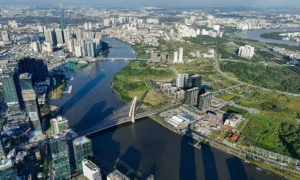
This philosophy is already taking tangible shape in Vietnam’s commercial hub. SonKim Land has formally proposed an ambitious TOD 5.0 master plan concept for Ho Chi Minh City, centered around the multi-functional Thu Thiem Station urban core. This proposal envisions a hyper-connected, multidimensional urban space designed to optimize pedestrian flow, reduce carbon emissions, and maximize the economic productivity of land surrounding key rail nodes.
Strategic Implications for Vietnam’s Real Estate and Infrastructure Landscape
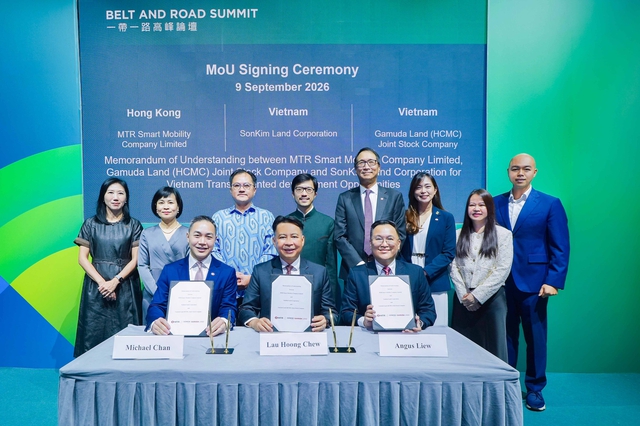
The implications of the SonKim Land-MTR-Gamuda Land partnership extend far beyond individual corporate growth, touching upon core structural shifts within Vietnam’s national economy.
First, the agreement diversifies investment capital streams into Vietnam’s critical infrastructure sector. Historically, mass rapid transit (MRT) and heavy rail projects in developing nations have relied heavily on public debt, sovereign loans, or direct state budget allocations. By introducing a private-sector-led TOD model backed by international expertise, the partnership demonstrates how private developers can share the financial and operational burden of infrastructure delivery. Value capture mechanisms—whereby the appreciation of real estate values surrounding transit stations is reinvested into public infrastructure maintenance and expansion—can become a viable financing model for Vietnam’s future metro lines.
Second, the alignment addresses acute urban planning challenges in Hanoi and Ho Chi Minh City. Both mega-cities are currently grappling with rapid population growth, escalating vehicular traffic, and environmental pollution. Implementing robust TOD frameworks helps curtail urban sprawl by encouraging high-density, vertical growth along designated mass transit corridors, thereby promoting sustainable mobility choices among urban residents.
Third, the partnership signals a maturing Vietnamese real estate market. Domestic developers are increasingly looking beyond conventional residential and commercial projects, pivoting toward complex, mixed-use ecosystems that require sophisticated engineering, long-term capital commitment, and cross-sectoral collaboration. By associating with global industry titans like MTR, Vietnamese enterprises are elevating their operational standards, governance frameworks, and technical capabilities to meet stringent international benchmarks.
Broader Economic Outlook and Future Roadmap
The participation of SonKim Land in the 2026 Belt and Road Summit and the subsequent signing of the master principles agreement underscore the company’s long-term vision of internationalizing its operational footprint. By integrating external expertise, cutting-edge urban design principles, and diversified capital sources, the consortium is well-positioned to shape the next generation of Vietnamese urban infrastructure.
As Vietnam’s major metropolitan areas continue to roll out extensive urban railway networks over the coming decade, the successful execution of TOD pilot projects will serve as a vital blueprint for nationwide replication. The collaborative efforts initiated in Hong Kong this September mark the beginning of a transformative journey—one that promises to redefine how millions of Vietnamese citizens live, work, and move within their cities, establishing a resilient foundation for sustainable, high-quality urban growth.