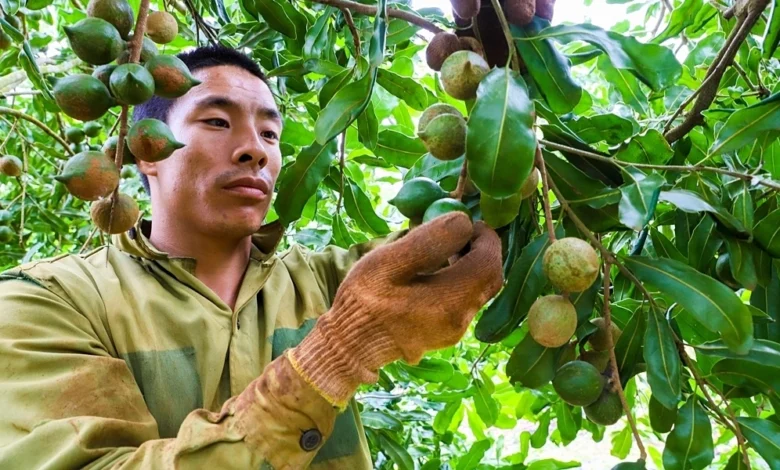
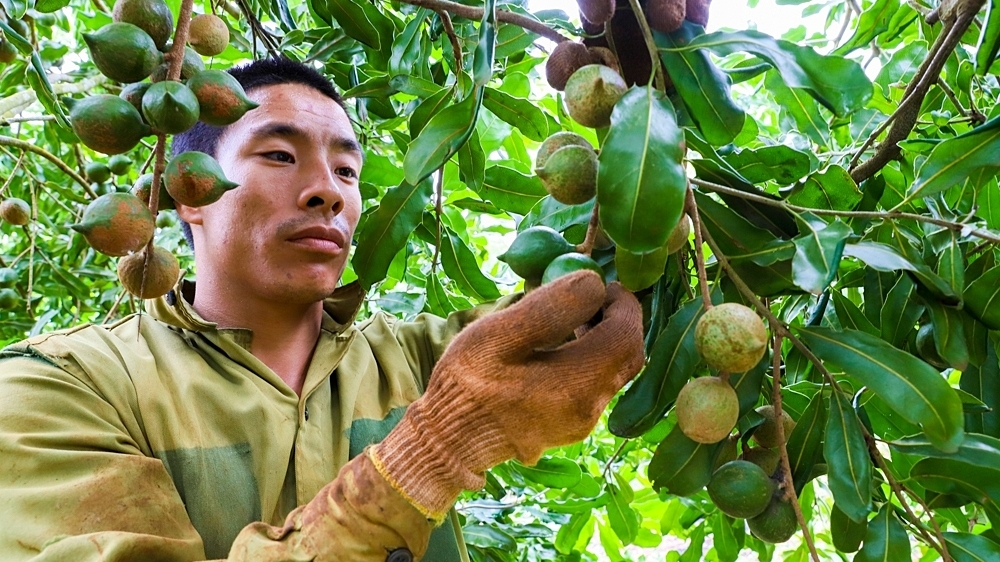
In the first seven months of the year, Vietnam has spent approximately 30 million USD on macadamia nut imports, a figure that highlights a deepening paradox in the country’s agricultural sector. Despite boasting a nationwide cultivation area exceeding 46,000 hectares, the domestic supply chain remains unable to keep pace with the rapidly expanding demand from local processors and international markets. This discrepancy between land allocation and actual market output has prompted a re-evaluation of the industry’s developmental trajectory, shifting the focus from mere expansion of acreage to the critical improvement of yield, quality, and processing efficiency.
A Disconnect Between Acreage and Output
According to data from the General Department of Vietnam Customs, the total export value of macadamia products for the seven-month period reached nearly 34 million USD. A breakdown of these figures reveals a significant structural shift in the industry: while the export value of fresh macadamia nuts declined by 11.2% to approximately 18 million USD, processed products surged by an impressive 346%, reaching nearly 16 million USD.
This transition suggests that the industry is maturing, moving away from the simple export of raw agricultural commodities toward higher-value, processed goods. However, this shift has also created an urgent, stable demand for high-quality raw materials that local farmers have struggled to meet.
The root of the issue lies in the biological nature of the macadamia tree and the maturity of existing plantations. Macadamia is a perennial crop; therefore, an increase in planting area does not immediately translate to a proportional increase in production. According to the Vietnam Academy of Forest Sciences, while grafted macadamia trees can begin bearing fruit by the third year, they require significantly more time to reach peak productivity. Consequently, the massive expansion of land observed over the last decade has not yet hit its stride in terms of yielding harvestable tonnage.
The Statistical Reality: A Look at the Numbers
National agricultural statistics illustrate this "yield gap" clearly. Although Vietnam has successfully expanded its macadamia cultivation to over 46,000 hectares, the projected harvest for 2025 is estimated to be just over 20,000 tons of fresh nuts. In 2024 alone, domestic manufacturers were forced to import between 3,500 and 4,000 tons of raw macadamia nuts to satisfy both the processing requirements for export and domestic consumer demand.
Lam Dong province serves as a prime case study for this phenomenon. Agricultural records from the province indicate that while local farmers have dedicated approximately 16,000 hectares to the crop, only 6,600 hectares are currently within the productive "business" phase. While the province expects to harvest roughly 13,700 tons in 2025—a nearly 50% increase from the previous year—the lag between planting and full-scale production remains a persistent hurdle.
Chronology of Industry Growth
The development of Vietnam’s macadamia industry has been marked by three distinct phases:
- Experimental Phase (2000s–2010): Initial trials were conducted in the Central Highlands to assess soil and climate compatibility. Results were promising, prompting interest from both the government and private investors.
- Expansion Phase (2011–2020): Following the successful pilot programs, a massive land-grab for macadamia cultivation occurred. Provincial governments encouraged farmers to convert low-yield coffee or tea land to macadamia, leading to the rapid growth of the current 46,000-hectare footprint.
- Integration and Processing Phase (2021–Present): The current era is defined by a pivot toward vertical integration. Companies are investing in modern shelling, roasting, and value-added processing facilities. This phase is characterized by the current supply-demand imbalance, as processing capacity has outstripped the maturity of the trees planted during the expansion phase.
Official Perspectives and Market Analysis
Experts argue that the reliance on imports is not necessarily a sign of failure, but a temporary symptom of a maturing industry. Dang Phuc Nguyen, General Secretary of the Vietnam Fruit and Vegetable Association (Vinafruit), emphasizes that the global market is hungry for nuts.
"By 2030, the global market is projected to require approximately 220,000 tons of macadamia kernels, which is equivalent to roughly 850,000 tons of fresh nuts," Nguyen stated. "Consumers are increasingly seeking out nutrient-dense superfoods, and macadamia has a unique position due to its versatility—ranging from roasted kernels to nut milks and oils."
Nguyen posits that Vietnam has a significant opportunity to ascend the global value chain. However, this success is contingent on several factors: the strict standardization of the raw material supply, the development of sophisticated processing technology, and the ability to meet the rigorous sanitary and phytosanitary standards required by premium markets such as the United States, Japan, South Korea, and the European Union.
Implications for the Future
The current shortfall in domestic supply has forced processors to navigate a challenging landscape. A representative from a major processing facility in Ho Chi Minh City noted that their operational stability depends entirely on the consistency of the raw material. "When we scale up production for processed goods, we need a steady, high-quality supply. If the domestic market cannot guarantee that, we have no choice but to look abroad to keep our machinery running and our contracts fulfilled," the representative explained.
This underscores the "missing middle" in the industry: the lack of a standardized, large-scale collection and grading system that can aggregate yields from thousands of smallholder farmers into a uniform supply capable of meeting industrial-grade requirements.
Looking Toward 2030
The Vietnam Macadamia Association has set ambitious goals for the next five years. By 2030, the organization aims to increase total cultivation area to between 130,000 and 150,000 hectares, with the objective of pushing export revenue from nut-based products beyond the 100 million USD mark.
Beyond the numbers, the association views macadamia as a strategic tool for socio-economic development. By promoting cultivation in mountainous, border, and sparsely populated regions, the government hopes to create sustainable livelihoods for ethnic minority communities and contribute to poverty reduction programs.
However, the path forward requires more than just planting more trees. It demands a holistic approach that includes:
- Genetic Improvement: Transitioning toward higher-yielding, climate-resilient grafted varieties.
- Technological Investment: Providing farmers with better post-harvest storage and drying technologies to reduce the high wastage rates currently plaguing the industry.
- Cooperative Models: Moving away from fragmented, small-scale farming toward professional cooperatives that can provide technical support and ensure consistent quality control.
In conclusion, while the 46,000 hectares currently under cultivation represent a massive investment of capital and labor, they are only the foundation. The "white gold" of the macadamia industry will only fully materialize when the gap between the field and the factory is closed, allowing Vietnam to leverage its growing acreage into a competitive advantage in the global agricultural economy. The current reliance on imports is a clear indicator that while the industry has scaled, it has not yet fully matured—a challenge that will define the next decade of Vietnamese agricultural development.