Non-compliant driver faces heavy fine and license penalty for running a red light in Thanh Hoa


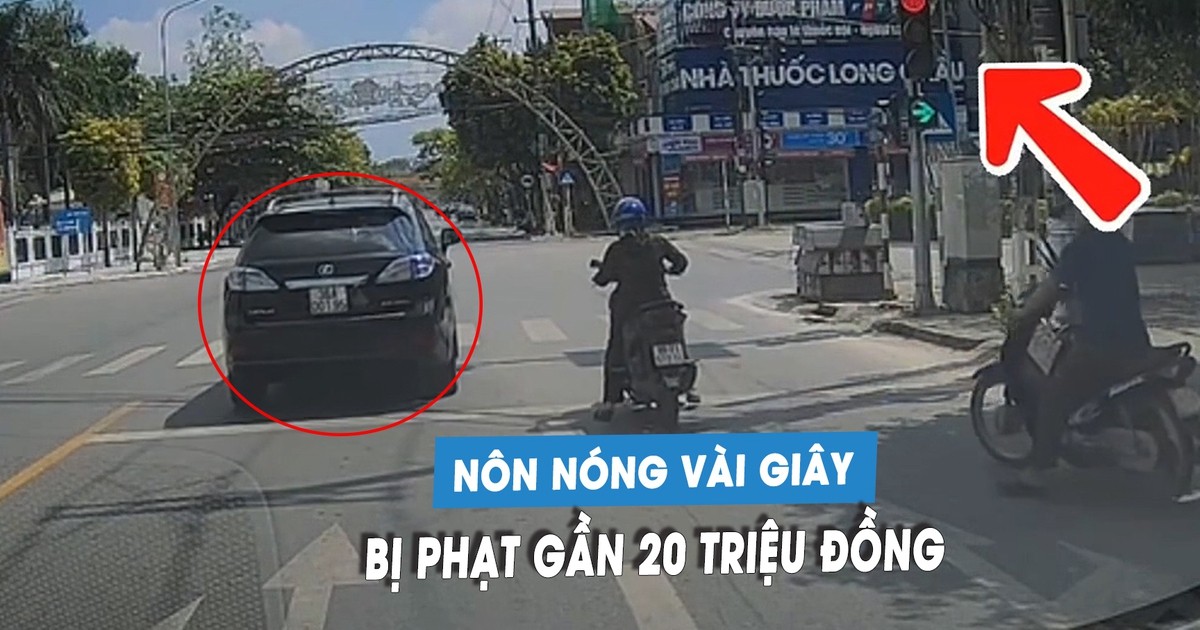
A blatant disregard for traffic safety regulations has resulted in significant legal and financial consequences for a motorist in Thanh Hoa province. On October 20, 2026, a driver operating a black Lexus sedan chose to ignore a red traffic signal at a busy intersection in the Bim Son district, despite nearly ten seconds remaining on the countdown timer. The incident, captured by the dashboard camera of a nearby vehicle, sparked widespread public criticism and prompted an immediate investigation by local traffic authorities.
Chronology of the Incident
The events unfolded at approximately 11:35 AM on October 20, 2026, along Tran Phu Road, a major thoroughfare in the Bim Son district of Thanh Hoa. According to footage retrieved from a witness’s dashcam, the black Lexus (bearing license plate 36A-001.xx) was traveling from the direction of National Highway 1 toward Cau Dam.
Upon reaching the intersection with Nguyen Duc Canh Road, the traffic signal was clearly displaying a red light with nearly ten seconds of remaining duration. Despite the clear visual signal and the potential for cross-traffic, the driver of the Lexus proceeded to accelerate through the intersection. The reckless maneuver forced other road users to exercise extreme caution to avoid a collision, creating an immediate hazard in the middle of a high-traffic urban zone.
Following the circulation of the video on social media platforms, the Traffic Police Department (Cục CSGT) initiated a formal inquiry. Through digital surveillance and plate identification, authorities identified the driver as Mr. D.V.T., born in 1969 and a resident of the Bim Son district. Mr. T was subsequently summoned to the local police headquarters to provide a statement. During the proceedings, the driver acknowledged his traffic violation and consented to the penalties prescribed by national regulations.
The Financial and Legal Repercussions
Under current traffic legislation—specifically Decree 168/2024/ND-CP—the penalties for failing to adhere to traffic light signals are stringent. For the offense of running a red light, drivers of passenger vehicles face a monetary fine ranging from 18 million to 20 million VND. Furthermore, the violation triggers an administrative penalty involving the deduction of four points from the driver’s license.
If such a violation were to result in a traffic accident, the penalty would escalate significantly, with fines ranging between 20 million and 22 million VND, in addition to further license-related sanctions. In this instance, while no physical collision occurred, the severity of the fine reflects the authorities’ commitment to zero-tolerance policies regarding dangerous driving behavior.
Statistical Context and Road Safety Trends
The incident in Thanh Hoa is part of a broader, ongoing effort by the Vietnamese Ministry of Public Safety to curb rising rates of traffic violations. According to data from the Traffic Police Department, "non-compliance with signal lights" remains one of the leading causes of urban intersection accidents.
Nationwide, intersection accidents account for approximately 25% of all traffic-related incidents in metropolitan areas. These accidents are characterized by higher rates of fatality and serious injury due to the perpendicular force of collisions. The introduction of the "point-deduction" system for driver licenses in late 2024 has been a pivotal shift in policy. By linking behavioral outcomes to the long-term validity of a driver’s license, the government aims to move away from purely monetary fines toward a system that encourages sustained, responsible driving habits.
Official Stance and Public Accountability
The Traffic Police Department has emphasized that this case serves as a stern warning to all motorists. In their official statement, authorities noted that modern road monitoring is no longer reliant solely on on-site patrol officers. The proliferation of high-definition dashboard cameras, combined with the public’s increasing willingness to submit footage of traffic violations, has created a "citizen-led" enforcement environment.
"Every act of traffic violation is now subject to detection and processing through monitoring systems, recording devices, and reports provided by the public," a spokesperson for the local police unit stated. "We urge drivers to prioritize compliance with road safety laws not only to avoid financial penalties but to ensure the physical safety of themselves and the general public."
The integration of public-submitted evidence into official investigative procedures has significantly increased the clearance rate for traffic offenses that would have previously gone unnoticed. By utilizing digital evidence, law enforcement can now reconstruct scenes with high accuracy, leaving little room for offenders to contest the facts.
The Broader Implications of Traffic Enforcement
The case of the Lexus driver in Thanh Hoa highlights a shifting culture on the road. For decades, "non-compliance" was often viewed as a minor nuisance, but it is now being framed as a significant public health issue.
- Psychological Factors: Many drivers report "non-compliance" due to a phenomenon described by traffic psychologists as "time-pressure anxiety." Drivers often estimate they have enough time to clear an intersection before the cross-traffic begins, ignoring the fact that traffic lights are calibrated with safety buffers designed to prevent mid-intersection collisions.
- Technological Deterrence: The use of AI-driven traffic cameras and widespread dashcam ownership has created a "panopticon" effect. Drivers are increasingly aware that they may be recorded at any time, which statistically reduces the frequency of spontaneous traffic violations.
- Legal Consistency: The standardization of fines under Decree 168/2024/ND-CP ensures that regardless of the location—whether in a major city like Hanoi or a district like Bim Son—the penalty remains a powerful deterrent.
Conclusion
The incident involving the driver in Bim Son serves as a microcosm of the challenges facing road safety in modern Vietnam. While vehicle ownership continues to rise, the infrastructure and the behavior of road users must evolve to meet the demands of modern traffic density.
The swift action taken by the traffic police in this case demonstrates a clear institutional resolve to hold drivers accountable. By leveraging both legislative frameworks and public oversight, authorities are attempting to shift the paradigm from reactive policing to a culture of voluntary compliance. For Mr. T, the incident concludes with a substantial fine and a stain on his driving record; for the public, it reinforces the message that the "few seconds" gained by rushing a red light are never worth the cost of a fine, or more importantly, the risk of a life-altering accident.
As traffic management technologies continue to improve, the likelihood of avoiding detection for such maneuvers will continue to diminish. The ultimate goal of these enforcement efforts is to foster an environment where drivers understand that traffic signals are not merely suggestions to be bypassed when the road appears empty, but essential protocols for the collective safety of the community. Moving forward, the Traffic Police Department intends to continue monitoring key intersections in Thanh Hoa, ensuring that the rules of the road are strictly upheld for the benefit of all commuters.