Global Gold Price Soars Unexpectedly to $4,070 Amid Geopolitical Tensions and Inflationary Pressures


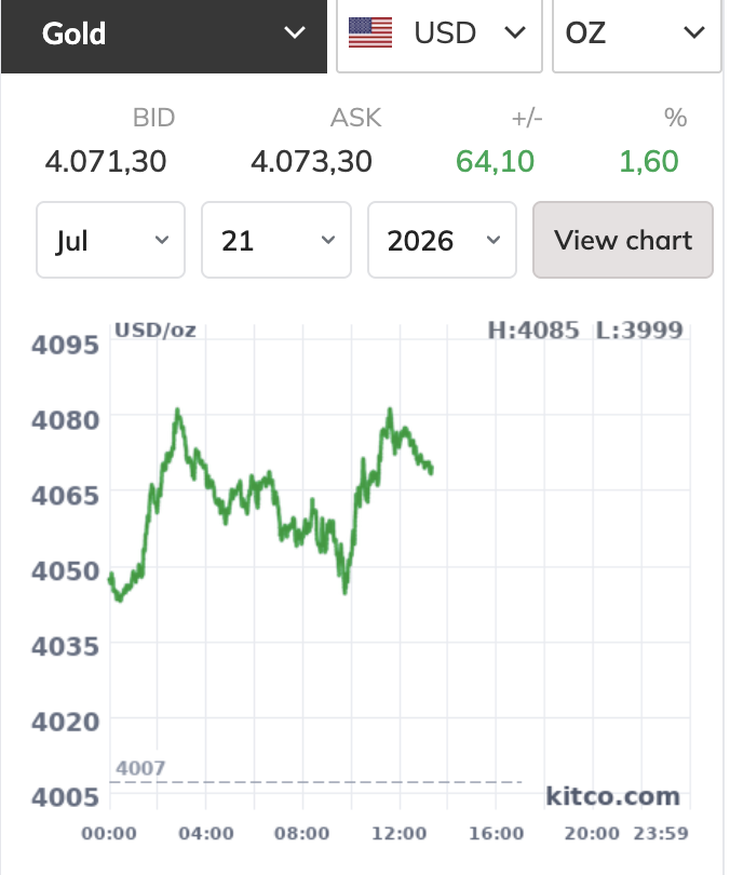
In a surprising turn of events that caught many market analysts off guard, the international gold market witnessed a significant surge in early trading hours on July 22, 2026. At approximately 1 AM local time, prices unexpectedly climbed by a notable $62 per ounce, pushing the precious metal to a new, elevated threshold of $4,070 per ounce. This sharp upward movement, translating to a substantial gain in the Vietnamese market, means the global gold price is now equivalent to roughly 130 million Vietnamese Dong (VND) per tael. This represents an increase of approximately 1.98 million VND per tael, marking one of the most robust single-day upward movements observed in the precious metal’s value in recent memory. The rally signals a profound shift in investor sentiment, reflecting heightened anxiety and a renewed flight to safety amidst a complex and increasingly volatile global economic and geopolitical landscape. This unexpected leap underscores gold’s enduring role as a critical safe-haven asset, particularly when traditional financial markets face multiple, compounding uncertainties.

Global Gold Market Responds to Mounting Headwinds
The sudden escalation in gold prices follows a challenging period of intense volatility where the precious metal had repeatedly tested, but ultimately retreated from, the critical $4,100 per ounce level. This specific price point has become a significant psychological and technical barrier for traders, reflecting deep-seated underlying market uncertainties and a tug-of-war between bullish and bearish forces. The primary catalyst for gold’s renewed ascent appears to be a potent confluence of intensifying geopolitical tensions, particularly between the United States and Iran in the strategic Middle East, which have sent significant ripples through global energy markets. Concurrently, persistent inflationary concerns continue to influence the monetary policy decisions of central banks worldwide, adding another layer of complexity to the investment environment. Investors are seeking refuge from both kinetic and economic risks, finding solace in the perceived stability of precious metals.
The ongoing friction in the Middle East, characterized by heightened rhetoric, intermittent naval maneuvers in the Strait of Hormuz, and reports of cyberattacks targeting critical infrastructure, has significantly impacted crude oil prices. As the Strait of Hormuz is a vital chokepoint for approximately 20% of the world’s daily oil consumption, any disruption or perceived threat in the region tends to trigger an immediate and sharp increase in energy costs. Over the past few weeks, crude oil benchmarks such as Brent and WTI have shown a sustained upward trend, with some analysts predicting a return to triple-digit prices per barrel. This surge in energy costs directly contributes to increased inflationary pressures across major economies, fueling fears of a potential wage-price spiral and eroding consumer purchasing power. This scenario has, in turn, reinforced market expectations of a more aggressive and prolonged anti-inflationary stance from central banks, particularly the U.S. Federal Reserve, further complicating the outlook for economic growth.
The Federal Reserve’s Unyielding Battle Against Inflation
The prospect of sustained high inflation, exacerbated by rising energy costs and supply chain vulnerabilities, has solidified the Federal Reserve’s unwavering commitment to its anti-inflationary policies. Despite previous market speculation about a potential pivot or easing of monetary tightening, investors are increasingly betting on the Fed maintaining, or
Related posts: