Tehran has raised the stakes in its ongoing geopolitical confrontation with Western powers and regional adversaries by explicitly warning that any future military strikes targeting its critical infrastructure could provoke devastating asymmetric retaliation. According to statements broadcast by Iranian state-aligned news agencies Tasnim and WANA, senior Islamic Revolutionary Guard Corps (IRGC) leadership has signaled that Iran could retaliate by severing vital subsea internet cables running through the strategic Strait of Hormuz.
This latest development marks a significant strategic pivot in modern warfare rhetoric, shifting focus away from traditional maritime choke points where oil tankers and naval warships routinely navigate, and directing attention toward the fragile digital architecture resting on the ocean floor. While the Strait of Hormuz has historically been monitored primarily for its role as the world’s most critical oil transit artery, security analysts note that its seabed infrastructure represents an equally vital, albeit far less visible, nexus of global economic and digital stability.
Anatomy of Subsea Digital Arteries
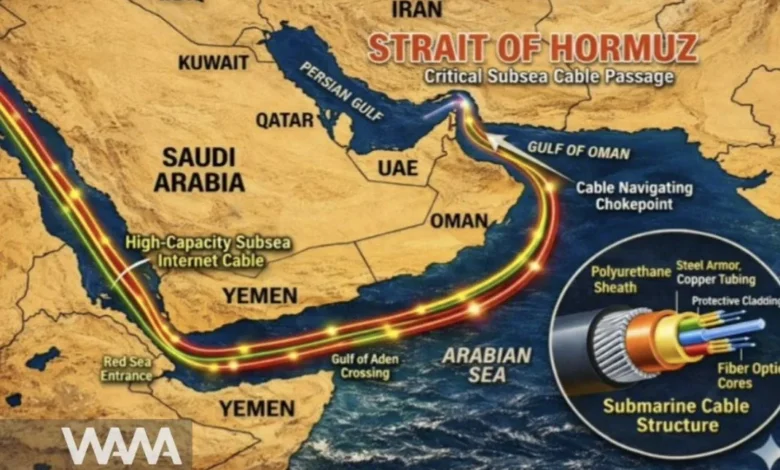
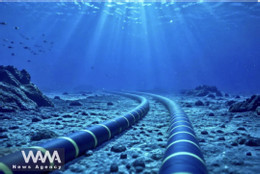
Subsea cables are robust fiber-optic lines engineered to transmit vast quantities of data across oceans and seas in the form of pulses of light. Because these fragile glass strands are exceptionally vulnerable to physical damage, they are encased in heavily fortified layers of protection. This protective shielding typically includes waterproof plastic tubing to prevent biological corrosion, steel wire armoring to withstand intense deep-sea pressure, and sometimes heavy iron sleeves designed to resist accidental impacts from heavy commercial maritime activity.
Specialized cable-laying vessels deploy these lines along meticulously pre-mapped seabed trajectories. In shallow waters, cables are routinely buried beneath the ocean floor using heavy plows to protect them from the dragging anchors of cargo vessels and fishing trawlers. Conversely, in deep-water environments, cables are laid directly onto the seabed.
Despite the advent of satellite communications, roughly 90 percent of all international internet traffic relies on these subterranean and subsea cables. Satellites are generally unsuitable as a primary replacement due to lower data transmission capacities, significantly higher latency, and exponentially greater deployment costs. Everyday digital activities—ranging from instant messaging, video streaming, and online banking to cloud computing services utilized by global technology enterprises—are entirely dependent on this physical maritime infrastructure.
The Strategic Importance of the Strait of Hormuz
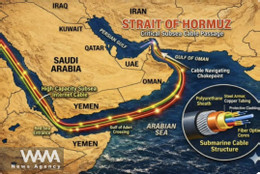
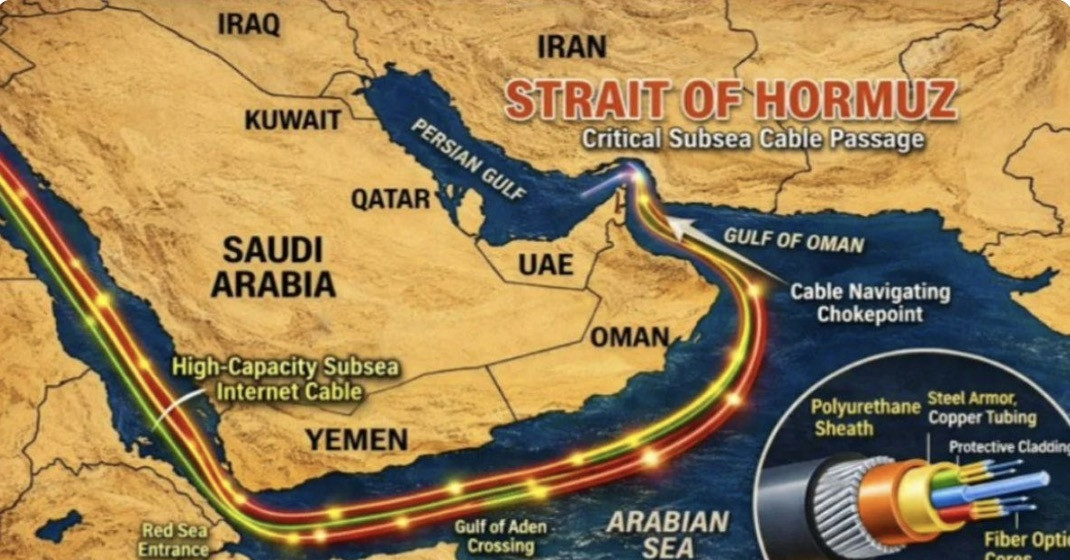
Due to its unique geographical positioning, the Strait of Hormuz serves as the principal gateway linking the petroleum-rich economies of the Persian Gulf to the broader global internet network. Several major submarine cable systems traverse the narrow waterway and its surrounding marine environments, bridging the Gulf states with international trunk lines stretching toward India, East Asia, Africa, and Europe.
Nations such as the United Arab Emirates (UAE), Qatar, Bahrain, Kuwait, Oman, and Saudi Arabia rely heavily on a combination of subsea cables and overland terrestrial routes to maintain continuous international connectivity. Within this intricate matrix, the Strait of Hormuz functions not merely as a maritime corridor for energy exports, but as a physical structural component connecting the digital communications systems of the Middle East to the rest of the world.
Cartographic and analytical data compiled by major telecommunications research firms, including TeleGeography and Submarine Networks, indicate that between five and seven major submarine cable systems pass directly through the Strait of Hormuz and adjacent waters. This concentration establishes the immediate region as a premier telecommunications hub in the Middle East.
The data carried through the Strait of Hormuz extends far beyond routine consumer internet usage. The infrastructure routinely transports high-value commercial and financial data, including high-frequency stock market transactions, foreign exchange settlements, and secure messaging services utilized by financial cooperatives such as the Society for Worldwide Interbank Financial Telecommunication (SWIFT). Industry estimates suggest that the total cumulative value of financial transactions and enterprise data transmitted through this specific regional corridor reaches tens of trillions of dollars annually.
Potential Repercussions of Subsea Disruption
If these critical subsea cables were to suffer catastrophic damage or a coordinated multi-line severing event, the consequences would be swift and far-reaching. The synchronization and data-sharing processes between major enterprise data centers located in the Middle East, Europe, and Asia could experience severe bottlenecks. Furthermore, widespread outages would immediately impact hyper-scale cloud computing services, including major enterprise platforms operated by global technology giants like Microsoft Azure and Amazon Web Services.
Nations situated along the southern coastline of the Persian Gulf are particularly vulnerable. While these countries rely heavily on submarine lines to maintain high-capacity international connectivity, alternative overland routes crossing regional landmasses possess significantly smaller bandwidth capacities. Consequently, if multiple primary submarine routes were compromised simultaneously, the cascading effects would likely spread across neighboring economies, triggering severe financial transaction delays, regional stock market disruptions, and sudden bandwidth degradation that would place unsustainable pressure on surviving alternative pathways.
Repairing damaged subsea cables is an exceptionally complex, costly, and time-consuming engineering endeavor that frequently requires weeks or even months to complete. The repair process necessitates specialized cable-laying vessels equipped with heavy grappling hooks to retrieve severed cable ends from the ocean floor, cut away damaged sections, splice in replacement fiber-optic segments, seal the housing under sterile conditions, and safely re-lower the repaired assembly back to the seabed.
According to telecommunications infrastructure researchers, regional repair capacity is already severely constrained. Out of a limited fleet of specialized cable repair vessels operating across the broader maritime region, only a single vessel is currently stationed within the immediate Persian Gulf area to service emergency outages.
Broader Regional Context and Escalating Tensions
The Iranian military warning regarding subsea infrastructure coincides with a broader, dangerous escalation of hostilities across the Persian Gulf and surrounding territories. The geopolitical landscape has grown increasingly volatile amid a series of direct and indirect military confrontations involving the United States, Iran, and various aligned regional factions.
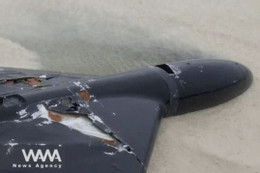
On October 25, the Iranian military officially announced that its integrated air defense network successfully intercepted and destroyed an advanced U.S. military unmanned aerial vehicle (UAV)—specifically identified as a LUCAS drone—operating in the airspace near the strategic southern Iranian port city of Bandar Abbas. The downing of the aircraft underscores the persistent risk of accidental escalation or calculated military engagement between Iranian forces and American assets deployed in the region.
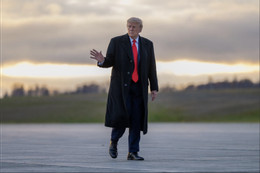
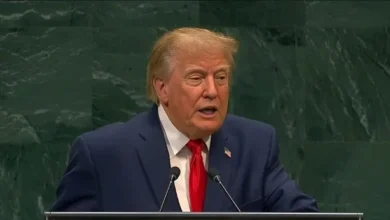
Simultaneously, diplomatic channels remain profoundly strained. U.S. President Donald Trump addressed the diplomatic stalemate on October 24, indicating that Washington has considered scaling back targeted military operations against specific Iranian leadership figures to evaluate potential diplomatic openings. However, this cautious diplomatic posture has been counterbalanced by explicit warnings from Washington that the United States remains fully prepared to execute a massive military campaign—colloquially described by administration officials as a crushing blow—should Tehran refuse to return to substantive negotiations regarding its nuclear program and regional proxy networks.
The economic and psychological toll of the widening conflict is already manifesting across Gulf states. Most notably, Saudi Arabia recently announced the abrupt cancellation of its premier international investment summit, widely known as the Davos in the Desert, which had been scheduled to convene in Riyadh. The decision to cancel the high-profile economic gathering came directly on the heels of a renewed wave of drone and missile attacks launched by Houthi forces in Yemen, an organization widely recognized as receiving extensive material and strategic support from Tehran.
Implications for Global Cybersecurity and Critical Infrastructure
Military strategists and cybersecurity experts have long warned that critical civilian infrastructure, including subsea telecommunications cables, represents an asymmetric vulnerability in modern geopolitical conflicts. Because these networks are widely distributed across international waters and are largely unguarded, they offer state actors a powerful lever for economic disruption without the necessity of engaging in direct conventional warfare.

By publicly highlighting the vulnerability of the subsea cables traversing the Strait of Hormuz, Iranian leadership is effectively signaling its capacity to inflict systemic economic pain on regional neighbors and Western-aligned nations alike. While executing such an attack would carry profound international legal consequences and risk alienating neutral third-party nations whose data also traverses the cables, the mere articulation of the threat demonstrates how deep-sea communications lines have been integrated into the calculus of modern deterrence.
As diplomatic efforts stall and military postures harden across the Middle East, the security of the invisible digital highways resting beneath the waters of the Persian Gulf will remain a critical point of concern for governments, multinational corporations, and telecommunications operators worldwide.
Related posts: