Driving at 120 kilometers per hour in the leftmost lane of the modern Dau Giay – Phan Thiet expressway, Pham Khoa, a motorist from Ho Chi Minh City, suddenly heard a deafening explosion originating from the rear wheel of his sedan. The unexpected incident occurred during the late afternoon hours of November 3, turning a routine journey into a harrowing life-or-death struggle. As the vehicle violently swerved and the steering wheel was forcibly yanked to the side, Khoa experienced the terrifying sensation that his car was about to plow directly into the concrete median barrier. In those critical seconds, the specter of a catastrophic rollover flashed through his mind, threatening not only his own life but also the safety of his passengers.
The incident highlights the immense dangers associated with high-speed tire failures on modern expressways. Maintaining composure under extreme pressure, applying correct emergency protocols, and adhering to rigorous vehicle maintenance schedules are critical factors that ultimately prevented a tragic outcome in this specific case. Transportation experts and safety authorities continually emphasize that understanding vehicular physics during a blowout can mean the difference between life and death for motorists traversing high-speed transport corridors.
Anatomy of a High-Speed Blowout and Chronology of Events
The emergency unfolded in a matter of seconds on a stretch of the Dau Giay – Phan Thiet expressway known for minor surface irregularities. Just moments after traversing a transitional expansion joint—a common feature on elevated roadway sections that can deliver a sharp jolt to a vehicle’s suspension—Khoa’s rear left tire suffered a catastrophic structural failure. The sudden loss of pressure immediately compromised the vehicle’s handling dynamics.
As the rear left tire shredded, a significant portion of the rubber tread tore away near the rim edge, creating an abrupt imbalance in the car’s weight distribution and aerodynamic drag. The steering wheel jerked violently, demanding instantaneous physical strength and mental focus from the driver. In the span of a heartbeat, Khoa recalled fundamental defensive driving techniques acquired over years behind the wheel: resist the panic, grip the steering wheel with both hands to maintain directional stability, and strictly avoid slamming on the brakes.
Recognizing that heavy braking could cause the vehicle to spin out of control or flip over due to weight transfer, Khoa instead eased his foot off the accelerator. He allowed the car to coast, letting natural deceleration reduce the forward momentum safely. Approximately one kilometer from the exact location where the blowout occurred, the vehicle successfully bled off enough speed to allow a controlled transition into the emergency lane. The entire ordeal, from the initial explosion to a complete and safe stop, lasted less than two minutes, yet it tested the driver’s psychological endurance to its absolute limits.
Post-Incident Assessment and Mechanical Analysis
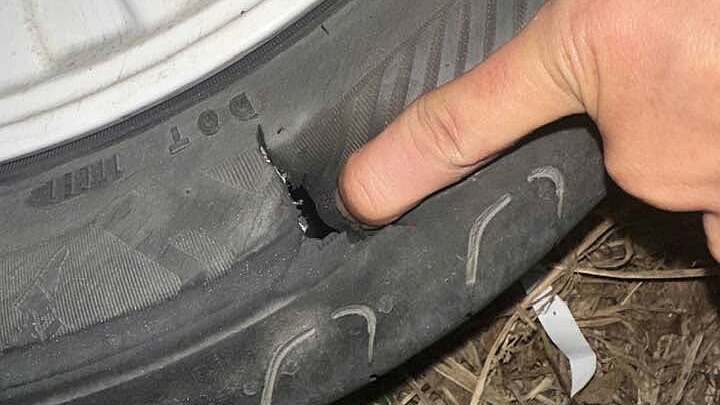
Upon bringing the vehicle to a halt in the emergency lane, the immediate danger had passed, but the logistical and mechanical challenges were only beginning. Inspection of the damaged wheel assembly revealed that the rear left tire was severely lacerated along the sidewall, with a large section of rubber completely torn away near the bead. Miraculously, the alloy rim remained largely undamaged, avoiding structural deformation that could have dramatically increased repair costs and safety risks.
Khoa later noted that the failed tire was the original factory-equipped unit, having logged approximately 60,000 kilometers of service. Based on his post-incident assessment, the tire may have reached a critical stage of wear after its extended operational lifespan. Furthermore, investigators suggest that internal tire pressure might have fallen slightly below optimal levels prior to the trip, a factor that significantly accelerates heat buildup and structural fatigue at high sustained speeds.
Equipped with a standard emergency kit—including a hydraulic jack and lug wrench—Khoa and his passengers managed to replace the damaged wheel with a space-saver spare tire in roughly 20 minutes. This swift action enabled them to clear the hazardous expressway environment promptly. Subsequent professional inspection at a service center revealed that the hub assembly required minor alignment adjustments, costing approximately 600,000 Vietnamese Dong, while a complete set of four new replacement tires was purchased for 8 million Dong to ensure future road safety.
Expert Guidelines on Handling Tire Blowouts
Traffic safety authorities and automotive engineers stress that tire blowouts at highway speeds remain one of the most perilous scenarios a driver can encounter. When a tire fails, the sudden deflation alters the rolling radius and grip of that specific corner of the vehicle, disrupting directional stability.
To maximize survival odds during a blowout, motorists must adhere to a strict protocol:
- Grip the steering wheel firmly with both hands to counteract the pulling force and maintain a straight trajectory.
- Refrain from making sudden steering corrections or applying emergency brakes, as abrupt maneuvers easily trigger loss of control, fishtailing, or rollovers.
- Gradually release the accelerator pedal to let the vehicle slow down naturally through engine braking and aerodynamic resistance.
- Once the speed has dropped to a manageable level, apply gentle, progressive braking and activate hazard warning lights.
- Safely maneuver the vehicle into the emergency lane or the nearest safe refuge area. Continuing to drive on a completely destroyed tire is strictly discouraged, as it destroys the wheel rim and severely compromises vehicle control.
Protocol for Safe Roadside Stops
Stopping on an active expressway presents secondary hazards that can be just as lethal as the initial mechanical failure. Once the vehicle is safely positioned in the emergency lane or on the hard shoulder, the driver must immediately activate hazard lights and deploy warning triangles or reflective markers behind the vehicle in accordance with legal regulations.
Passengers should be evacuated from the vehicle immediately if it is safe to do so. Rather than remaining seated inside or standing directly in front of or behind the vulnerable vehicle, all occupants should move behind the outer safety barrier, keeping as much distance as possible from the active flow of high-speed traffic.
Changing a tire directly on the roadside should only be attempted if the stopping position offers adequate space, clear visibility, and supportive assistance. If a vehicle breaks down in a constricted area, such as a narrow bridge, a tunnel, or a blind curve with heavy traffic, drivers are strongly advised to contact expressway management or roadside assistance rather than attempting DIY repairs in a high-risk zone.
Proactive Maintenance and Tire Longevity
As the sole point of contact between a 1.5-ton vehicle and the asphalt, tires dictate braking efficiency, cornering grip, and overall directional control. Industry standards dictate that motorists must check tire pressure regularly—ideally when the tires are cold—using a calibrated pressure gauge. Recommended pressure specifications are typically located on a placard affixed to the driver’s door jamb or detailed in the owner’s manual.
Improper inflation habits directly threaten tire integrity:
- Under-inflated tires suffer from excessive flexing, leading to rapid heat generation, structural degradation of internal belts, and a high probability of a blowout.
- Over-inflated tires reduce the optimal contact patch with the road surface, diminishing braking performance and accelerating center-tread wear.
Drivers must also routinely inspect the tread and sidewalls for cuts, bulging, deep cracks, or embedded foreign objects. If a tire exhibits sidewall blistering or exposes internal fabric layers, immediate replacement is mandatory.
Tread depth is another vital metric. Modern tires feature built-in tread wear indicators (TWI) located across the main grooves. Once the tread wears down to these indicator bars—typically at a depth of 1.6 millimeters—the tire must be replaced to maintain wet-weather traction and prevent hydroplaning.
Ultimately, tire lifespan is not governed solely by mileage milestones. Temporal degradation, environmental storage conditions, vehicle payload, and driving habits all influence rubber longevity. Consequently, no single mileage figure applies universally to every tire type. Regular tire rotations, professional wheel alignments, and careful driving over potholes, construction debris, and expansion joints remain essential practices for preventing catastrophic road emergencies.
Related posts: