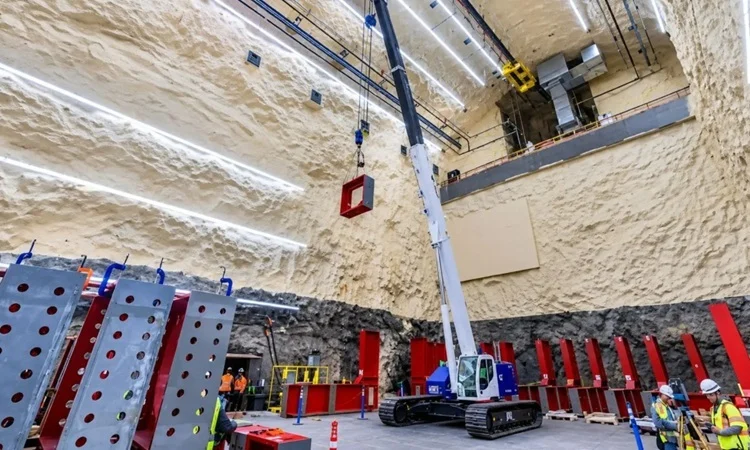
The Deep Underground Neutrino Experiment (DUNE) stands as a monumental achievement in global scientific infrastructure, representing the most ambitious effort to date to unlock the mysteries of the subatomic particle known as the neutrino. Often referred to as a "ghost particle" due to its elusive nature, the neutrino is a fundamental building block of the universe, and its study is poised to rewrite our understanding of matter, antimatter, and the evolution of the cosmos. Located in South Dakota, United States, this $3 billion project is a collaborative masterpiece involving the Fermi National Accelerator Laboratory (Fermilab), the European Organization for Nuclear Research (CERN), and the Sanford Underground Research Facility (SURF).
The Genesis of a Scientific Titan
DUNE is not merely a single experiment; it is a sprawling, international scientific enterprise involving more than 1,500 researchers from dozens of countries. The project is inextricably linked to the Long-Baseline Neutrino Facility (LBNF), which provides the critical infrastructure necessary to propel, detect, and analyze these elusive particles over vast distances. The core of the facility is split between two primary sites located 1,300 kilometers apart: the origin point at Fermilab in Illinois and the detection site deep beneath the Earth’s surface in South Dakota.
Neutrinos are electrically neutral and possess near-zero mass, allowing them to pass through solid matter—including the entire Earth—without leaving a trace. Because they are generated at the heart of stars and travel across cosmic distances, they carry pristine information about the conditions of the early universe. By constructing an incredibly sensitive detector, scientists aim to observe neutrino interactions and their subtle mass differences, which could explain the fundamental asymmetry between matter and antimatter—a phenomenon that allowed the universe to exist in its current form rather than annihilating itself shortly after the Big Bang.
Engineering the Impossible: The Underground Laboratory
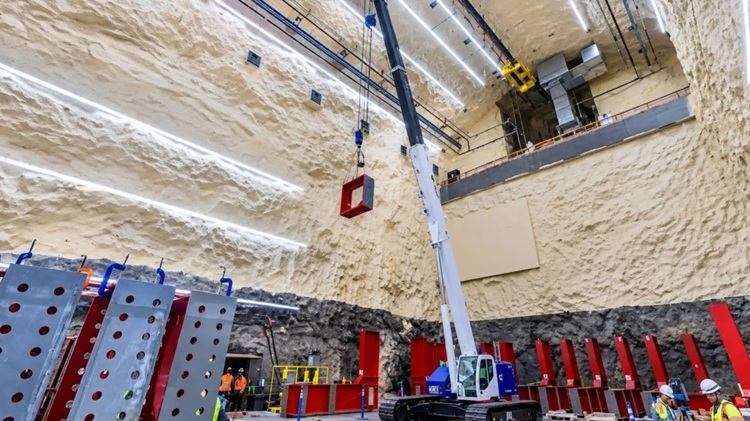
The construction of the DUNE detector, situated 1,478 meters (nearly a mile) below the surface at the Sanford Underground Research Facility, is an engineering marvel. This depth is essential to shield the sensitive equipment from cosmic radiation that would otherwise interfere with the detection of rare neutrino events.
The facility utilizes massive cryostats—containers designed to hold liquid argon at temperatures as low as -184 degrees Celsius. Each of the two primary detectors is gargantuan, measuring 65.8 meters in length, 18.9 meters in width, and 18.3 meters in height. Together, these detectors will house approximately 17,000 tons of high-purity liquid argon. The logistical feat of transporting 2,600 steel beams into the depths of the Earth to assemble these structures is a project that has required years of meticulous planning and international cooperation.
Chronology and Project Development
The timeline of DUNE is a multi-decade commitment to fundamental physics. While the concepts for such long-baseline experiments have been debated since the early 2000s, the official construction of the current DUNE configuration began in earnest as international partnerships solidified.
- 2015-2017: Conceptualization and site selection finalized; initial design phases for the LBNF/DUNE project.
- 2019-2021: Excavation of the underground caverns at the Sanford Underground Research Facility.
- November 2026: Commencement of the construction of the primary cryostat support structures, marking a critical transition from excavation to assembly.
- 2027: Scheduled installation and assembly of the second cryostat steel support systems.
- 2031: Targeted date for the first beam of neutrinos to be fired from Fermilab to the DUNE detector in South Dakota.
The Role of Global Collaboration
The partnership between Fermilab and CERN is the backbone of this endeavor. CERN has contributed over 6,200 tons of specialized materials and technical expertise to the construction of the cryostats. This collaboration signifies the importance of DUNE in the broader landscape of particle physics, as it complements other international efforts such as the Large Hadron Collider (LHC).
SURF, acting as the host institution, manages the complex task of underground operations, logistics, and safety protocols. The technical challenge of moving equipment, including thousands of tons of steel, into a working gold mine turned laboratory requires a precision that pushes the limits of modern industrial engineering.
Understanding the "Ghost Particle"
To understand the significance of DUNE, one must understand the neutrino’s role in the Standard Model of particle physics. Neutrinos come in three "flavors"—electron, muon, and tau—and they oscillate between these states as they travel. This oscillation is intrinsically linked to their mass, a property that was not fully understood until the late 20th century.
By generating an intense beam of muon neutrinos at Fermilab and measuring their composition after they have traveled through the Earth’s crust to South Dakota, scientists will be able to observe these oscillations with unprecedented precision. The absence of a tunnel is intentional; the neutrinos travel directly through the Earth’s rock, and the detectors at both ends serve as "cameras" to record the beam’s evolution.
Broader Scientific Implications
The implications of DUNE extend far beyond the detection of neutrinos. The primary scientific objectives include:
- CP Violation in Neutrinos: Investigating whether neutrinos and antineutrinos behave differently. This could provide the "smoking gun" for why the universe contains significantly more matter than antimatter.
- Supernova Observation: If a supernova occurs within our galaxy, the DUNE detectors will be able to capture the massive burst of neutrinos, providing real-time data on the death of a star and the formation of neutron stars or black holes.
- Proton Decay: The sheer scale of the liquid argon detectors will allow researchers to search for signs of proton decay, a long-theorized event that would prove the grand unified theories of physics, suggesting that all forces in the universe are linked.
Official Statements and Industry Perspectives
Leading researchers have frequently highlighted the "discovery potential" of DUNE. While project leads at Fermilab and CERN generally remain focused on the technical milestones, the consensus in the global physics community is that DUNE is the flagship experiment of the next generation. It is viewed as a successor to the legacy of the Deep Underground Neutrino Experiment and the earlier Long-Baseline Neutrino Oscillation Experiment (MINOS).
"Building a detector of this scale in such an extreme environment is a testament to the power of international collaboration," a spokesperson for the project noted during the recent commencement of cryostat assembly. "We are not just building a machine; we are building a lens through which we can view the very beginning of the universe."
Economic and Infrastructure Impact
The investment of $3 billion, while significant, is distributed across decades and shared among several nations. Beyond the scientific output, the project provides a massive boost to regional infrastructure in South Dakota and Illinois. The creation of specialized jobs, the development of advanced cryogenic technologies, and the necessity of high-tech manufacturing have fostered a unique ecosystem of scientific and industrial growth.
Moreover, the project is a driver for advancements in data processing and AI. Because the detectors will produce massive amounts of data during neutrino interactions, the project is pioneering new ways to filter, store, and analyze information in real-time, technologies that will likely find applications in commercial sectors such as telecommunications and high-performance computing.
Future Outlook: The Road to 2031
As the construction of the first cryostat gains momentum, the focus shifts to the technical challenges of the coming five years. The assembly of the internal components, which must be perfectly clean to ensure the purity of the liquid argon, represents a unique set of hazards. Contamination by even a few parts-per-billion of oxygen could jeopardize the sensitivity of the detector, requiring the team to maintain an environment more sterile than a surgical operating room, despite being situated in a deep underground mine.
The completion of DUNE will not mark the end of the research, but rather the beginning of an era. The data collected will likely be the subject of doctoral theses and Nobel Prize-winning research for the latter half of the 21st century. By the time the first neutrino beam is fired in 2031, the facility will represent the culmination of nearly three decades of preparation, marking a new milestone in humanity’s quest to decode the fundamental laws that govern the cosmos.
In conclusion, the DUNE project is a testament to human ingenuity. By reaching into the Earth to capture the most elusive particles in the universe, scientists are preparing to answer questions that have puzzled humanity for centuries. Whether or not it discovers the secrets of matter-antimatter asymmetry, the process of building DUNE has already unified the international scientific community in a shared mission to push the boundaries of what is possible.