Apple Watch Ultra 4 vs Garmin Fenix 9: A Comprehensive Technical and Ecosystem Showdown for High-End Sports Watches

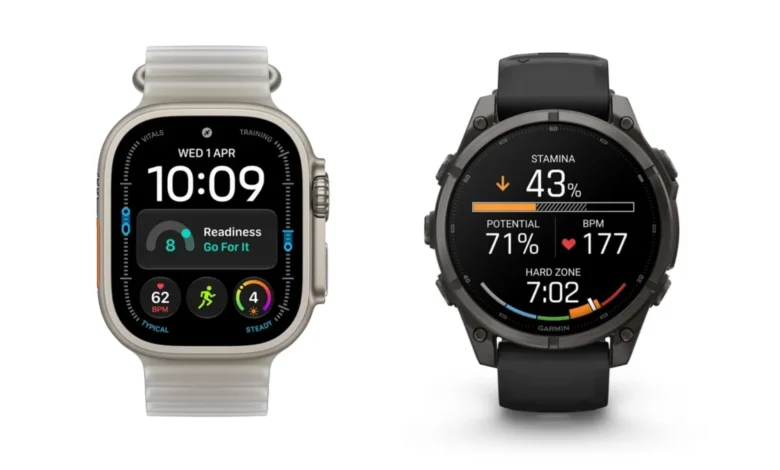
The global wearable technology market has entered a fiercely competitive era, highlighted by the near-simultaneous Vietnamese market launches of two premier outdoor athletic smartwatches: the Garmin Fenix 9, introduced in late August 2026, and the Apple Watch Ultra 4, which debuted in early September 2026. Both flagship devices represent the pinnacle of modern fitness engineering, featuring high-brightness AMOLED screens, aerospace-grade titanium chassis, sapphire crystal glass protection, 100-meter water resistance, and recreational dive support up to 40 meters. However, beneath their strikingly similar specification sheets lie fundamentally different product philosophies. One is an ultra-capable smartwatch deeply integrated into the iOS ecosystem, while the other functions as an independent, rugged
multisport computer built for extreme endurance. This comprehensive analysis evaluates their hardware architectures, tracking metrics, power management capabilities, and ecosystem implications based on official manufacturer specifications.
Pricing Strategy and Ecosystem Positioning

Positioned at the apex of the consumer wearable market, the pricing structures of the Apple Watch Ultra 4 and the Garmin Fenix 9 reflect a remarkably close financial battleground, with the baseline difference hovering between 2.3 million and 3.7 million Vietnamese Dong. The Apple Watch Ultra 4, when paired with standard Ocean, Alpine, or Trail loops, retails at approximately 23,990,000 VND, while the version featuring the premium Milanese loop commands around 26,990,000 VND. Conversely, the Garmin Fenix 9 (47mm variant) starts at approximately 26,290,000 VND, scaling up to roughly 27,690,000 VND for the variant featuring a scratch-resistant Carbon DLC gray titanium bezel.
Beyond initial acquisition costs, the most critical dividing line between the two devices is platform compatibility. The Apple Watch Ultra 4 is exclusively available in a single 49mm casing size and strictly requires an iPhone 11 or later running iOS 27 or newer. For Android users, the Apple Watch ecosystem remains entirely inaccessible. The Garmin Fenix 9 adopts a far more versatile approach by offering three distinct case sizes—43mm, 47mm, and 51mm—and maintaining cross-platform compatibility with both iOS and Android devices. This fundamental constraint immediately dictates the target audience for prospective buyers, as cross-platform utility heavily favors Garmin’s hardware lineup.
Display Engineering and Durability Standards
When examining visual output and structural durability, both Apple and Garmin employ cutting-edge materials while utilizing divergent manufacturing techniques. The Apple Watch Ultra 4 utilizes an always-on OLED display boasting a crisp resolution of 422 by 514 pixels and a peak outdoor brightness of 3,000 nits. Its chassis is forged from Grade 5 titanium, measuring 49 by 44 by 12 millimeters with a total weight of 63 grams, protected by a raised flat sapphire crystal face that shields the screen from blunt impacts.

In comparison, the Garmin Fenix 9 (47mm) incorporates a vibrant 1.4-inch AMOLED display with a resolution of 454 by 454 pixels. According to official Garmin disclosures, this new generation panel delivers double the brightness of its predecessor, the Fenix 8, with peak outdoor readability matching the 3,000-nit threshold specifically on its Pro tier variants. Structurally, the Fenix 9 utilizes a fiber-reinforced polymer body coupled with a titanium rear cover and a robust titanium bezel, protected beneath a sapphire crystal lens. Measuring 47 by 47 by 13.8 millimeters and weighing 75 grams, the Fenix 9 is marginally heavier and thicker than its Apple counterpart. Garmin equips the device with physical metal push-buttons specifically engineered to prevent liquid ingress, enabling reliable tactile operation even when the user is wearing heavy mountaineering or winter gloves.
Although both manufacturers advertise peak brightness figures reaching 3,000 nits, differing testing protocols prevent a definitive crown based solely on spec sheets. Nevertheless, both displays easily exceed the luminosity thresholds required for legibility under glaring midday sunlight and during intense nocturnal expeditions.
Health Metrics, Recovery Analytics, and Physiological Tracking
Health and wellness tracking represent core competencies for both flagships, yet their methodologies for processing and interpreting physiological data diverge significantly. Apple has completely overhauled the sensor architecture within the Watch Ultra 4, introducing a continuous heart rate monitoring system that records data every five seconds throughout the day. Furthermore, Heart Rate Variability (HRV) is sampled continuously up to 24 times daily, subsequently segregated into recovery HRV and overall baseline HRV. This continuous stream feeds into a newly designed Readiness score ranging from 0 to 10 every morning. The device retains advanced clinical-grade features, including an electrical heart sensor for electrocardiograms (ECG), blood oxygen saturation monitoring, skin temperature sensors, and nocturnal respiratory tracking with sleep apnea notifications.

The Garmin Fenix 9 adopts a longitudinal approach to health tracking, providing 24/7 heart rate monitoring, sleep-based HRV status, Pulse Ox tracking, skin temperature monitoring, and its proprietary Body Battery energy tracking metric. The Fenix 9 also includes an embedded ECG application. However, Garmin’s true strength lies in its ability to synthesize data into a long-term tapestry, evaluating sleep patterns, physical recovery, and training loads across consecutive weeks.
The essential philosophical difference lies in data utilization: Apple tells the user how prepared their body is to perform on any given morning, whereas Garmin explains where the physical body is trending after weeks of sustained, structured training blocks.
Battery Endurance and Power Management
Power management represents the most stark operational divergence between the two ecosystems. The Apple Watch Ultra 4 delivers up to 36 hours of typical daily use under standard operating conditions, which can be extended up to 84 hours when utilizing the dedicated Low Power Mode. Fast-charging capabilities allow the device to recover up to 18 hours of use with a mere 15-minute charge. For outdoor workouts, the Extended Workout mode provides up to 25 hours of tracking, while the Max Extended Workout mode stretches battery life to 45 hours by sampling GPS coordinates once every second.

In stark contrast, the Garmin Fenix 9 (47mm) operates more akin to a traditional sports computer, delivering up to 16 days of battery life in smartwatch mode and up to 24 days when utilizing Battery Saver Mode. When the GPS system is actively engaged for continuous outdoor training, the Fenix 9 runs for up to 30 hours, accompanied by expedition tracking modes that can push maximum battery endurance up to 81 hours.
GPS Precision and Offline Navigation Capabilities
Accurate spatial positioning is vital for elite athletes, and both manufacturers integrate state-of-the-art navigation hardware. The Apple Watch Ultra 4 utilizes a dual-frequency GNSS architecture, which Apple markets as its most accurate positioning system ever deployed on an athletic wearable.
The Garmin Fenix 9 counters with a multi-band GNSS system enhanced by SatIQ technology, which automatically adjusts GPS settings based on environmental conditions to balance tracking accuracy with battery preservation. Crucially, the Fenix 9 features preloaded TopoActive mapping right out of the box, offering comprehensive offline navigation capabilities complete with turn-by-turn routing that functions entirely independently of cellular network coverage.

Subaquatic Performance and Auxiliary Utility Features
Both devices boast 100-meter water resistance certifications, support recreational scuba diving down to 40 meters, and feature dedicated depth sensors. The Apple Watch Ultra 4 includes an integrated water temperature sensor, while delegating advanced dive computer functionalities to compatible third-party applications available through the App Store. The Garmin Fenix 9 incorporates an integrated LED flashlight—a signature inclusion for the Fenix series—alongside an onboard speaker and microphone for taking phone calls, Garmin Pay integration, and 64 GB of internal storage dedicated to offline music storage and topographic maps.
The Apple Watch Ultra 4 balances these hardware limitations through advanced connectivity suites. It features an integrated eSIM allowing independent cellular voice calls, 5G data connectivity, cellular-based emergency SOS, and global satellite messaging and location tracking services, which Apple provides free of charge for the first two years following activation. Additionally, upcoming software updates introduce Audio Intelligence features including Live Rewind and Siri Recap capabilities. The standard Garmin Fenix 9 lacks native cellular eSIM or satellite messaging hardware, requiring users to upgrade to specialized Pro or inReach variants to access satellite communication networks in remote wilderness areas.
Target Audience and Final Recommendations

Choosing between the Apple Watch Ultra 4 and the Garmin Fenix 9 ultimately depends on the user’s primary lifestyle requirements and technological ecosystem alignment.
Consumers should choose the Apple Watch Ultra 4 if they are deeply entrenched within the iOS ecosystem, utilize an iPhone as their primary daily device, and require a versatile smartwatch that excels both inside and outside of athletic training. The ability to make phone calls without a nearby smartphone, process contactless payments, access detailed daily health metrics, and rely on cellular emergency services makes the Ultra 4 an exceptional everyday companion. These capabilities require accepting a charging routine of every two to three days and remaining strictly within Apple’s proprietary hardware ecosystem.
Conversely, consumers should choose the Garmin Fenix 9 if their priority is serious multisport training, multi-day wilderness expeditions, or if they rely primarily on Android smartphones. With up to 16 days of battery endurance, robust offline topographic mapping, physical button controls, and a dedicated LED flashlight, the Fenix 9 provides utility features that the Apple Watch Ultra 4 simply cannot match—qualities that become essential when navigating remote terrain or participating in ultra-endurance racing far from traditional power grids.