Lionel Messi Demands VAR Intervention After Marc Cucurella Covers Mouth in Tense World Cup Final Exchange.

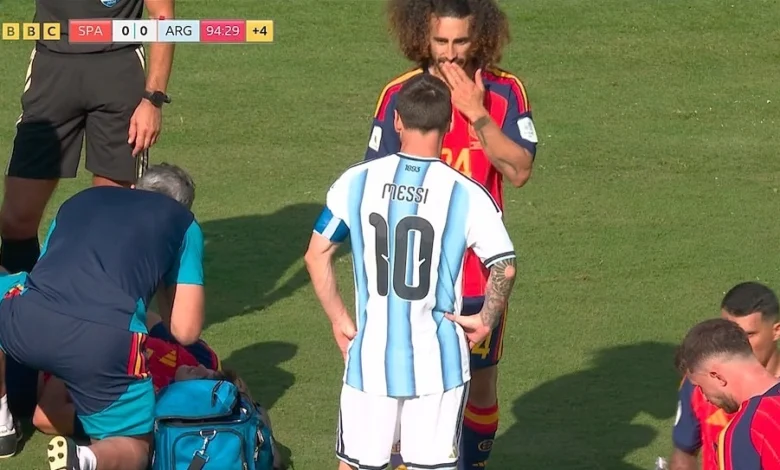
On Sunday, July 20, 2026, at 05:33 GMT+7, a contentious moment unfolded in the FIFA World Cup 2026 final between Argentina and Spain at MetLife Stadium in East Rutherford, New Jersey, igniting widespread debate over the interpretation of new football rules and the role of VAR. Argentine captain Lionel Messi vehemently appealed to the referee, Slavko Vincic, and called for VAR intervention after Spain’s defender Marc Cucurella covered his mouth while speaking during a heated exchange. This incident occurred just minutes after Argentina’s midfielder Enzo Fernandez was controversially sent off, escalating tensions in a match that remained deadlocked at 0-0 in the second half.
The Catalytic Red Card and On-Field Confrontation
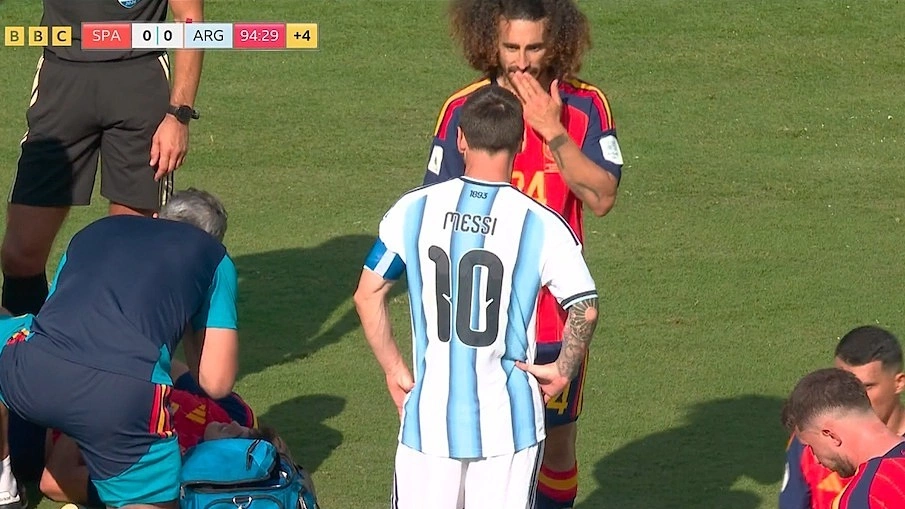
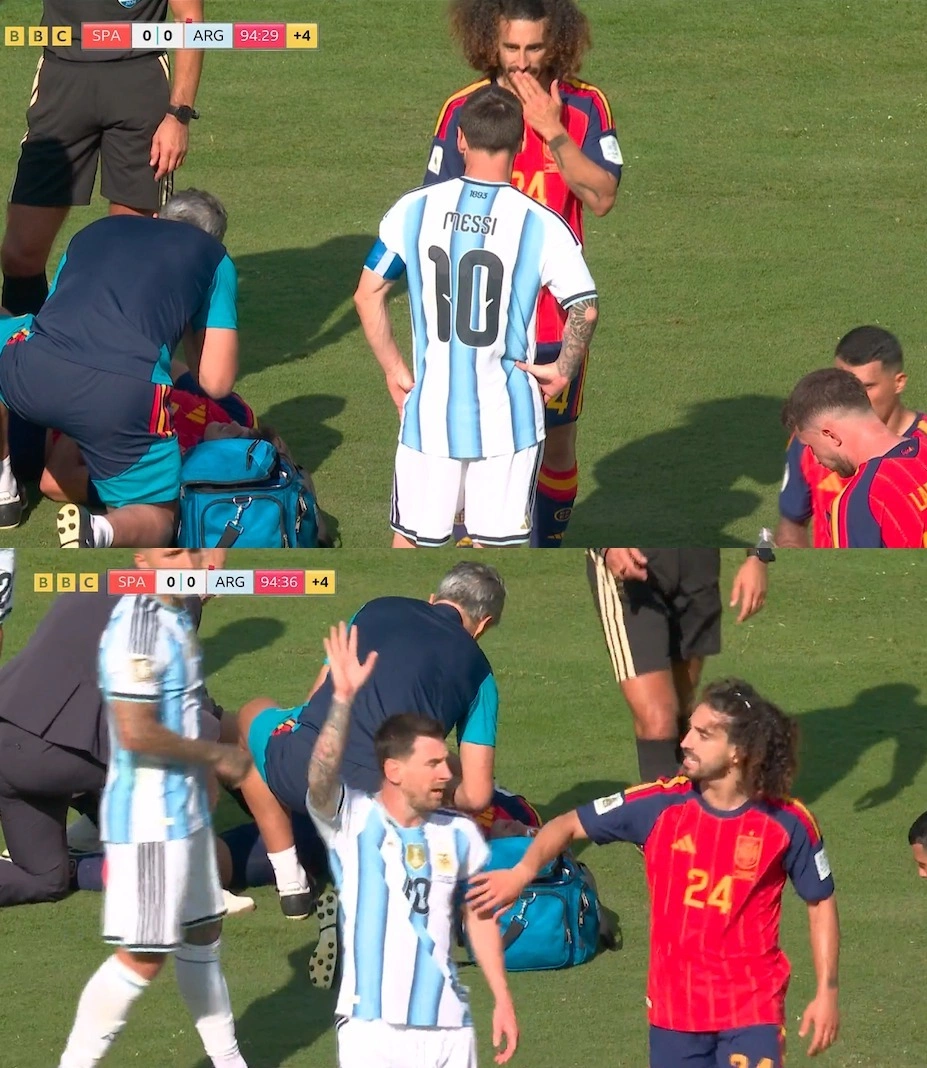
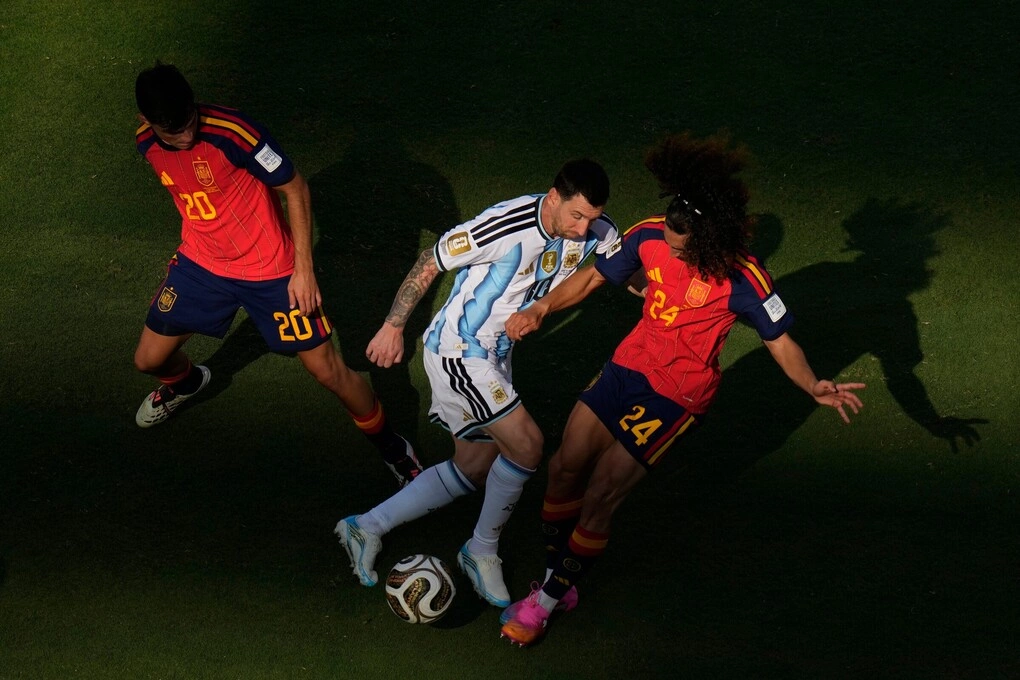
The flashpoint arrived in the 53rd minute of the second half. Argentine midfielder Enzo Fernandez, already on a yellow card, committed a foul on Spanish defender Pau Cubarsi, leading to a second yellow card and his subsequent dismissal. This left Argentina, the reigning champions, playing with ten men in the most crucial match of the tournament. As Cubarsi lay on the pitch, a verbal altercation erupted between players from both sides. It was during this charged moment that Marc Cucurella, positioned near Messi, was observed briefly covering his mouth with his hand while speaking to the Argentine superstar, before quickly lowering it.
Messi, visibly frustrated by his teammate’s sending off and the overall intensity of the situation, immediately reacted to Cucurella’s gesture. He pointed towards Cucurella and then to the referee, making an explicit appeal for VAR to review the incident, clearly indicating his belief that Cucurella’s action warranted a penalty under FIFA’s recently introduced guidelines. The Argentine bench and other players also showed signs of agitation, reflecting the high stakes of the final and the perceived injustice of Fernandez’s red card.
FIFA’s New Rule on Covered Mouths: Rationale and Application
The controversy stems from a new directive issued by FIFA and the International Football Association Board (IFAB) for the World Cup 2026, aimed at increasing transparency and combating unsporting behavior. This rule prohibits players from deliberately covering their mouths when speaking during contentious exchanges or in situations deemed to be confrontational. The primary motivation behind this rule is multi-faceted: it aims to prevent players from engaging in offensive, abusive, or discriminatory language that would otherwise be undetectable by pitch-side microphones or lip-reading experts. It also serves as a measure against potential match-fixing communications or tactical instructions that could be deemed unsporting if hidden.
Prior to the tournament, Pierluigi Collina, Chairman of the FIFA Referees Committee, had clarified the nuances of this new regulation. He emphasized that players are still permitted to cover their mouths during routine conversations with teammates or opponents in non-confrontational contexts. The rule specifically targets situations where players intentionally conceal their dialogue during heated arguments, confrontations with opponents, or appeals to officials, especially when such communication could involve illicit or unsporting content. In such cases, referees are empowered to issue a yellow or even a direct red card, with VAR consultation, if the action is deemed to be a deliberate attempt to hide malicious intent, threats, or discriminatory remarks.
Precedents and Inconsistencies in Enforcement
The 2026 World Cup had already seen previous instances where this new rule was applied, albeit with varying degrees of severity, leading to a perception of inconsistency among fans and pundits. The first player to receive a direct red card for this offense was Paraguay’s Miguel Almiron during a Group D match against Turkey. Almiron’s dismissal for covering his mouth while arguing with an opponent sparked initial surprise but set a precedent for strict enforcement.
Later in the tournament, during the Round of 16 clash between Mexico and Ecuador, Ecuadorian defender Piero Hincapie also received a direct red card for a similar action, covering his mouth while disputing a decision. These early sendings-off reinforced the idea that FIFA was serious about enforcing the new directive to promote sportsmanship and transparency.
However, the application of the rule has not been uniformly strict. Notably, England’s Jude Bellingham was observed covering his mouth during a group stage match against Ghana, yet he was not penalized by the referee or VAR. This particular incident, among others, had already fueled discussions about the subjective nature of the rule’s interpretation and the discretion afforded to match officials. The perceived inconsistency contributed to the intensity of Messi’s appeal, as he likely felt that if others had been penalized, Cucurella should also face consequences, especially given the immediate context of Fernandez’s dismissal.
The Referee’s Non-Intervention and VAR’s Silence
Despite Messi’s fervent appeal and the clear visibility of Cucurella’s action, referee Slavko Vincic did not issue a card to the Spanish defender. Crucially, no signal for a VAR review was initiated either. This decision implied that, in the judgment of the on-field referee and the VAR officials, Cucurella’s brief gesture did not meet the threshold for a violation of the new rule. The officials likely interpreted the incident as a momentary, perhaps subconscious, act rather than a deliberate attempt to conceal offensive or unsporting communication within a "tense context," as defined by Collina.
The non-intervention of VAR in this high-stakes moment further underscored the complexities of implementing new rules. While VAR is designed to rectify "clear and obvious errors" or "serious missed incidents," the subjective nature of judging intent behind a player’s action, particularly a brief hand gesture, presents a significant challenge. The officials might have concluded that there was insufficient evidence to determine that Cucurella’s words were malicious, threatening, or discriminatory, thereby falling outside the scope for a red card under the specific interpretation of the rule. This discretion, while intended to prevent over-officiating, often leads to frustration among players and fans who seek consistent application.
Punditry and Public Outcry
The incident immediately became a hot topic in post-match analysis and ignited a firestorm of opinions among football pundits and on social media. Former Arsenal and England defender Lee Dixon, commentating on ITV, expressed strong disapproval of Messi’s reaction, viewing it as an opportunistic attempt to gain an unfair advantage. "If just touching your nose for half a second gets you a yellow or red card, then football is truly over," Dixon exclaimed. "It’s like a child behaving this way just to get an opponent sent off. It’s absolutely ridiculous." Dixon’s comments highlighted a concern that players might exploit the new rule to manipulate referee decisions, detracting from the spirit of the game.
Former England goalkeeper Joe Hart, speaking on BBC, echoed Dixon’s sentiment, expressing disappointment in Messi’s conduct. "I didn’t like that from Lionel Messi at all," Hart stated. "It just shows how much Spain was dominating and putting them under pressure, that even Messi had to resort to such tactics." Hart’s analysis suggested that Messi’s actions were a sign of Argentina’s desperation and frustration, rather than a genuine concern about unsporting communication.
Conversely, Manchester United legend Wayne Rooney viewed the incident as a stark indication of the pressure and desperation gripping the Argentine side. "That’s desperation," Rooney remarked on BBC. "Argentina always plays like this, but what people want to see is sportsmanship. It’s a shame to witness Messi doing that." Rooney’s perspective emphasized the emotional toll of the final and suggested that Messi’s behavior, while perhaps uncharacteristic, was a symptom of the high-pressure environment.
The debate extended rapidly to social media platforms, where fans were sharply divided. Many supporters argued that Cucurella’s action was too fleeting to warrant a red card, accusing Argentine fans of overreacting. User @arden_bntz on Instagram commented, "Cucurella only touched his nose for half a second," implying that the Argentine fanbase was exaggerating the situation to gain sympathy or a perceived advantage.
Other comments were more critical of Messi’s appeal. User @75brian simply wrote, "FIFA, the kid is crying," a sarcastic jab at Messi’s perceived petulance. Another user, @johnstone014, posted a succinct and critical remark: "Not today, Pepsi," a derogatory nickname often used by detractors of Messi, further highlighting the polarized views.
A significant portion of the online discourse also shifted to criticize Argentina’s overall playing style. User @muscab1_ remarked, "At this point, Argentina’s plan is just to foul." This comment reflected a broader sentiment among some viewers that Argentina was resorting to cynical tactics in the face of Spain’s dominance. User @jar3dcr7 questioned the refereeing consistency, asking why Leandro Paredes continued to commit fouls after already receiving a yellow card, implying a perceived leniency towards Argentine players.
Broader Implications for the World Cup and Modern Football
The incident between Messi and Cucurella, regardless of its ultimate outcome, carries significant implications for the World Cup final and the future of football. For Argentina, already reduced to ten men, the hope was to level the playing field by potentially seeing a Spanish player dismissed. The failure of this appeal meant they had to continue playing with a numerical disadvantage, profoundly impacting their tactical approach and energy levels in the remainder of the match. Spain, on the other hand, was spared a potential red card that could have dramatically altered the game’s dynamics, allowing them to maintain their full squad strength against a depleted opponent.
Beyond the immediate context of the final, this incident reignites the ongoing debate about VAR’s effectiveness and consistency. While VAR was introduced to minimize human error, its application in subjective interpretations of rules, particularly new ones, continues to generate controversy. The lack of a clear, universally accepted standard for what constitutes a "deliberate attempt to conceal" in such situations leaves room for differing interpretations among referees and VAR officials, leading to the very inconsistencies the system was meant to eliminate.
Furthermore, the incident raises questions about sportsmanship and player conduct at the highest level. While competitive drive is inherent in elite sport, the line between strategic play and unsporting behavior remains a contentious area. Messi’s appeal, perceived by some as manipulative, forces a re-evaluation of how players leverage rules to their advantage, potentially eroding the spirit of fair play.
As the World Cup 2026 progresses towards its conclusion, the Messi-Cucurella incident will undoubtedly serve as a significant talking point. It highlights the inherent challenges in balancing the introduction of new rules to enhance transparency and fair play with the need for consistent and objective enforcement. The ongoing discussions among fans, pundits, and governing bodies will likely influence future clarifications or amendments to football’s laws, striving for a clearer and more equitable application in an increasingly scrutinized global sport.