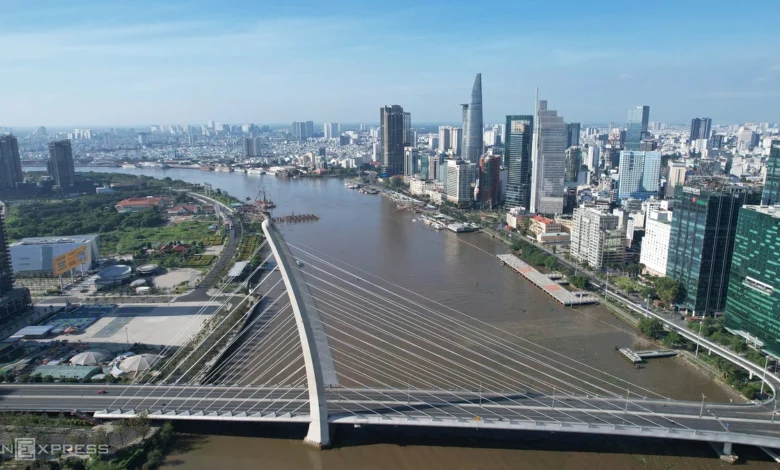
Ho Chi Minh City has achieved a significant milestone in the global financial landscape, climbing 17 positions to reach 67th place out of 117 cities in the 40th edition of the Global Financial Centres Index (GFCI 40). This report, released on September 30 by Z/Yen Partners (UK) and the China Development Institute (CDI), underscores the rapid evolution of Vietnam’s commercial hub as it seeks to integrate further into the international economic order. Simultaneously, Da Nang made its debut in the index, securing the 71st position, marking a historic moment for the nation as it positions two major cities as twin pillars of a budding international financial network.
The Rise of Ho Chi Minh City
Ho Chi Minh City’s ascent was driven by a commendable performance in score metrics, achieving a total of 692 points—a 4.1% increase. This growth rate is notably higher than the global average of 0.8% and the Asia-Pacific regional average of 1.48%. Among financial centers evaluated in this cycle, the city demonstrated the second-fastest growth rate globally, trailing only Copenhagen.
Within Southeast Asia, Ho Chi Minh City stands out as the fastest-rising financial center, maintaining its position within the regional top three, surpassed only by Singapore and Kuala Lumpur. Furthermore, the city remains in the top 15 global centers predicted to see significant development over the next two to three years. In the specific sector of financial technology (fintech), the city surged 12 places, reaching the 71st rank, highlighting a growing commitment to digital transformation within the banking and investment sectors.
Da Nang Enters the Global Arena
In a noteworthy development for Vietnam’s secondary urban centers, Da Nang has been officially included in the GFCI for the first time. Ranking 71st globally and 4th in Southeast Asia, the coastal city outperformed established regional counterparts such as Bangkok, Manila, and Jakarta. Da Nang’s inclusion, particularly its 74th-place ranking in fintech, signals a strategic diversification of Vietnam’s financial infrastructure. By fostering growth in both Ho Chi Minh City and Da Nang, the government is executing a “one center, two poles” development model designed to distribute economic vitality and specialized financial services across the country.
Strategic Context and Official Directives
The pursuit of international financial center status is a core component of Vietnam’s long-term economic strategy. During a high-level meeting in early September, Deputy Prime Minister Nguyen Van Thang emphasized that these designated centers must move beyond theoretical frameworks. He issued a clear directive for local authorities in both cities to produce concrete products, services, and clear institutional roadmaps starting in November.
Richard D. McClellan, Executive Director of the Ho Chi Minh City International Financial Center (VIFC-HCMC), characterized the city’s rise in the GFCI as a powerful signal to the international investor community. He noted that the VIFC is currently being built as a financial engine to propel Vietnam’s next phase of growth, aimed at raising the standards of capital markets, banking operations, and personal asset management to align with global benchmarks.
Adding to this perspective, Bhaskar Dasgupta, a member of the VIFC-HCMC strategic advisory board and a former executive at Abu Dhabi Global Market (ADGM), noted that the progress made within the first nine months of the VIFC’s establishment has been rapid. According to Dasgupta, the focus is now on institutional quality, governance, international partnerships, and operational structures. He emphasized that the path forward requires removing regulatory bottlenecks, attracting top-tier global talent, and unlocking capital flows to facilitate complex, real-world financial transactions.
Global Benchmarking: The GFCI Methodology
The GFCI serves as a critical barometer for the competitiveness of financial centers. Compiled by Z/Yen Partners and the CDI, the index evaluates cities based on 144 instrumental factors derived from over 80 third-party data sources, including the World Bank, the OECD, and the United Nations. Beyond statistical data, the index incorporates the subjective assessments of over 6,000 professionals who provided nearly 40,000 evaluations. To be included in the rankings, a city must receive at least 150 evaluations from professionals working in other financial centers, ensuring a robust and peer-reviewed assessment.
In the current global rankings, New York continues to lead with 761 points, followed by London, Hong Kong, and Singapore. The top tier of the index remains relatively stable, though the rise of centers like Zurich—which replaced San Francisco in the top 10—and the ascent of Abu Dhabi, Beijing, and Osaka into the top 20, illustrates the shifting power dynamics in global finance.
Implications for the Vietnamese Economy
The consistent improvement in these rankings carries several implications for Vietnam’s economic trajectory:
- Increased Foreign Direct Investment (FDI): High rankings in indices like the GFCI provide a psychological boost to institutional investors, suggesting that a city has the infrastructure, regulatory environment, and professional talent required for complex financial operations.
- Regulatory Reform: The pressure to maintain or improve these rankings acts as a catalyst for domestic legislative reform. To compete with centers like Singapore or Kuala Lumpur, Vietnam must continue to modernize its banking laws, liberalize capital accounts, and improve the transparency of its legal system.
- Talent Retention: As Ho Chi Minh City and Da Nang strive for international relevance, they are increasingly forced to compete for talent. This creates a feedback loop where the demand for world-class financial professionals drives investment into education and professional training.
- Digital and Fintech Integration: The strong performance in fintech rankings is perhaps the most critical indicator for the future. As traditional banking becomes increasingly digitized, the ability of a city to foster a robust startup ecosystem and implement blockchain or AI-based financial solutions will determine its long-term viability as a hub.
Chronology of Performance (2022–2026)
The trajectory of Ho Chi Minh City in the GFCI reflects a volatile but ultimately upward trend. In March 2022, the city held a rank of 102. By September 2022, it shifted slightly to 104, before experiencing a series of fluctuations in 2023 and 2024. The most significant shift occurred in late 2026, where consistent policy implementation and increased engagement with international advisory bodies helped push the city toward the top 60s.
For comparison, while Singapore has maintained a steady hold in the top 4, the rapid movement of other regional centers like Manila and Bangkok suggests a highly competitive environment. Vietnam’s ability to remain within the top 100—and now its steady movement toward the middle of the pack—indicates that the systemic changes are beginning to yield tangible results in the eyes of the international financial community.
Challenges Ahead
Despite the optimism, the path to becoming a premier international financial center remains fraught with challenges. Analysts point to the need for a more comprehensive legal framework that provides certainty to international firms, particularly regarding dispute resolution and tax transparency. Furthermore, while the physical infrastructure of Ho Chi Minh City is expanding, the soft infrastructure—such as the depth of the local capital market and the liquidity of bond markets—must see significant improvement to match the standards of Singapore or Hong Kong.
The government’s decision to move toward a "one center, two poles" model is a bold attempt to leverage the specific strengths of both Ho Chi Minh City (as a commercial and trading hub) and Da Nang (as a potential high-tech and service-oriented center). Whether this model can achieve the necessary scale to compete globally will depend on the speed of implementation and the ability of the state to attract large-scale international banking institutions to set up regional headquarters in Vietnam.
As the VIFC continues to mature, its focus on "real-world" financial products will be the litmus test for its success. If the center can successfully facilitate complex cross-border transactions and provide a secure, transparent environment for international capital, it is likely that the positive trend in the GFCI rankings will continue, further cementing Vietnam’s role as an emerging financial powerhouse in the Asia-Pacific region.
Related posts: