When a Child’s Play Leaves a Luxury Car Damaged: A Masterclass in Accountability, Empathy, and Community Grace in Liaoning

An unexpected incident involving an inquisitive child, a damaged luxury vehicle, and an uncompromising display of accountability has captured the collective imagination of millions across social media platforms in China. What could easily have escalated into a bitter neighborhood dispute, costly litigation, or prolonged hostility transformed instead into a heartwarming testament to integrity, mutual respect, and human kindness. The unfolding events, which took place on August 12 in a residential neighborhood in Shenyang, Liaoning Province, offer a profound reflection on modern urban living, parental responsibility, and the surprising grace that can emerge from accidental conflicts.
The Unfolding of an Unexpected Accident
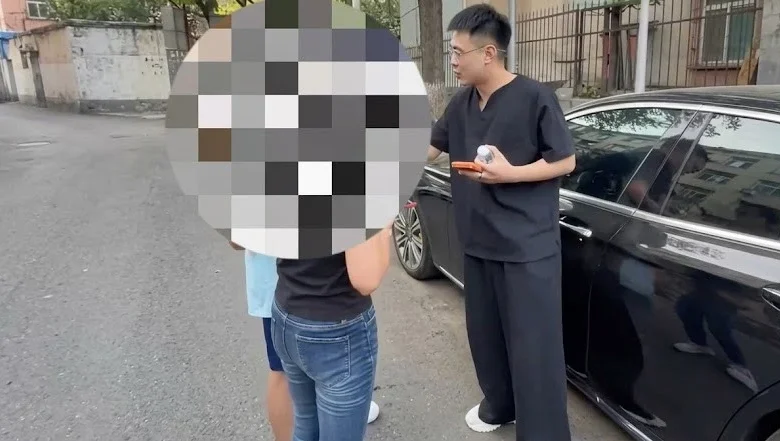
The series of events began on a seemingly ordinary afternoon when the owner of a Mercedes-Benz sedan, who was resting at his home within the residential complex, received an urgent alert on his mobile phone. The notification chillingly informed him that his parked vehicle, stationed directly beneath his apartment building, had suffered external damage. Acting quickly, the vehicle owner rushed downstairs to assess the situation from afar.
Upon approaching the vehicle, he was met with an unusual sight: a local woman accompanied by her young son standing near the rear of his luxury car. It quickly became apparent that the young boy, while playing unsupervised for a brief moment, had inadvertently caused significant cosmetic damage to the vehicle’s exterior. Specifically, the boy’s play had compromised the car’s body wrap, peeling away portions of the protective film and leaving the underlying paint exposed to the elements.
Rather than running away from the scene or attempting to conceal the damage—a reaction unfortunately common in accidental property damage cases—the child immediately confessed his actions to his mother. Recognizing the gravity of the situation, the mother took immediate corrective action. She brought her son directly back to the damaged vehicle, located the owner, and offered an unreserved apology alongside a commitment to fully compensate for all repair expenses incurred.
A Clash of Principles: When Both Parties Refuse to Accept Payment
What followed next defied typical urban conflict resolution models. Faced with a mother demanding to pay for the damages and a child taking full verbal accountability for his mistake, the owner of the Mercedes-Benz responded not with anger, but with profound empathy.
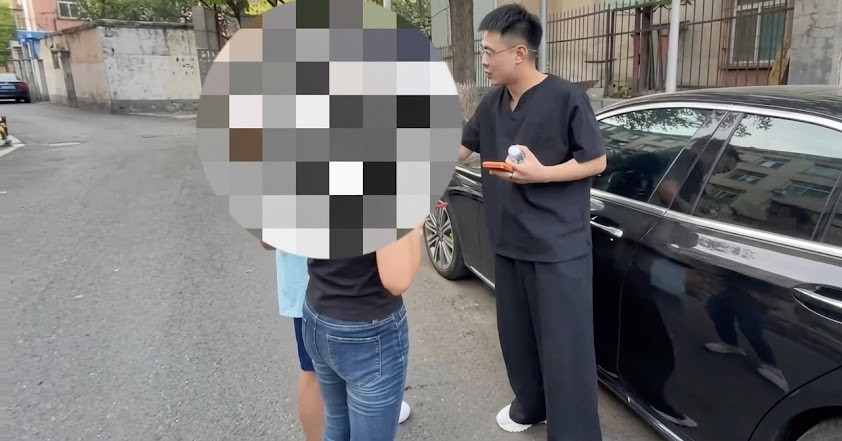
Upon inspecting the vehicle, the owner noted that the car had already been in service for five to six years. Prior to the incident, the vehicle still featured its original factory paint, and the scratches to the exterior protective film were, in his view, not severe enough to warrant a complete repaint or a costly re-application of the wrap. Given that the damage was largely superficial and did not diminish the core mechanical integrity or structural safety of the vehicle, the owner made a surprising decision: he informed the mother that no financial compensation was necessary.
The owner later emphasized to local reporters that his decision was heavily influenced by the exemplary behavior displayed by both the mother and the child. "The child made a mistake, but he did not run away; he stood his ground and assumed responsibility," the owner remarked during subsequent interviews. "Equally, the adult did not try to evade or shirk the issue, but stepped forward willingly to resolve it. Under those circumstances, I simply did not feel it was right to demand financial restitution."
Despite the owner’s magnanimous waiver, the boy’s mother remained steadfastly resolute. She argued that regardless of the vehicle’s age or the superficial nature of the scratches, it remained a luxury automobile, and damaging another person’s property inherently necessitated full financial restitution. To settle the matter definitively, she consulted a local automotive repair contact to estimate the cost of the specialized wrap repairs. The estimated expense was quoted at approximately 3,200 Chinese yuan, roughly equivalent to $450 to $500 USD (or between 11 million and 13 million Vietnamese dong).
Determined not to let a neighbor absorb financial losses stemming from her son’s carelessness, the mother insisted on paying the full amount. This sparked an extraordinary tug-of-war of mutual courtesy between the two parties: the mother aggressively pushing to transfer the full repair funds, while the car owner continuously refused to accept a single cent.
Negotiating Compromise and the Sweet Resolution
Finding herself unable to convince the car owner to abandon his waiver entirely, the owner proposed a middle-ground solution designed to honor the mother’s sense of duty without burdening her financially. He suggested that if she truly felt compelled to contribute, she could transfer a nominal sum of 1,000 Chinese yuan (approximately $140 USD or 3.7 million Vietnamese dong) to cover a fraction of the vehicle’s depreciation and material costs, urging her that neighbors should not overly calculate or stand on formal ceremony with one another.
Even then, the mother felt that 1,000 yuan was insufficient for the damage caused and initially attempted to push the amount up to 2,000 Chinese yuan. However, the Mercedes-Benz owner held firm in his refusal of the higher amount, ultimately accepting only the baseline 1,000 yuan contribution to conclude the negotiation amicably.

The story, however, did not end with financial transactions. Driven by a desire to express personal gratitude and remorse, the young boy used his own pocket money to purchase two large, heavy watermelons. He carried them to the vehicle owner as a final token of apology and appreciation for the owner’s extraordinary patience and empathy throughout the ordeal. Photographs and video footage of the boy presenting the watermelons to the car owner quickly circulated across regional news outlets, including Shenyang Net and Sina, touching the hearts of internet users nationwide.
Broader Implications and Social Media Reactions
When the story was shared across Chinese social media platforms, it rapidly went viral, accumulating tens of thousands of positive interactions, comments, and shares. Commentators widely noted that the viral appeal of the incident extended far beyond the monetary value of the luxury car or the cost of the repairs. Instead, the core fascination lay in the psychological and moral dynamic displayed by both the child’s family and the car owner.
"In a society where minor property disputes frequently escalate into hostile legal battles or aggressive confrontations on social media, witnessing a mother with such high civic integrity paired with a remarkably gracious car owner is deeply refreshing," one prominent online commentator wrote. "What could have been a source of neighborhood bitterness ultimately transformed into an event that leaves everyone feeling warm and reassured about human nature."
Analysts and cultural observers point out that incidents like the Shenyang car incident serve as an informal case study in emotional intelligence and community resilience. Urban density often breeds friction between neighbors, particularly in high-rise residential complexes where shared spaces, parking lots, and recreational areas frequently become flashpoints for conflict. When children accidentally damage private property—ranging from keyed vehicles to broken landscaping features—the immediate reaction of parents often dictates whether the situation escalates or de-escalates.
By choosing accountability over evasion, the mother provided her son with an invaluable real-world lesson in personal responsibility. Simultaneously, by choosing empathy over litigiousness, the luxury car owner demonstrated that material wealth does not preclude emotional generosity. The final gesture of the watermelons closed the loop on the conflict, turning a potential neighborhood adversary into an enduring symbol of community harmony.