Vietnam Sports Delegation Begins Departure for Asiad 20 with High Ambitions and Strategic Phased Travel Plans

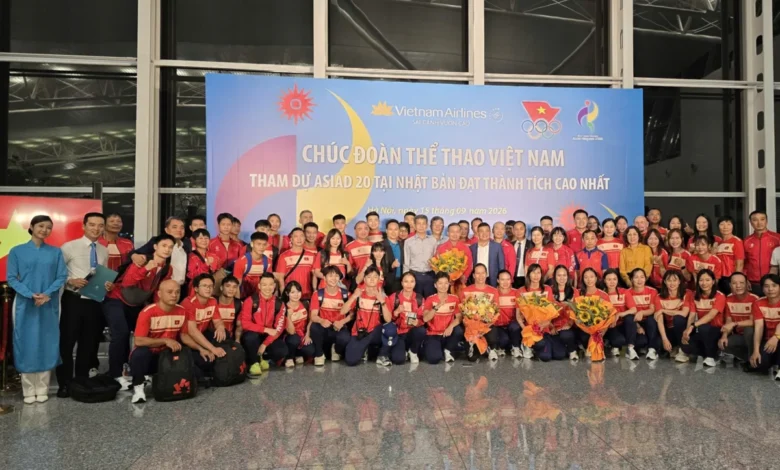
The official journey of the Vietnam Sports Delegation toward Asiad 20 has officially commenced, led by Nguyen Hong Minh, Deputy Director of the Department of Physical Education and Sports and Head of the Delegation. Setting out from Hanoi, the initial wave of athletes, coaches, and administrative officials has departed for Japan, marking the beginning of a meticulously scheduled logistical rollout designed to accommodate the diverse competition timelines of various sporting codes.
Because different disciplines adhere to distinct training regimens and preliminary competition windows set by the organizing committee, Vietnamese sports authorities structured the transit arrangements into multiple waves. This phased deployment ensures that athletes arrive in optimal physical and mental condition, acclimatizing to local conditions without unnecessary fatigue.
The first major deployment wave took place on September 15 and September 16, featuring administrative staff alongside core members from high-priority national teams, including shooting, rowing, Wushu, and canoeing. According to the updated itinerary issued by the Department of Physical Education and Sports, the national shooting team—comprising 21 members—departed Vietnam on September 15 aboard flight VN348. They were followed on September 16 by the core karate squad of 10 athletes, alongside administrative officials and representatives from other disciplines, while four additional karate practitioners followed alternative travel schedules. The movement of key medal contenders will continue in the coming days, with 25 members of the sepak takraw team scheduled to begin their journey to Japan on September 18.
Strategic Focus on Key Disciplines and Medal Expectations
The early deployment of squads such as shooting, karate, and sepak takraw underscores the strategic significance placed on these disciplines by the Vietnamese sports administration. At the previous continental showcase, Asiad 19 in Hangzhou, China, these specific sports served as the backbone of Vietnam’s gold medal tally, securing three prestigious titles and demonstrating world-class competitiveness in their respective categories.
Consequently, the current journey to Japan carries expectations that extend far beyond simple participation or the defense of past titles in favored events. It embodies the collective determination of the entire delegation to surpass previous benchmarks and target a total yield of four or more gold medals at Asiad 20. Sports analysts note that preparation for these core disciplines has involved rigorous domestic training camps, international sparring sessions, and exhaustive biomechanical evaluations to ensure peak performance during the marquee events in Japan.
Comprehensive Overview of the Vietnamese Contingent
Vietnam is fielding a substantial and diverse delegation at Asiad 20, comprising 498 members, which includes 348 elite athletes competing across a broad spectrum of 43 official sports and numerous disciplines. The nation’s representatives span traditional powerhouses and emerging sports alike, covering athletics, swimming, weightlifting, shooting, rowing, canoeing, sepak takraw, karate, gymnastics, taekwondo, archery, boxing, wrestling, cycling, wushu, kurash, jujitsu, indoor volleyball (men and women), beach volleyball (men and women), football (men and women), judo, golf, handball, badminton, fencing, sailing, teqball, esports, breaking, and mixed martial arts (MMA).
This expansive representation reflects the steady diversification and professionalization of Vietnamese high-performance sports over recent decades. While traditional combat sports and accuracy disciplines remain the most reliable avenues for gold medals, investments in team sports, technical events, and modern disciplines such as esports and breaking highlight a strategic shift toward broad-based continental competitiveness.
Asiad 20: Event Background, Venues, and National Targets
Asiad 20 is scheduled to take place across the Aichi Prefecture and the city of Nagoya, Japan, running from September 19 to October 4. The Games will feature a massive competitive program encompassing 43 official sports and a total of 469 medal events, drawing thousands of elite athletes from across the Asian continent.
For the Vietnam Sports Delegation, the overarching objective for Asiad 20 is to secure a position within the top 20 nations on the final official medal table. This target represents a step forward from the country’s performance at Asiad 19 in Hangzhou, where the Vietnamese contingent finished 21st overall with a final haul of 3 gold, 5 silver, and 19 bronze medals.
Achieving a top-20 finish will require optimal execution from established medal contenders while relying on breakthrough performances from younger athletes in sports that have received enhanced state and private investment during the current Olympic and Asian Games cycle.
Logistical Preparations and Team Readiness
The phased departure strategy implemented by the Department of Physical Education and Sports highlights the complex logistical challenges inherent in managing a delegation of nearly 500 people across multiple host cities and venues in Japan. Advanced coordination between the national Olympic committee, sport-specific federations, and the Asiad 20 organizing committee has been critical in securing training venues, accommodation, and transportation slots that align precisely with competition schedules.

Among the early arrivals are several squads carrying high public expectations, notably the national volleyball teams. The Vietnam women’s volleyball team is scheduled to play its opening match of Asiad 20 against Qatar at 11:00 AM on September 16, entering the tournament with high confidence following a series of strong regional performances. Simultaneously, the men’s volleyball team, guided by head coach Federico Rampazzo, has been drawn into a competitive Group C and is intensifying preparations with the primary objective of advancing past the preliminary group stage against formidable continental opponents.
Broader Implications for Vietnamese Sports Development
The outcomes of Asiad 20 will serve as a crucial barometer for the health, efficiency, and future direction of Vietnam’s national sports system. Beyond the immediate pursuit of medals, the tournament provides invaluable international exposure for a new generation of athletes, many of whom are using the Asian Games as a vital stepping stone toward qualification and peak performance at the upcoming Olympic Games.
Sports administrators have emphasized that sustained success at events like Asiad requires continuous refinement of athlete welfare programs, sports science integration, and international competition exposure. As the final contingents complete their journeys to Japan and competition gets underway across Aichi and Nagoya, the collective focus of the nation remains fixed on the athletes striving to elevate Vietnamese sports to new heights on the continental stage.