AS MONACO PREPARES TO TERMINATE PAUL POGBAS CONTRACT FOLLOWING RECURRING KNEE INJURIES AND DISAPPOINTING RETURN TO PROFESSIONAL FOOTBALL

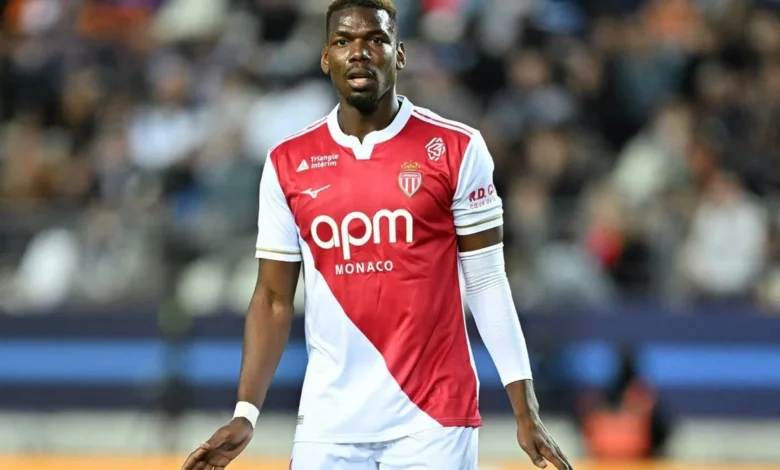
The professional football career of Paul Pogba has once again arrived at a profound and potentially terminal crossroads, as AS Monaco moves closer to terminating the French midfielder’s contract following yet another debilitating injury setback. At 33 years of age, the 2018 World Cup winner had envisioned his tenure in the French Ligue 1 as a definitive redemption arc—a chance to reassert his elite status after enduring a prolonged, career-halting suspension related to doping violations. Instead, his journey in the red and white shirt of Monaco has unraveled into a narrative filled with physical fragility, unmet expectations, and mounting frustration within the club’s upper management.
Club executives had originally earmarked the preparations for the 2026/27 campaign as the critical testing ground to evaluate whether Pogba could still contribute meaningfully to a side harboring ambitious domestic and European objectives. Following a grueling period on the sidelines that forced him to watch the sport from afar, the former Manchester United and Juventus star was granted a fresh lease on life when Monaco offered him a platform to restart his career in his homeland. However, the stark realities of professional athletics have once again intervened, threatening to cut short what was supposed to be a triumphant homecoming.
A Chronology of Physical Setbacks and Frustrated Hopes
Pogba’s resurgence was fraught with caution from the very beginning. Upon returning to training following his suspension, the midfielder struggled to regain the dynamic match fitness that once defined his status as one of the world’s premier playmakers. During the preliminary stages of Monaco’s pre-season schedule, he managed a mere 45 minutes of action in a friendly fixture before a recurrence of a knee injury—the exact ailment that severely disrupted his playing time during the previous season—flared up once more. This initial flare-up forced him to miss four consecutive training matches and subsequent test fixtures.
The situation deteriorated further during a recent training session when Pogba dropped to the turf, clutching his knee in visible discomfort. According to reports from French sports daily L’Équipe, this latest injury has pushed Monaco’s hierarchy to the brink of a definitive decision regarding the remainder of his contract. Pogba subsequently underwent comprehensive magnetic resonance imaging (MRI) scans to determine the precise structural damage to his knee, confirming the club’s worst fears regarding his long-term physical viability.
Monaco’s management team is now scheduled to hold formal discussions with Pogba and his legal representatives to negotiate a mutual settlement and a financial compensation package for the remainder of his contract, which was originally slated to run until the summer of next year. While the club had hoped to anchor their midfield around his renowned vision and passing range, the physical toll of his recent years has proven too heavy a burden for the demanding pace of modern European football.
Financial Disparities and Alternative Horizons
The financial contrast between Pogba’s past grandeur and his current reality underscores the magnitude of his career transition. During his peak years at Manchester United, the French international commanded a staggering weekly wage reaching approximately £290,000, making him one of the highest-paid earners in the English Premier League. In stark contrast, his gamble on AS Monaco saw him accept a drastically reduced salary package, with his earnings at the Ligue 1 club falling well short of £44,000 per week as he prioritized playing time and sporting rehabilitation over financial remuneration.
Despite the disappointing sporting return—which saw him feature in a mere six competitive matches during the 2025/26 season—Pogba’s enduring global brand continues to attract external interest. Over the past week, intermediaries have reportedly introduced the midfielder to several potential suitors within Major League Soccer (MLS) in the United States, where the less frenetic physical pace of the North American league could potentially accommodate his current fitness profile.
The prospect of a move across the Atlantic represents an intriguing option for a player seeking to salvage the twilight of his career away from the intense media scrutiny of European football. However, whether any prospective club is willing to gamble on a player with such an extensive and recent history of soft-tissue and joint injuries remains a central question for his management team.
Club Strategy and the Broader Context at Monaco
For AS Monaco, the decision to part ways with Pogba reflects a pragmatic, business-first approach to squad building. Ligue 1 clubs operate under increasingly stringent financial fair play regulations and wage-to-revenue ratios, meaning that carrying a high-profile, non-playing asset is an unsustainable luxury. Managerial staff had hoped that Pogba’s veteran presence would mentor a young, developing squad, but his inability to maintain physical continuity disrupted tactical continuity on the pitch.
Monaco’s sporting director and coaching staff must now pivot their strategy toward the remainder of the transfer window, seeking alternative reinforcements in the central midfield sector. The club’s recruitment department has already begun vetting younger, more durable profiles across Europe to ensure that the team remains competitive on all fronts as the 2026/27 domestic season gathers momentum and their European commitments loom on the horizon.
The situation also highlights the broader risk-reward calculus associated with signing players attempting to revive their careers after extended layoffs. While the potential upside of capturing a talent of Pogba’s technical caliber is immense, the invisible physical toll of aging, combined with multi-year inactivity, creates a volatility that even elite medical departments struggle to manage.
Implications for Paul Pogba’s Legacy and Future
As uncertainty continues to shroud Paul Pogba’s professional future, the footballing world is once again forced to contemplate the legacy of a uniquely gifted talent whose career has been defined as much by brilliance as it has by controversy, managerial friction, and physical misfortune. From his record-breaking transfer to Manchester United, his triumphant World Cup campaign with France in Russia, his subsequent struggles in Turin and Manchester, and his suspension-shortened stint in the French Riviera, Pogba’s journey has rarely followed a predictable path.
If the impending contract termination with Monaco is finalized, the immediate question centers on whether the 33-year-old will choose to embark on another arduous rehabilitation process with a new club—potentially in the MLS or the Middle East—or whether he will ultimately decide to hang up his boots. For a player who once commanded the center circle with an effortless elegance and unmatched flair, the prospect of a quiet exit from the highest level of European football serves as a sobering reminder of the unforgiving nature of elite sport.
For now, all eyes remain fixed on the negotiating table in Monaco, where the formal conclusion of a high-profile partnership will mark the end of one chapter and the beginning of a profound decision regarding the final chapter of Paul Pogba’s extraordinary footballing life.