Vanguard Eyes $2.5 Billion Inflow as Vietnam Stock Market Enters New Era of Global Integration


Vietnam’s financial landscape has reached a historic watershed moment following the official inclusion of the country’s stock market in the FTSE Russell Global Equity Index Series (FTSE GEIS). This monumental transition from frontier market status to secondary emerging market has not only validated years of regulatory reforms but has also triggered an immediate and overwhelming surge of confidence from institutional capital management giants across the globe.
Leading the charge of foreign capital deployment is Vanguard, one of the world’s largest asset management corporations. According to high-level revelations from the State Securities Commission (SSC) under the Ministry of Finance, Vanguard has significantly revised its initial projections. The global fund manager now plans to disburse approximately $2.5 billion into the Vietnamese stock market over the upcoming year, a figure substantially higher than its conservative preliminary estimate of $1.6 billion.
This unprecedented level of foreign interest signals a structural paradigm shift for Vietnam’s economy, transforming the national stock market into a robust, long-term capital conduit capable of supporting sustained macroeconomic growth.
A Landmark Milestone in Vietnam’s Financial History
The formal implementation of Vietnam’s market upgrade on September 21 marked the culmination of decades of careful regulatory restructuring, infrastructure enhancements, and legislative alignment with international standards. For years, foreign institutional investors faced bottlenecks regarding pre-funding requirements, foreign ownership limits, and information disclosure barriers.
Addressing these challenges became a top priority for the Vietnamese government, the Ministry of Finance, and the SSC. By enacting sweeping reforms—most notably the removal of the stringent pre-funding rule for institutional investors and the expansion of English-language corporate disclosures—regulatory authorities successfully bridged the gap between domestic market operations and global expectations.
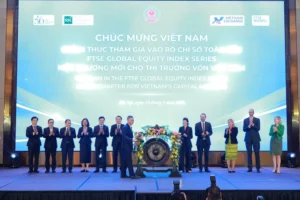
Speaking at a high-level symposium in Hanoi on September 18, themed around Vietnam’s official entry into the FTSE GEIS index series, SSC Vice Chairman Bui Hoang Hai underscored the depth of foreign institutional interest. The conference drew representatives from some of the world’s most influential financial institutions, including Vanguard and BlackRock, whose combined assets under management scale into the hundreds of trillions of dollars.
"The level of attention from international financial institutions toward the Vietnamese market is clearly manifested through the presence of these major asset management titans," Mr. Hai noted during the panel discussions. "Many signs regarding the inflow of international capital into Vietnam are very positive and promising."
Vanguard’s Aggressive Capital Allocation Strategy
Vanguard’s revised commitment of $2.5 billion over the next 12 months represents a profound vote of confidence in the underlying fundamentals of Vietnamese equities. The allocation strategy has been meticulously planned to ensure smooth market absorption without causing undue volatility.
In the initial deployment phase, Vanguard is projected to disburse approximately $250 million, accounting for roughly 10% of its total intended allocation. This phased approach allows market liquidity to absorb the incoming wave of capital organically while offering portfolio managers the flexibility to optimize execution prices across benchmarked equities.
Financial analysts point out that Vanguard’s heavy weighting toward Vietnam is largely driven by passive tracking funds that mirror the FTSE Emerging Markets indices. As these institutional funds adjust their portfolio weights to incorporate Vietnamese blue-chip stocks, secondary and tertiary waves of active capital are expected to follow suit, compounding the overall liquidity effect.

Strategic Roadmap and Government Vision to 2030 and Beyond
While the market upgrade is widely celebrated as a historic victory, senior Vietnamese officials have emphasized that reaching secondary emerging market status is not a final destination, but rather a rigorous new beginning.
Addressing the assembly of international delegates, Minister of Finance Nguyen Van Tuan asserted that the upgrade imposes significantly higher demands and responsibilities on both market participants and regulatory bodies. The government and the Ministry of Finance have already deployed synchronized strategies outlined in the master plan for the development of the financial and securities markets through 2030, with a visionary outlook extending to 2045.
"The core focus remains on continuously enhancing market liquidity and quality, modernizing trading and settlement infrastructure, strengthening risk management tools, diversifying financial products, and attracting sustainable capital flows," Minister Tuan stated. "Alongside these measures, we must continuously elevate regulatory supervision, enforcement capabilities, and ensure the market remains open, transparent, and resilient."
To sustain this momentum, the SSC is actively researching and implementing new financial products and services. Collaborative efforts across various government ministries are also underway to refine legal frameworks that support foreign investors. Furthermore, domestic listed enterprises are being strongly urged to elevate their corporate governance practices toward international standards, enhance operational transparency, and standardize corporate reporting in English.
International Perspectives on Vietnam’s Market Evolution
The broader international community has closely monitored Vietnam’s economic ascent, offering glowing assessments while advising caution regarding long-term structural resilience.
British Ambassador to Vietnam Iain Grant Frew described the market upgrade as a critical milestone in the broader process of developing Vietnam’s capital markets. However, the Ambassador cautioned that an upgrade does not automatically guarantee long-term success. To maintain investor trust and attract large-scale, long-term capital, Vietnam must continue to refine market infrastructure, strengthen legal protections for investors, upgrade trading platforms, and streamline dispute-resolution mechanisms.
Echoing these sentiments, financial experts suggest that the influx of $2.5 billion from Vanguard—alongside parallel inflows from other global funds—will place a premium on transparency and corporate governance among Vietnamese listed companies. Firms that fail to meet international reporting standards risk being overlooked by passive and active foreign funds alike, while well-governed enterprises are expected to capture the lion’s share of incoming liquidity.
Implications for the Domestic Economy and Future Outlook
The integration of Vietnam into major global equity indices carries profound macroeconomic implications:
- Reduced Reliance on Bank Credit: A mature, highly liquid stock market provides domestic corporations with an alternative, highly efficient channel for raising long-term capital, thereby easing systemic pressure on the commercial banking sector.
- Enhanced Corporate Governance: As foreign institutional investors demand higher standards of accountability, transparency, and environmental, social, and governance (ESG) compliance, Vietnamese enterprises will naturally evolve into more globally competitive entities.
- Wealth Generation and Retail Participation: Increased institutional participation typically stabilizes market volatility over the long term, protecting domestic retail investors and fostering a more sustainable investing culture within the country.
As Vietnam navigates this transformative phase, the concerted efforts of regulatory bodies, policymakers, and corporate leaders will be vital. With global giants like Vanguard laying down a multi-billion-dollar stake, Vietnam’s stock market has firmly established itself as one of the most dynamic and promising investment destinations in the emerging world economy.