Vietnam Advances National Digital Transformation Through Data Infrastructure Development and AI Integration


The landscape of national development and global economics is experiencing a fundamental paradigm shift, one where physical resources are gradually being matched—and in many cases outperformed—by a new, infinitely renewable asset: data. This transformative vision took center stage at the Vietnam – Asia DX Summit 2024, held in late May, where senior government officials, technology leaders, and enterprise experts gathered to deliberate on the future of digital and green transitions. Among the key voices shaping this national discourse was Nguyen Manh Hung, Minister of Information and Communications (MIC), who underscored that data is no longer merely a byproduct of administrative processes, but the core foundation of a modern digital economy.
The summit served as a crucial platform for unveiling and discussing the operationalization of Vietnam’s "National Data Strategy to 2030." Approved by the Prime Minister earlier in February 2024 following extensive consultations led by the MIC, the strategy represents a watershed moment in Vietnam’s administrative and economic evolution. By establishing a robust, interconnected data infrastructure, the government aims to position Vietnam alongside global leaders in digital maturity, fostering innovation, creating high-value jobs, and optimizing both public sector governance and corporate management.
Redefining Resources: From Extraction to Generation
In his opening address at the Vietnam – Asia DX Summit 2024, Minister Nguyen Manh Hung introduced a philosophical and economic framework that challenges centuries of industrial norms. Throughout human history, industrial development has been synonymous with resource depletion—mining, logging, and consuming finite earthly materials to fuel economic growth. However, the digital era introduces an unprecedented inversion of this rule.
"For the first time in the history of human development, instead of consuming and depleting resources, humanity is creating a new type of resource: data," Minister Hung stated. "Previously, development meant resource depletion; today, development generates more resources."

This conceptual pivot forms the backbone of Vietnam’s current digital policy. By treating data as a vital economic factor of production—comparable to labor, capital, and land—the government is laying the groundwork for advanced technologies such as Artificial Intelligence (AI), big data analytics, and cloud computing. The overarching objective is to build a sovereign data ecosystem where information is safely collected, structured, shared, and leveraged to drive national prosperity while maintaining strict cross-border security standards.
The Pillars of the National Data Strategy
Elaborating on the specifics of the national framework during a specialized thematic workshop titled "Effective Business and Organizational Governance and Management Based on Data," Tran Minh Tan, Deputy Director of the MIC’s National Institute of Information and Communications Strategy (NIICS), outlined the core philosophy and goals of the strategy.
According to Mr. Tan, the strategy is anchored by three primary pillars:
- Public Sector Data Development: Enhancing the collection, organization, and inter-agency sharing of public data to better serve society and improve administrative efficiency.
- Private and Commercial Data Development: Fostering a vibrant data market, encouraging open data exchanges, and empowering enterprises to harness analytics for commercial growth.
- Data Security and Cross-Border Governance: Safeguarding national data assets, regulating the flow of information across national borders, and ensuring that strategic data remains securely anchored within Vietnam.
To realize these goals, the MIC has established a comprehensive action plan and issued implementation guidelines for ministries, ministerial-level agencies, and provincial People’s Committees. A vital immediate requirement for all local and sectoral authorities is the public release of their respective open data catalogs and foundational data strategies. By synchronizing local digital agendas with the overarching national framework, the government aims to dismantle bureaucratic data silos and enable seamless integration across the entire public-private spectrum.
"This is extremely important," Mr. Tan emphasized, noting that transparent data publishing creates the necessary conditions for state agencies, social organizations, and private enterprises to actively participate in developing, sharing, and extracting value from public information assets.

Corporate Governance in the Data Era: Challenges and Opportunities for SMEs
While national infrastructure sets the macro-level trajectory, the micro-level implementation relies heavily on how individual enterprises adapt to data-driven management. Providing a commercial perspective during the summit, Nguyen Ngoc Ly, Director of the Business Center at MISA—a leading digital technology enterprise supporting thousands of organizations—highlighted the urgent need for businesses to modernize their operational frameworks.
"Organizing and exploiting data effectively helps enterprises operate better, significantly enhances their competitiveness, and multiplies productivity—especially when data is processed using artificial intelligence," Ms. Ly affirmed.
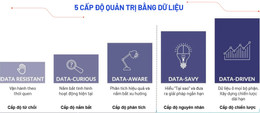
Despite the proven benefits of data-driven decision-making, MISA’s market assessments reveal that a vast majority of Vietnamese enterprises, particularly Small and Medium-sized Enterprises (SMEs), remain stuck at the foundational "awareness" stage (Level 2 of the data maturity model). Many companies fail to unlock the full potential of their operational data due to three primary barriers: data fragmentation, integration hurdles, and high financial costs.
In many corporate environments, different departments rely on disparate software solutions that fail to communicate with one another. This fragmentation forces employees to re-enter data manually, leading to siloed information and redundant administrative tasks. Furthermore, while legacy software solutions may suffice during a company’s early startup phase, scaling up or transitioning to comprehensive Enterprise Resource Planning (ERP) systems often proves prohibitively expensive and technically complex for smaller firms.
To mitigate these challenges, experts recommend that businesses invest in unified ecosystems from the very beginning of their operations. Establishing centralized data governance early in a company’s lifecycle is exponentially more cost-effective than attempting to retrofit legacy systems during later stages of rapid expansion.

Technological Solutions and the Rise of AI-Driven Ecosystems
Addressing the systemic challenges faced by SMEs, technology providers are increasingly offering integrated platforms that combine core administrative functions with advanced data analytics. Platforms such as MISA AMIS serve as prime examples of this trend, having been deployed across more than 250,000 businesses and 25,000 household businesses across various sectors and scales.
By consolidating accounting, human resources, sales, and marketing operations onto a single system, such ecosystems generate multi-dimensional reports and executive dashboards. These tools provide enterprise leaders with a holistic, real-time overview of their organizations, enabling agile strategic decision-making and optimized operational workflows.
Furthermore, the integration of generative AI assistants—such as MISA AVA—into enterprise software represents the next frontier of digital maturity. These AI tools assist in automating routine administrative tasks, analyzing complex datasets, and generating actionable business insights, effectively lowering the technical barriers that traditionally prevented SMEs from adopting advanced data analytics.
Broader Implications and Future Outlook
Vietnam’s aggressive pursuit of a data-centric economy arrives at a critical juncture in the global technology landscape. As international supply chains digitize and artificial intelligence reshapes global labor markets, nations that successfully transition from data consumers to data producers will secure a distinct competitive advantage.
The collaborative approach demonstrated at the Vietnam – Asia DX Summit 2024 highlights a maturing public-private partnership model. By establishing clear regulatory frameworks through the National Data Strategy while encouraging private sector innovation through scalable technology platforms, Vietnam is steadily building the institutional capacity required to achieve its dual digital and green transformation goals.
Looking ahead, the successful execution of these strategies will depend heavily on sustained investments in digital literacy, robust cybersecurity measures, and continuous regulatory adaptation. As ministries, local authorities, and business communities align their operations with national data standards, Vietnam moves closer to realizing its ambition of standing among the leading digital economies in the region and the wider global community.