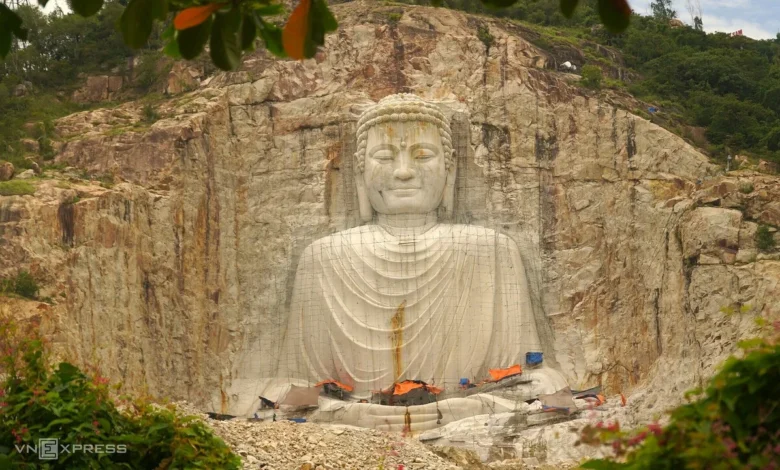
In the heart of the Mekong Delta, specifically within the rugged terrain of Sam Mountain in An Giang province, a monumental architectural endeavor is nearing its final phase. The construction of an 81-meter-tall Shakyamuni Buddha statue, carved directly into the natural rock face, represents a decade-long struggle against environmental challenges, engineering complexities, and shifting project parameters. Originally slated for completion within five years, the project has now entered its eleventh year, serving as a case study in the intersection of spiritual tourism development and the preservation of natural landscapes.
A Decade of Evolution and Engineering Challenges
The project, officially designated as part of the Sam Mountain Cultural Park, was first integrated into the regional development plan in 2012. Since its groundbreaking in March 2015, the initiative has undergone seven major revisions, reflecting the difficulty of executing such a high-precision project on a volatile, naturally formed mountain surface.
According to Dr. Ngo Quang Lang, former Deputy Director of the An Giang Department of Culture, Sports and Tourism, the site was selected for its immense spiritual and historical significance. Sam Mountain is situated at the gateway to the Seven Mountains (That Son) region, a landscape rich with cultural heritage, including the tomb of Thoai Ngoc Hau, the Lady Chua Xu Temple, and the historic Hang Pagoda.
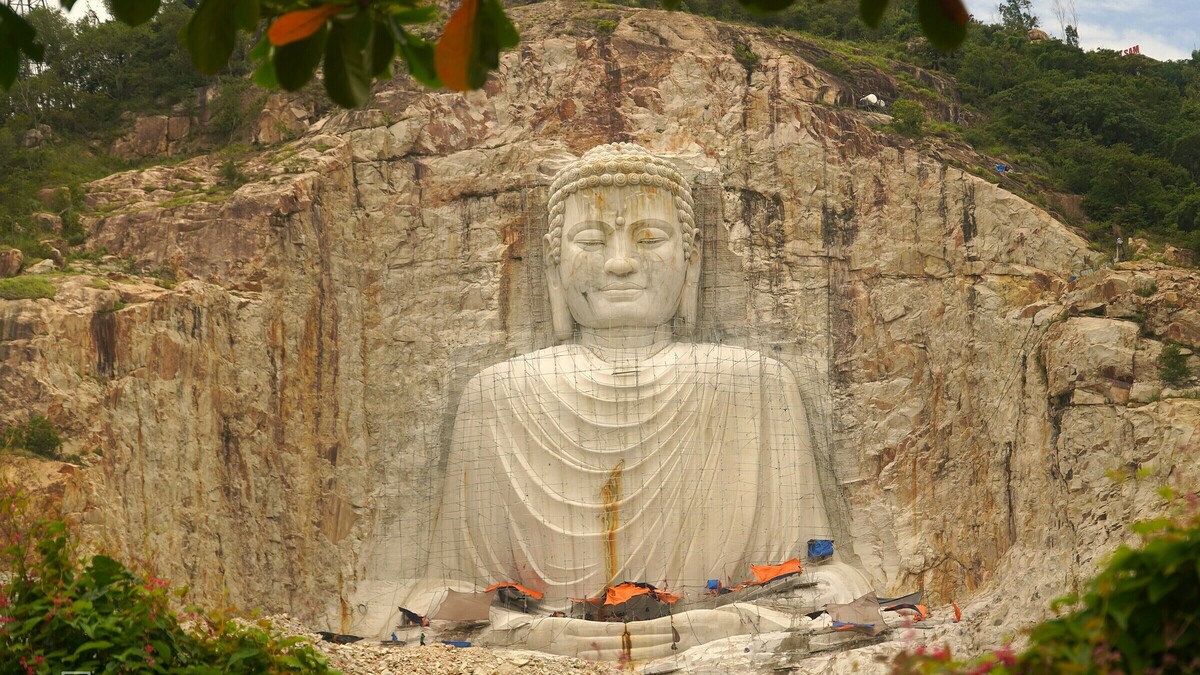
However, the location presented a unique challenge: the area had been subjected to decades of unregulated rock quarrying, dating back to the colonial era and continuing long after 1975. By the time the state moved to preserve the mountain in the 1980s, the landscape was scarred by deep pits and jagged cliffs. When the initial proposal for the Buddha statue was drafted, the objective was not merely to build a monument but to create a focal point that would rehabilitate a degraded area. Upon surveying the cliff face, the project team realized that the existing damage could be repurposed as an artistic canvas. Instead of constructing a freestanding statue, the team opted for a relief sculpture carved directly into the mountain, effectively "healing" the scars left by historical mining.
Chronology of Construction and Adjustments
The timeline of the project reflects the immense technical hurdles faced by the developers:
- 2012: Initial inclusion of the project in the regional master plan.
- March 2015: Official groundbreaking of the Sam Mountain Cultural Park.
- 2018: Following initial site surveys, the project team and the An Giang Provincial People’s Committee reached a consensus to relocate the statue’s axis to better align with the natural rock quality.
- 2020–2022: The project faced significant delays due to the global Covid-19 pandemic, which halted logistics and the arrival of specialized technical personnel.
- October 2025: Construction resumed with full intensity following the long hiatus.
- August 2026: Approximately 70% of the physical carving and structural work is reported as complete.
- End of 2027 (Projected): Final completion of the statue and surrounding park facilities.
The logistical complexity of the project forced numerous adjustments to the design specifications. The design height was increased from 107 meters to 126 meters to improve structural integrity, while the statue’s central axis was shifted by 11 meters. Furthermore, the depth of the carving into the cliff face was extended by 29 meters to accommodate the scale of the 81-meter figure.
Technical Specifications and Site Management
The scale of the project is unprecedented in the region. The overall statue dimensions span 70 meters in width and 81 meters in height, comprising a 68-meter-tall Buddha figure sitting on a two-tier lotus base—the first tier measuring 9 meters and the second 4 meters.
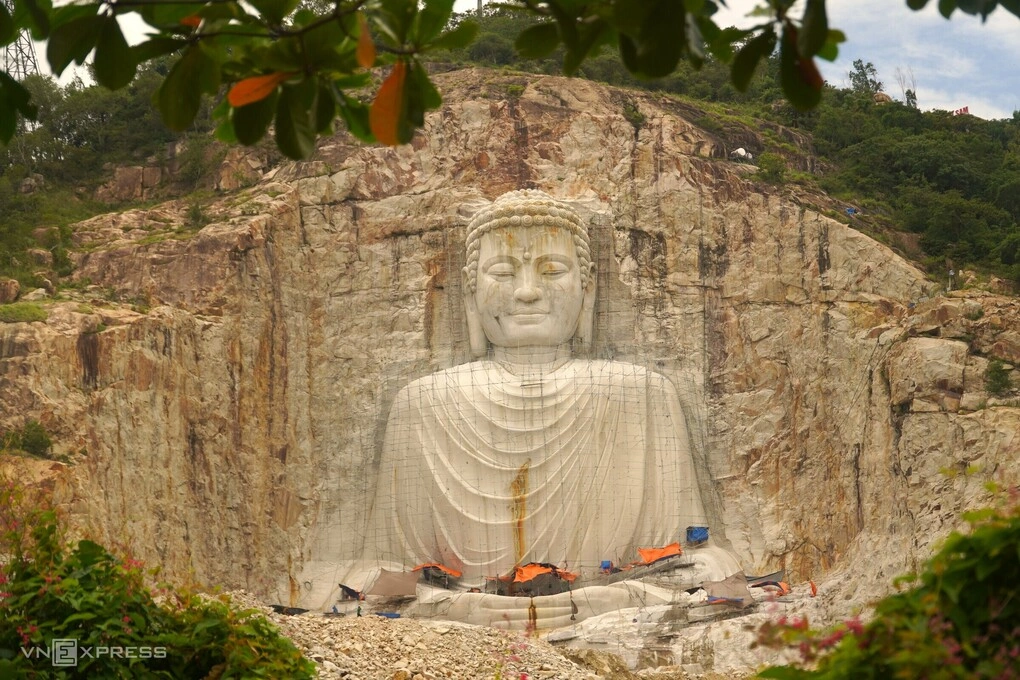
Mr. Nguyen Phuc Hoan, Head of the Management Board of the Sam Mountain Relics, noted that the construction required the removal and management of approximately 165,000 cubic meters of rock. "Because we are carving directly into a natural formation, every cut must be mathematically precise," Hoan explained. "The project is subject to constant geological monitoring to ensure safety, particularly during the rainy season when high winds and moisture pose risks to the stability of the cliffside."
The project management team has employed specialized firms to oversee environmental impact control, ensuring that dust and noise pollution remain within acceptable limits for the surrounding residential areas. Despite these precautions, the process remains slow, as delicate facial features and complex drapery of the robes require meticulous, hand-finished carving rather than mass-mechanical excavation.
Economic and Cultural Implications
The broader development of the 12-hectare cultural park is designed to boost An Giang’s tourism economy. With a total investment that has escalated from 255 billion VND to approximately 456 billion VND, and a total project cost exceeding 1 trillion VND, the statue is intended to be a flagship destination.
Critics of the project have previously expressed concerns regarding the alteration of the mountain’s natural form. However, proponents argue that the site was already significantly degraded. By transforming the disused, jagged quarry into a cultural landmark, the developers aim to create a space that balances spiritual tourism with landscape restoration.

Dr. Lang emphasizes that the project is not just a statue but a land-reclamation effort. "We had to choose between leaving a scarred, dangerous, and eroding rock face or creating something that provides cultural value and economic stability," he stated. "The environmental impact of the construction is negligible when compared to the long-term benefit of stabilizing the mountain slopes through landscaping and the planting of thousands of trees."
Environmental Restoration and Future Outlook
A significant portion of the master plan involves the "greening" of the mountain. The project includes a comprehensive ecological restoration plan, which involves planting 610 large trees, over 7,000 bushes, and 31,500 square meters of ground cover. This vegetation is essential for preventing soil erosion and mitigating the effects of the heavy quarrying that occurred in previous decades.
The park is designed with a low building density—less than 5% of the total land area will be used for structures. The vast majority of the 12 hectares will be dedicated to green space, water features, and open areas to minimize human footprint and promote biodiversity.
As the project approaches its final stages, it is poised to become the tallest rock-carved Buddha in the world, surpassing the Leshan Giant Buddha in China (71 meters). Local authorities are confident that once completed, the site will serve as a vital cultural nexus, attracting both domestic and international visitors and firmly establishing An Giang as a premier center for spiritual and heritage tourism in Vietnam. The ten-year journey, while longer than anticipated, has resulted in a project that serves as a testament to both modern engineering and the enduring cultural legacy of the Mekong Delta.
Related posts: