Nearly 700,000 real estate products are under construction while transactions plummet: Where is the capital flowing?


The Vietnamese real estate market is currently navigating a period of profound structural adjustment, characterized by a paradoxical trend: while the total inventory of projects under construction continues to surge toward the 700,000-unit mark, the velocity of market transactions has hit a notable stagnation point. This divergence between supply growth and consumer absorption is creating a complex economic puzzle for investors, developers, and policymakers alike. As capital continues to flow into the sector, the fundamental nature of this investment is shifting away from residential homeownership and toward specialized commercial and industrial real estate, reflecting a broader recalibration of the national economy.
A Chronology of Market Imbalance
The current state of the property market can be traced back to the final quarter of 2025 and the beginning of 2026, when government authorities and the State Bank of Vietnam (SBV) intensified their focus on controlling the runaway appreciation of real estate assets. During this period, the central bank implemented stricter guidelines on credit growth for the real estate sector, aiming to ensure it did not exceed the overall growth rate of the national economy.
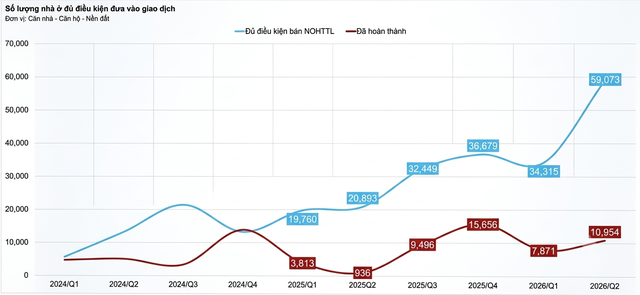
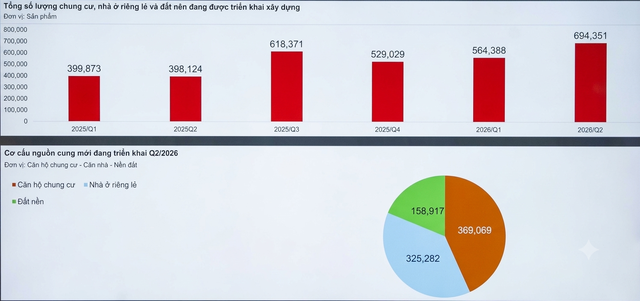
By the end of the second quarter of 2026, the data from the Ministry of Construction revealed a stark reality. A total of 59,737 new housing units, all of which met the legal requirements to be sold as future assets, were introduced to the market. When combined with the massive backlog of projects currently in progress, the total number of products under development reached 694,351. This figure comprises approximately 369,069 apartment units, 325,282 detached houses or townhouses, and 158,917 plots of land.
However, the absorption rate has failed to keep pace. In the second quarter of 2026 alone, transactions for apartment complexes and individual houses declined by 13.9% compared to the first quarter, and by a significant 22.91% compared to the same period in the previous year. The land segment faced an even sharper correction, with transaction volumes plummeting by 28.49% quarter-on-quarter and 36.31% year-on-year.
The Growing Inventory Dilemma
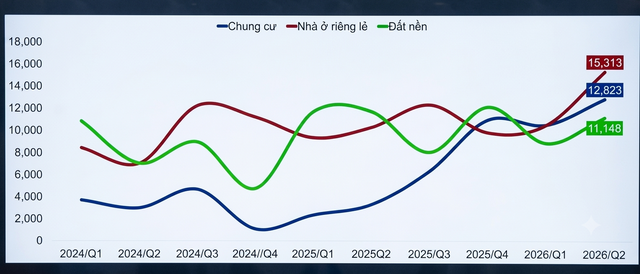
As supply outstrips demand, developers are grappling with an ever-expanding inventory. By the end of Q2/2026, the market was burdened with 12,823 unsold apartment units, 15,331 detached houses, and 11,148 land plots. This accumulation of finished but unsold product represents a significant drain on developer liquidity.
Experts, including Long Phan, Chairman of the AFA Group and Chairman of the Vietnam Wealth Advisors (VWA) Community, suggest that the market is no longer dictated solely by cost-plus pricing models. Instead, it has transitioned into a highly sensitive financial product market. In an environment of persistent inflation and elevated capital costs, the pricing of residential units and townhouses is under immense pressure to adjust downward. While properties in high-demand residential zones maintain some intrinsic value, projects marketed purely for speculative investment are struggling to find liquidity, regardless of how much prices have been reduced.
Credit Flows: Where is the Money Going?
Despite the cooling of the housing market, credit to the real estate sector has not vanished; rather, it has been redirected. As of June 30, 2026, total outstanding credit in the real estate sector reached approximately 5.2 quadrillion VND, an increase of 8.3% compared to December 2025.
The most striking detail in this data is the breakdown of that credit. Lending for real estate business activities—defined as loans provided to developers or professional investors for the development and sale of projects—surged by 25.85%, reaching 2.5 quadrillion VND. Conversely, credit for consumption—loans taken by individuals for buying, building, or renovating their own homes—grew by a modest 5.66%, reaching 2.7 quadrillion VND.
This data clearly indicates that the majority of recent real estate credit growth is concentrated on business expansion and project development rather than individual home acquisition. This is a critical point for analysts to consider when assessing the "real" demand of the market. The financial support is currently favoring the supply-side developers rather than the end-user buyers.
The Role of Foreign Direct Investment (FDI)
One of the most encouraging signs in the current landscape is the sustained interest from foreign investors. By the end of July 2026, registered FDI in the real estate business sector had reached 5.6 billion USD, a figure that nears the record-breaking 7.1 billion USD achieved for the entirety of 2025.
It is important to note that FDI into real estate is not monolithic. It covers a vast array of sub-sectors, including office development, urban township projects, and, most importantly, industrial real estate. Within the second quarter of 2026, credit allocated to industrial zones and export processing zones grew by 32.38%, marking it as the highest growth category within the real estate spectrum. This shift aligns with Vietnam’s broader national strategy to bolster its position as a global manufacturing hub. The infusion of capital into industrial real estate is not merely a financial trend; it is a strategic response to the country’s need for infrastructure to support long-term economic growth.
Implications for Future Market Stability
For the average citizen, the current market dynamics present a challenging environment. The "wait-and-see" approach, often adopted by potential homebuyers, is increasingly influenced by two main factors: the reasonableness of asset pricing and the individual’s ability to access credit.
Experts like Tô Anh Hùng, CEO of Refi and a financial advisor, argue that owning a home in the current economic climate is not just a calculation of interest rates and percentages, but a decision involving long-term financial stability and family security. For young professionals, a stable home remains a cornerstone of long-term development. However, in a market where transaction volume is low and prices are under downward pressure, those who have prudently accumulated financial resources may find unique opportunities to enter the market at more favorable price points.
Looking ahead, the market is expected to remain in a state of flux as it reconciles the high volume of supply currently under construction with the more cautious borrowing behavior of consumers. The government’s continued oversight of credit growth, coupled with the ongoing influx of FDI into industrial and commercial sectors, suggests that while the residential market may remain sluggish in the near term, the broader real estate ecosystem is undergoing a necessary, if painful, professionalization.
For developers, the mandate is clear: the era of easy, speculative gains is over. Success in the current cycle will be reserved for those who can align their product offerings with genuine demand, maintain fiscal discipline, and effectively navigate the tightening credit environment. As the national economy continues to evolve, the real estate sector will likely emerge as a more transparent, business-oriented market, prioritized by its contribution to infrastructure and industrial productivity rather than short-term capital appreciation.