PNJ Reaffirms Product Buyback Commitments and Strategic Liquidity Management Amid Market Volatility and Major Shareholder Divestment

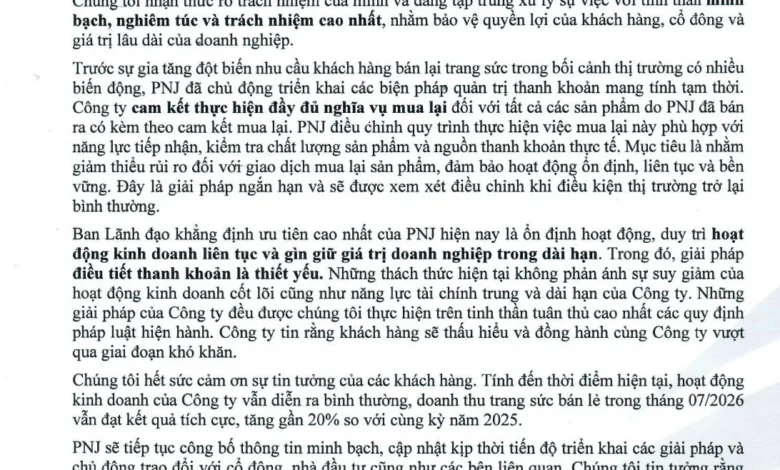
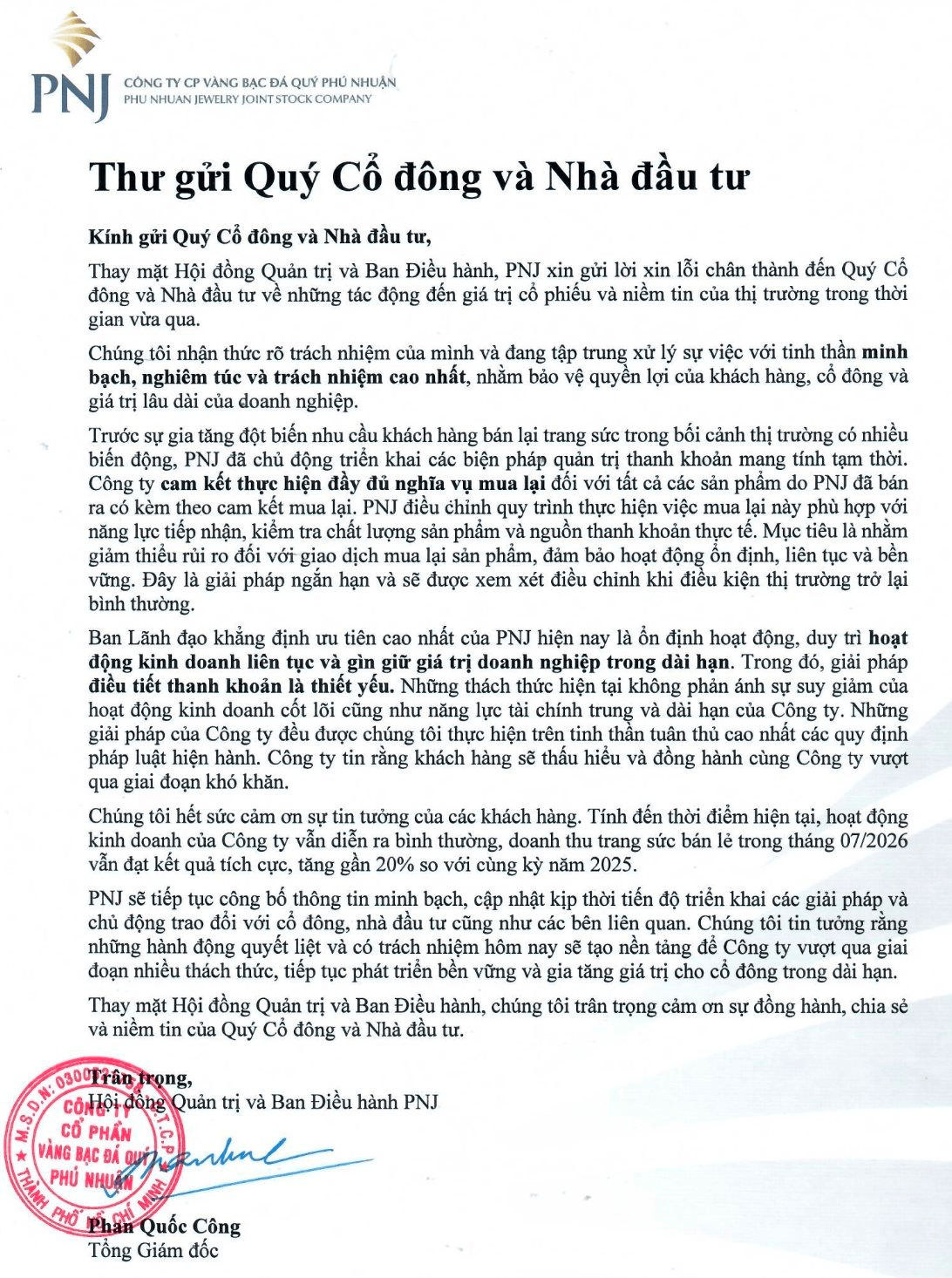
Phu Nhuan Jewelry Joint Stock Company (PNJ), the leading jewelry retailer in Vietnam, has issued an official communication to its shareholders and the broader investment community to address recent market turbulence and clarify its operational stance. In an unprecedented move, the company offered a formal apology for the recent fluctuations in its stock value and the resulting psychological impact on the market. Despite these challenges, PNJ management underscored that the enterprise continues to maintain stable business operations, highlighted by a nearly 20% increase in retail revenue during July 2026 compared to the same period in the previous year. This announcement comes at a critical juncture as the company navigates a complex landscape of regulatory scrutiny, shifting investor sentiment, and an localized surge in customer sell-backs.
The primary focus of PNJ’s recent communication was to reassure customers of its long-term reliability. The company explicitly confirmed that it remains fully committed to its buyback obligations for all PNJ products sold with a buyback guarantee. However, in response to an abrupt and significant spike in customers wishing to sell back their jewelry—a trend triggered by broader market volatility—PNJ has implemented a temporary adjustment to its liquidity management and product inspection protocols. These measures are designed to ensure that the company can balance its immediate cash flow requirements with the necessity of maintaining rigorous quality control over returned assets.
Strategic Adjustments to the Buyback Process
To manage the sudden influx of sell-back requests, PNJ has introduced a structured payment schedule for customers. Under the revised guidelines, once a product is received and the necessary documentation is verified, the company will process the buyback payment in five distinct installments spanning a 120-day period. The first installment, representing 10% of the total value, is paid upon the completion of the initial appraisal. This is followed by a second payment of 20%. The third and fourth installments are set at 25% each, with the final 20% being settled at the end of the four-month cycle.
Company representatives stated that this phased approach is a "temporary governance measure" necessitated by the current market environment. By staggering payments, PNJ aims to safeguard its liquidity while ensuring that every customer eventually receives the full value of their returned items. To formalize this arrangement and prevent potential legal disputes, PNJ has developed a supplementary contract appendix. This document clearly outlines the payment roadmap, the methods of disbursement, and the verification principles agreed upon by both the company and the seller. If a scheduled payment date falls on a weekend or a public holiday, the transaction is processed on the following business day.
Contextualizing the Market Turmoil: The PNJ-LAB Controversy
The defensive posture adopted by PNJ is largely a response to the fallout from a high-profile legal case involving the smuggling of 28,000 diamonds. The scandal gained significant traction when it was revealed that one of the primary suspects was the former Director of PNJ Monitoring One Member Company Limited (PNJ-LAB), a key subsidiary responsible for the certification and appraisal of gemstones. Although PNJ has distanced itself from the individual’s actions, asserting that the alleged crimes were personal in nature and did not involve the parent company’s direct operations, the news dealt a severe blow to consumer and investor confidence.
The link to PNJ-LAB is particularly sensitive because the laboratory serves as the backbone of PNJ’s quality assurance. Investors expressed concerns that the integrity of the company’s diamond inventory could be questioned, leading to the massive sell-off seen in early July 2026. In its latest missive, PNJ reiterated that it possesses sufficient resources to honor its commitments and that its core retail business remains insulated from the legal proceedings surrounding the smuggling case.
Financial Performance vs. Investor Sentiment
There is a stark contrast between PNJ’s fundamental business performance and its performance on the Ho Chi Minh City Stock Exchange (HOSE). While the company reported a robust 20% growth in retail revenue for July 2026, the PNJ ticker has faced relentless downward pressure. From the beginning of July to the middle of the month, the company’s market capitalization evaporated by more than 13,800 billion VND.
In recent trading sessions, PNJ shares frequently hit the daily floor price limit, often with large volumes of "sell" orders left unfilled due to a near-total absence of "buy" demand. The stock price, which had been trading at significantly higher levels earlier in the month, retreated to approximately 35,500 VND per share. This decline has brought the company’s total market valuation below the 18,200 billion VND mark, reflecting a profound shift in how institutional and retail investors perceive the risk profile of the jewelry giant.
Major Shareholders and Institutional Divestment
The downward trajectory of the stock has been exacerbated by the exit of several high-profile institutional investors. Most notably, the Dragon Capital group, a long-term fixture in PNJ’s shareholder structure, has officially ceased to be a major shareholder. In a transaction conducted on July 16, 2026, various funds managed by Dragon Capital offloaded a combined total of more than 2.5 million PNJ shares.
The divestment was led by the Vietnam Enterprise Investments Limited (VEIL) fund, which sold 1.38 million shares. Other participants in the sell-off included Norges Bank (600,000 shares) and the DC Developing Markets Strategies Public Limited Company (300,000 shares). Notably, the Gates Foundation Trust and Amersham Industries Limited also reduced their holdings by over 100,000 shares each. Following these transactions, the Gates Foundation Trust no longer holds any position in PNJ, a significant move considering the fund held over 830,000 shares as recently as March 2026.
Based on the closing price of 40,900 VND per share on the day of the transaction, it is estimated that Dragon Capital realized approximately 102 billion VND from this specific divestment round. This sale reduced Dragon Capital’s total ownership from 5.05% to approximately 4.55%, effectively removing their status as a "major shareholder" and the associated reporting requirements for future trades.
This move follows a similar trend set by VinaCapital. On July 8, five funds under the VinaCapital umbrella sold a total of 6.35 million PNJ shares, representing roughly 1.24% of the company’s charter capital. While VinaCapital remains a significant stakeholder with nearly 5% ownership (approximately 25.8 million shares), the synchronized reduction in exposure by the country’s two largest fund management groups has signaled a cautious "wait-and-see" approach among institutional players.
Implications and Future Outlook
The current situation at PNJ serves as a case study in the fragility of "trust assets" in the luxury retail sector. Jewelry and gemstones are not merely consumer goods; they are stores of value. When the institutions responsible for certifying that value—such as PNJ-LAB—are even tangentially linked to legal controversies, the impact on liquidity can be immediate and severe.
PNJ’s decision to move to a 120-day payment cycle for buybacks is a pragmatic but risky strategy. While it protects the company’s cash reserves in the short term, it may further erode consumer confidence if perceived as a sign of financial distress. To counter this, PNJ has pledged to maintain a high level of transparency, promising regular updates on its operational progress and the implementation of its "liquidity governance" measures.
The 20% growth in retail revenue suggests that the "PNJ" brand still holds significant weight with the general public for new purchases. The challenge for the Board of Directors will be to decouple the brand’s retail success from the subsidiary’s legal troubles. Moving forward, market analysts will be closely watching the company’s Q3 2026 financial results to see if the increased retail revenue can offset the costs associated with the buyback surge and the decline in investor equity.
For the broader Vietnamese stock market, the PNJ saga highlights the sensitivity of the retail and consumer goods sectors to corporate governance issues. As the company works to stabilize its stock price and fulfill its promises to customers, the next few months will be a defining period for Phu Nhuan Jewelry’s legacy as a cornerstone of the Vietnamese jewelry industry. The company has reaffirmed its commitment to proactive communication with shareholders and investors, aiming to rebuild the value that has been lost during this turbulent month.