Vietnamese Stock Market Braces for Major Capital Inflows as 24 Enterprises Set Record Dates for Cash and Stock Dividend Distributions

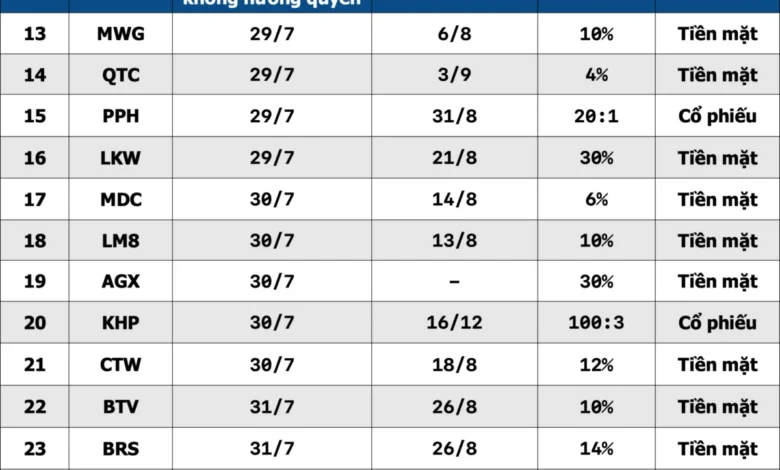
The Vietnamese equity market is preparing for a significant wave of liquidity and shareholder activity as 24 listed companies have officially announced their schedules for closing shareholder lists to implement dividend payments. During the final week of July, spanning from July 27 to July 31, these enterprises will execute their rights for both cash and stock dividends, marking a critical period for investors seeking to optimize their portfolios for the 2025 fiscal cycle. The upcoming week is characterized by a diverse range of distribution methods, including high-ratio cash payouts, stock issuances for capital increases, and hybrid models designed to balance immediate shareholder returns with long-term corporate reinvestment strategies.
The flurry of dividend activity comes at a time when the Vietnamese stock market is closely monitoring the cash flow health and profit distribution policies of major tickers across various sectors, including aviation services, construction materials, consumer goods, and retail. For many of these companies, the decision to maintain high dividend yields reflects a commitment to shareholder value despite fluctuating macroeconomic conditions. Investors are particularly focused on the ex-dividend dates, as these represent the final opportunity to acquire shares while remaining eligible for the scheduled distributions.

High-Yield Leaders: The Aviation and Logistics Sector
Leading the pack in terms of payout ratio is the Noi Bai Cargo Service Joint Stock Company (NCT). As a dominant player in the air cargo handling sector at Vietnam’s second-largest airport, NCT has long been a favorite for income-focused investors. For the 2025 period, the company has signaled a robust cash dividend payout of 80%, which translates to 8,000 VND per share. With approximately 26.2 million shares currently in circulation, NCT is expected to disburse over 209 billion VND to its shareholders.
The timeline for NCT’s distribution is tightly structured. The ex-dividend date is set for July 27, followed by the record date on July 28. Shareholders can expect the actual cash infusion to reach their accounts by August 25. This high payout ratio is not an anomaly for NCT; the company has a storied history of rewarding investors with ratios ranging from 75% to over 90% in previous years.
Furthermore, the strategic implications for major stakeholders are significant. As of the end of the 2025 fiscal period, Vietnam Airlines (HVN) maintains a controlling interest of 55.12% in NCT. This dividend distribution will provide the national carrier with an estimated 115 billion VND in cash, a vital liquidity boost for the airline industry as it continues its post-pandemic recovery. Looking ahead, NCT’s Board of Directors has already outlined a trajectory for even higher returns, with plans to elevate the dividend ratio to 100% for the 2026 fiscal year, contingent upon the approval of the General Meeting of Shareholders.

Industrial and Real Estate Giants: Viglacera’s Strategic Payout
Another heavyweight entering the dividend arena is the Viglacera Corporation (VGC). A leader in both building materials and industrial park development, Viglacera has announced a 22% cash dividend for 2025, equivalent to 2,200 VND per share. Given its large capital base of over 448 million shares, the total cash outflow for this distribution is estimated at approximately 986 billion VND.
The schedule for Viglacera investors includes an ex-dividend date of July 28 and a record date of July 29, with the final payment expected on August 28. This move follows the resolutions passed during the 2026 Annual General Meeting of Shareholders, which solidified the company’s profit distribution plan. A primary beneficiary of this payout is Gelex Infrastructure Joint Stock Company (GEL), which holds a 50.21% stake in Viglacera. Gelex is projected to receive nearly 495 billion VND from this round of dividends.
Analysts suggest that Viglacera’s ability to maintain a steady 22% payout is a testament to the resilient cash flows generated from its industrial land leases. As foreign direct investment (FDI) continues to flow into Vietnam, Viglacera’s industrial parks in Northern Vietnam remain high-occupancy assets, providing the financial stability required to sustain significant shareholder distributions while simultaneously funding new infrastructure projects.

Consumer Goods and the "Dividend Kings": Sabeco and Mobile World
The beverage industry, represented by the Saigon Beer-Alcohol-Beverage Corporation (Sabeco – SAB), remains one of the most consistent contributors to market dividends. Sabeco has announced the final cash dividend for 2025 at a rate of 30%, or 3,000 VND per share, scheduled for payment on August 28. With a massive circulating volume of 1.28 billion shares, Sabeco’s total disbursement for this period will reach a staggering 3,840 billion VND.
Due to Sabeco’s highly concentrated ownership structure, nearly 90% of this total will be distributed between two major entities. Vietnam Beverage (a subsidiary of ThaiBev), holding 53.59% of the shares, will receive over 2,061 billion VND. Meanwhile, the State Capital Investment Corporation (SCIC), representing the government’s 36% stake, is set to collect more than 1,382 billion VND. This final payment, combined with an earlier 20% interim dividend paid in February 2026, brings Sabeco’s total dividend for the 2025 fiscal year to 50% (5,000 VND per share), fulfilling the targets set by its shareholders.
In the retail sector, Mobile World Investment Corporation (MWG) is also finalizing its list for a 10% cash dividend (1,000 VND per share). As one of the largest retail conglomerates in Vietnam, MWG’s decision to pay out 1,500 billion VND to its holders of 1.47 billion shares is viewed as a signal of confidence. The ex-dividend date for MWG is July 29, with the record date on July 30 and payment scheduled for August 6. While MWG has historically focused on aggressive expansion and reinvestment, the 10% dividend serves to satisfy retail investors who look for tangible returns alongside capital appreciation.

Capital Expansion through Stock Dividends: The Case of Khanh Hoa Electric
While cash dividends are the primary focus for many, several companies are opting for stock dividends to preserve capital for operational needs. Khanh Hoa Power Joint Stock Company (KHP) has announced a stock dividend at a ratio of 100:3. This means that for every 100 shares held, a shareholder will receive 3 additional shares. The company plans to issue over 1.8 million new shares to facilitate this distribution.
The ex-dividend date for KHP is July 30, with the record date on July 31. Stock dividends are often utilized by utility companies like KHP to increase their charter capital, which in turn enhances their borrowing capacity for future infrastructure upgrades. For investors, while this does not provide immediate cash, it increases their total share count and can lead to higher total returns if the stock price recovers the "dilution" post-distribution.
Market Implications and Investor Strategy
The concentration of dividend record dates in a single week creates a unique set of dynamics for the Ho Chi Minh City Stock Exchange (HOSE) and the Hanoi Stock Exchange (HNX). Market analysts point out several key implications:

- Price Adjustments: On the ex-dividend date, the market price of a stock is adjusted downward by an amount equivalent to the dividend value. For high-payout stocks like NCT, this can lead to significant temporary volatility as the market recalibrates the stock’s valuation.
- Reinvestment Cycles: The massive influx of cash into investor accounts—totaling several trillions of VND across the 24 companies—often leads to a "reinvestment effect." Many institutional and individual investors choose to plow their dividend income back into the market, providing a secondary wave of buying pressure in the weeks following the payment dates.
- Yield Comparison: In a fluctuating interest rate environment, these dividend announcements allow investors to compare equity yields against traditional savings rates. Tickers like NCT and SAB, with yields significantly outperforming bank deposits, often see increased demand leading up to the ex-dividend date.
- Sentiment Indicator: The ability of 24 diverse companies to finalize their dividend plans simultaneously serves as a broader indicator of corporate health in Vietnam. It suggests that despite global headwinds, the domestic private sector and equitized state-owned enterprises have maintained sufficient "undistributed after-tax profits" to honor their commitments to shareholders.
Chronology of the "Dividend Week" (July 27 – July 31)
To assist investors in navigating this busy period, the following chronology outlines the key milestones:
- July 27: The week kicks off with NCT’s ex-dividend date for its 80% cash payout. This is the final day for buyers to be excluded from the 2025 dividend list.
- July 28: Record date for NCT. Simultaneously, VGC enters its ex-dividend phase for its 22% payout.
- July 29: Record date for VGC. MWG begins its ex-dividend trading for the 10% cash distribution.
- July 30: Record date for MWG. KHP begins its ex-dividend trading for its 100:3 stock dividend.
- July 31: The week concludes with the record date for KHP and several other smaller-cap companies finalizing their lists.
Conclusion and Future Outlook
The upcoming "Dividend Week" represents a pivotal moment for the Vietnamese securities market in the second half of the 2025/2026 cycle. The total value of cash to be disbursed by these 24 entities underscores the maturity of the Vietnamese equity market and the emphasis placed on shareholder rights. From the high-stakes logistics operations of NCT to the industrial scale of Viglacera and the consumer dominance of Sabeco, the variety of companies participating reflects a broad-based effort to reward capital providers.
As the payment dates approach in August, market participants will be watching closely to see how this liquidity affects trading volumes and whether the trend of high-ratio payouts will continue into the 2026 fiscal year. For now, the focus remains on the logistical execution of these distributions and the immediate impact on the portfolios of millions of domestic and international investors. Professional investors are advised to keep a close watch on the official filings from each ticker to ensure they meet all requirements for dividend eligibility.