Viettel Inaugurates Vietnam’s First Smart Logistics Hub to Revolutionize National Supply Chain Infrastructure

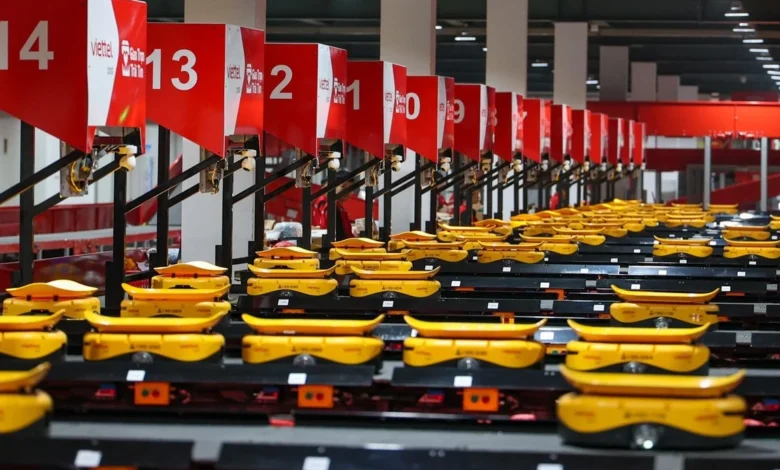
On January 17, at the Quang Minh Industrial Park in Hanoi, the Viettel Post Joint Stock Corporation officially inaugurated and operationalized Vietnam’s first and largest smart technology sorting hub. This landmark event marks a pivotal milestone in the military-backed telecommunications giant’s broader strategy to construct a comprehensive, technology-driven national logistics infrastructure.
The launch of this advanced facility not only underscores Viettel’s strategic commitment to pioneering logistics technology in Vietnam but also aligns with national economic objectives to elevate the logistics sector’s contribution to the country’s Gross Domestic Product (GDP). As Vietnam continues to position itself as a critical manufacturing and trade nexus in Southeast Asia, the modernization of its physical supply chains has become an urgent economic imperative.
Strategic Vision and National Infrastructure Development
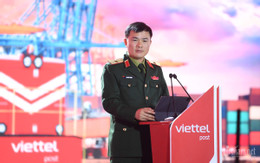
Speaking at the inauguration ceremony, Mr. Tào Đức Thắng, Chairman and General Director of the Viettel Group, emphasized that the deployment of the smart sorting hub represents the foundational step in establishing a nationwide intelligent logistics ecosystem.
For decades, Viettel has successfully built and operated two critical national infrastructures of unprecedented scale in Vietnam: a robust telecommunications network and a widespread digital platform. With the rollout of this new logistics hub, the group is now actively constructing the country’s third major national infrastructure—the logistics backbone.
"If telecommunications infrastructure is considered the lifeblood of the flow of information within the economy, and digital infrastructure serves as the infrastructure of infrastructure, then logistics infrastructure is the lifeblood of the physical flow," Mr. Thắng stated. He added that logistics plays an indispensable role in connecting, supporting, and propelling socio-economic development.
This monumental mission has been entrusted to Viettel Post, an enterprise that has consistently led the charge throughout the 35-year history of the Viettel Group. Group leadership has mandated that Viettel Post treat logistics as a core strategic growth pillar, spearheading technological mastery to build a national-scale smart logistics network with the ultimate capability to export its technological solutions globally.
Cutting-Edge Technology and Operational Efficiency
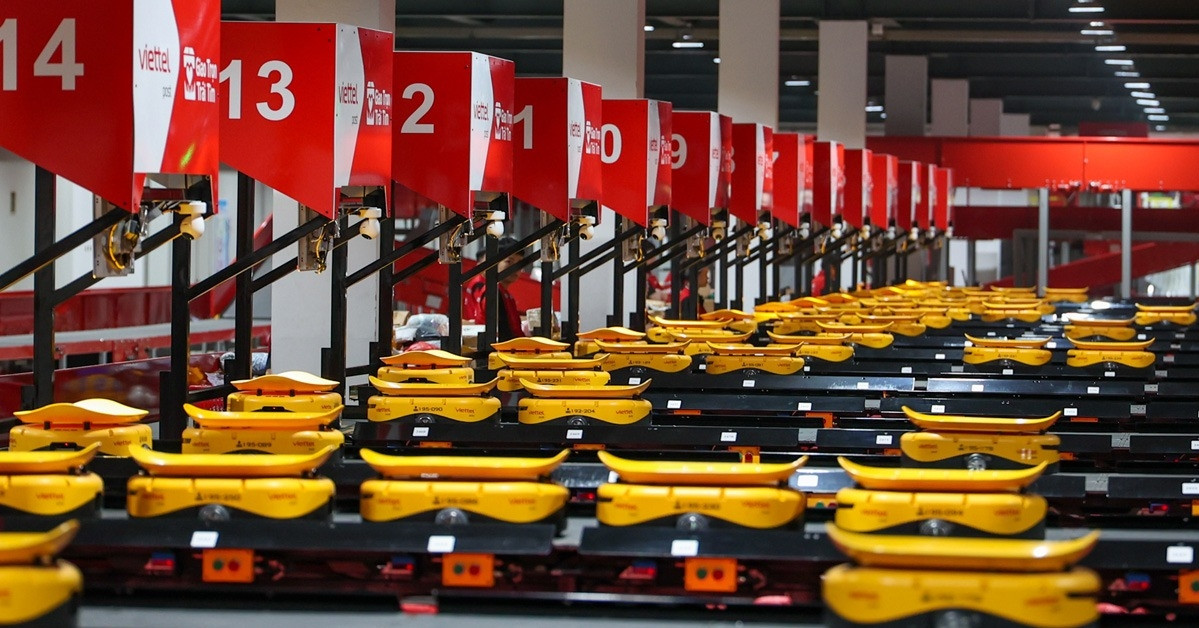
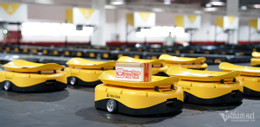
The newly unveiled smart sorting hub at Quang Minh Industrial Park represents a pinnacle of automation within Vietnam’s logistics sector. The facility integrates state-of-the-art technologies, including Automated Guided Vehicles (AGV) for sorting, large-scale parcel sorting systems, and advanced belt-sorting mechanisms.
Designed for high-throughput operations, the facility features nearly 40 import/export docks and approximately 1,200 sorting chutes. It boasts a processing capacity of 1.4 million parcels per day, representing a staggering 40% increase over previous domestic benchmarks. This addition elevates Viettel Post’s total system processing capacity to 4 million parcels daily—effectively capable of meeting 50% of Vietnam’s entire e-commerce delivery demand.
Furthermore, the technological integration has driven the error rate down to near-zero, significantly slashed total transit times by 8 to 10 hours, and multiplied throughput efficiency by 3.5 times. Thanks to deep automation, the hub achieves a 60% reduction in labor costs, mitigating the industry-wide challenges of labor shortages and rising operational expenses.
Advanced Monitoring and Digital Twin Integration
Behind the physical sorting operations lies a sophisticated command and control system. The hub is managed via a Network Operations Center (NOC) that tracks the journey of every single package in real-time.
To achieve this level of oversight, Viettel Post has deployed advanced monitoring technologies, including Digital Twin simulations and Artificial Intelligence (AI)-powered cameras. These systems continuously monitor the operational status of all equipment and cargo handling activities, automatically detecting and alerting operators to anomalies or disruptions. This allows management to resolve emerging bottlenecks immediately, ensuring seamless continuity of service.
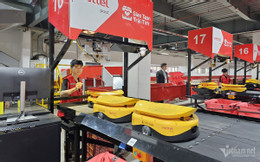
A remarkable aspect of this technological deployment is its origin. The entire logistics ecosystem—spanning warehouse management software, customer-facing applications, transport monitoring solutions, belt-tracking systems, and smart locks—was researched and developed entirely by a team of 100% Vietnamese engineers and experts. The core infrastructure was completed in just over six months, a timeline that contrasts sharply with global industry standards, where comparable facilities typically require approximately two years of deployment before commercial launch.
Expanding Beyond Parcel Delivery: A Comprehensive Supply Chain Strategy
During the inauguration, Viettel Post Chief Executive Officer Hoàng Trung Thành outlined the corporation’s ambitious trajectory. He asserted that Viettel Post is moving far beyond traditional courier services, laying the groundwork to successfully build out critical adjacent sectors within the supply chain. These include integrated supply chain solutions, logistics parks, smart border gates, cross-border logistics infrastructure, and intermodal rail freight systems.
Mr. Thành emphasized that the long-term vision involves connecting industrial parks and agricultural production zones directly with major multi-modal transportation hubs—including highways, railways, seaports, airports, and international border gates.
"Building a smart national logistics infrastructure is an inescapable necessity and a mission that Viettel Post has set for itself," Mr. Thành noted. "To fulfill this mission, Viettel Post must continuously apply, develop, and master advanced technology."
Broader Economic Implications
The operationalization of Viettel’s smart logistics hub arrives at a crucial juncture for Vietnam’s economy. The Vietnamese government has set a target for the logistics sector to contribute 5% to 6% of the national GDP by 2025. Achieving this goal requires dismantling traditional bottlenecks characterized by high logistics costs, which have historically dampened the global competitiveness of Vietnamese enterprises.
High logistics costs—frequently estimated to account for a significant portion of product prices in Vietnam—stem largely from fragmented infrastructure, manual handling inefficiencies, and inadequate technology integration. By introducing high-capacity, automated hubs that slash processing times and reduce labor overhead by more than half, enterprises like Viettel are setting a new benchmark for operational excellence.
Moreover, as Vietnam solidifies its position as a preferred destination for global supply chain diversification and "China+1" manufacturing strategies, the demand for sophisticated, reliable domestic logistics is skyrocketing. The ability of domestic firms to provide seamless, tech-enabled warehousing, sorting, and cross-border transport is vital for retaining foreign investment and supporting domestic small and medium-sized enterprises (SMEs).
By proving that Vietnamese engineers can independently design and deploy world-class logistics technology in record time, Viettel Post is not only transforming its own operational capacity but is also laying the technological foundation for Vietnam to evolve into a regional and global logistics powerhouse.