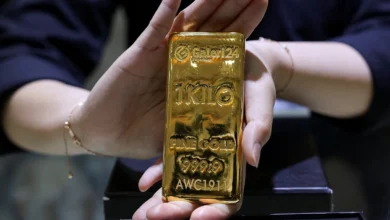
Domestic Gold and Silver Prices Plummet Sharply Amid Global Sell-Off and Rising US Federal Reserve Rate Hike Expectations


The domestic precious metals market experienced a severe downturn during the afternoon trading session on September 28, with both gold and silver recording substantial losses. This steep decline pushed local gold prices down to their lowest levels in approximately two months, triggered primarily by a sharp correction in global commodity markets and mounting macroeconomic pressures from the United States.
Major domestic trading desks, including Saigon Jewelry Company (SJC), DOJI, Bao Tin Minh Chau, and Phu Quy, simultaneously adjusted their pricing downward multiple times throughout the day. Market observers noted that the relentless selling pressure reflected a broader shift in investor sentiment as international markets reacted to shifting monetary policy expectations and strengthening yields across traditional safe-haven alternatives.
Sharp Contraction Across Domestic Gold and Silver Counterparts
As trading commenced on the afternoon of September 28, SJC slashed the price of its flagship gold bars by 1 million VND per tael, following earlier downward revisions earlier in the day. By late afternoon, the cumulative daily reduction reached 2 million VND per tael, bringing the buying price down to 139.4 million VND and the selling price to 142.4 million VND.
Concurrently, other leading gold businesses—such as DOJI, Bao Tin Minh Chau, and Phu Quy—aligned their SJC gold bar quotes with the market leader, purchasing at 139.4 million VND per tael and offloading at 142.4 million VND per tael.
The downward spiral extended to 9999 pure gold rings, which underwent continuous adjustments throughout the session. Total daily losses for gold rings ranged between 1.5 million VND and 2 million VND per tael. Specifically, Bao Tin Minh Chau listed its rings at 139.7 million VND for buyers and 143.7 million VND for sellers, while DOJI and Phu Quy matched the SJC bar benchmarks at 139.4 million VND and 142.4 million VND, respectively.
Silver was not spared from the downward momentum. Domestic silver prices tumbled by roughly 3.4% over the course of the session. Sacombank-SBJ lowered its rates by 1.2 million VND per contract, bringing buying quotes to 57 million VND and selling quotes to 58.96 million VND. Similarly, Phu Quy adjusted its silver prices downward by about 2 million VND per kilogram, with transactions settling at 57.06 million VND for purchases and 58.86 million VND for sales.
Global Market Drivers and Macroeconomic Pressures
While the domestic correction was swift, the pace of the decline in the local market lagged behind international benchmarks. On global exchanges, spot gold dropped precipitously by 70 USD per ounce during the session, culminating in a total daily loss of 128 USD per ounce—equivalent to a 3% decrease—to settle at 4,158 USD per ounce.

The international sell-off was fueled by a confluence of hawkish signals from the U.S. Federal Reserve. With Treasury yields hovering near multi-month highs and rising energy prices stoking renewed inflation fears, market participants increasingly priced in a more restrictive monetary policy path. Current market probabilities suggest a 68% to 70% likelihood that the Federal Reserve will implement another 25-basis-point interest rate hike during its upcoming policy meeting in October.
As a non-yielding asset, gold faces diminished attractiveness in an environment characterized by elevated interest rates and strong fixed-income yields. The rising opportunity cost of holding bullion has prompted institutional investors and large-scale traders to reallocate capital into yield-bearing instruments, triggering widespread long liquidation across global precious metals desks.
Silver experienced an even more aggressive correction on the global stage, plunging 5% or 3.2 USD per ounce within a single session to close at 60.97 USD per ounce. Because silver functions dually as a precious and an industrial metal, the downward adjustment reflected both macroeconomic monetary tightening concerns and broader uncertainties surrounding global manufacturing demand.
Industry Reactions and Market Sentiment
Market analysts and retail participants have expressed heightened caution following the abrupt price movements. Representatives from major domestic gold institutions noted that trading volume shifted noticeably toward profit-taking and defensive positioning. Investors who had accumulated gold during previous rallies opted to liquidate portions of their holdings to lock in gains, fearing extended consolidation periods should international monetary conditions tighten further.
Despite the recent corrections, domestic gold prices have historically maintained a positive variance compared to international parity due to structural supply constraints within the local market. However, industry insiders caution that domestic prices cannot entirely decouple from global trends over an extended horizon. The narrowing gap highlights the sensitivity of local traders to sudden shifts in overseas spot prices.
Economic Implications and Outlook
The sharp recalibration of precious metals prices underscores the vulnerability of commodities to shifts in central bank rhetoric. For retail investors in Vietnam, the drop to a two-month low presents a crucial juncture for portfolio reassessment.
Financial experts emphasize that while gold remains an effective long-term hedge against systemic volatility and currency depreciation, short-term price trajectories will heavily depend on incoming macroeconomic data from the United States. Key indicators—including upcoming employment reports, consumer price index (CPI) prints, and official statements from Federal Reserve officials—will serve as vital barometers determining whether the current correction is a temporary consolidation or the beginning of a broader downward trend.
As the market digests the September 28 price adjustments, participants are advised to monitor both global currency movements and domestic supply-demand dynamics closely. With volatility expected to persist in the near term, market prudence and diversified asset allocation remain paramount for navigating the evolving economic landscape.