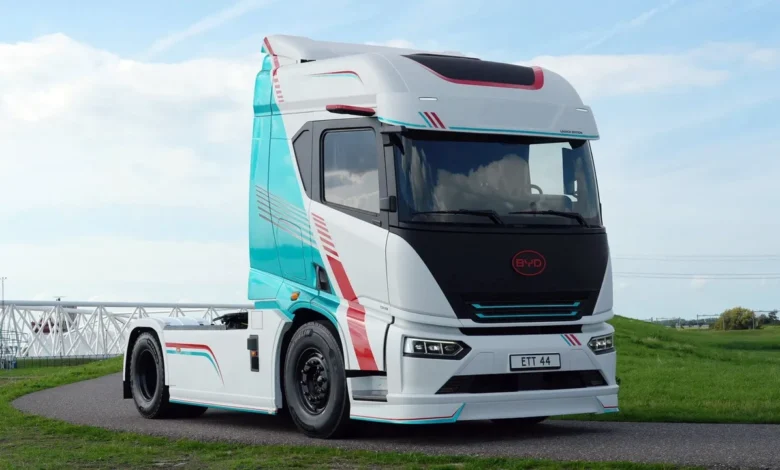
The global automotive landscape is experiencing a seismic shift toward sustainable heavy-duty transportation, and Chinese manufacturing giant BYD has firmly planted its flag in the heart of Europe’s commercial vehicle sector. At the prestigious IAA Transportation 2026 exhibition held in Hannover, Germany, BYD made a resounding statement by officially unveiling its flagship heavy-duty commercial electric tractor, the ETT 44. Designed explicitly to conquer the grueling demands of long-haul logistics across European roadways, this all-electric behemoth combines raw power, immense battery capacity, and cutting-edge ultra-fast charging capabilities. In doing so, the ETT 44 not only establishes a new benchmark for commercial electrification but also poses a formidable, direct challenge to established rivals, most notably the Tesla Semi.
Unveiling the ETT 44 at IAA Transportation 2026
The grand debut at Hannover served as the ideal stage for BYD to showcase its growing technological prowess in the commercial vehicle segment. The IAA Transportation exhibition, widely recognized as the premier global platform for logistics, commercial vehicles, and transport sectors, witnessed unprecedented interest surrounding the BYD pavilion. While BYD has previously established a solid footing in Europe with medium-duty trucks like the ETH 20, ETH 28, and ETH 8, the introduction of the ETT 44 marks the company’s decisive entry into the heavy-duty tractor-trailer market—a domain historically dominated by legacy diesel manufacturers and increasingly targeted by American and European electric startups.
The ETT 44 adopts a traditional cab-over (cab-over-engine) architecture tailored for European regulatory standards, balancing maximum cargo capacity with driver comfort. The vehicle unveiled in Hannover immediately stood out due to its meticulous aerodynamic refinements. Engineers incorporated advanced aerodynamic treatments across the front bumper, wheel housings, above the windshield, and along the roofline. These elements work in tandem with a custom-designed active cooling grille and unique exterior branding to significantly reduce drag, thereby optimizing energy efficiency during high-speed highway cruising—a critical factor for fleet operators striving to minimize operational costs.
State-of-the-Art Cabin and Ergonomics
Inside the spacious cab, the ETT 44 bridges the gap between utilitarian workspace and modern digital cockpit. The driver is greeted by a high-definition digital instrument cluster, a prominent 12.8-inch central infotainment touchscreen, and large auxiliary displays dedicated to the advanced digital camera-monitoring system that completely replaces traditional exterior mirrors. Despite the heavy integration of touch-based and digital controls, BYD has retained a thoughtful selection of tactile physical buttons, a passenger car-inspired gear selector, numerous cup holders, dedicated storage compartments, and an integrated radio system.
Driver welfare is further prioritized through a comfortable sleeper berth positioned directly behind the seats, ensuring that long-haul operators can rest adequately during mandatory breaks. Furthermore, the vehicle utilizes a sophisticated pneumatic air suspension system that absorbs severe road imperfections, drastically reducing fatigue over extended journeys. Integrated into the driving experience is a comprehensive suite of advanced driver-assistance systems (ADAS), aligning the heavy truck with stringent European safety regulations and offering features such as adaptive cruise control, lane-keeping assist, and autonomous emergency braking.
Unrivaled Technical Specifications and Performance
When examining the raw data, the BYD ETT 44 establishes a commanding lead over the European-spec Tesla Semi variant that has recently entered preliminary operational trials. The 4×2 axle configuration of the ETT 44 houses a powerhouse electric motor delivering an astounding 1,006 horsepower. This immense output ensures that the heavy tractor can effortlessly manage fully loaded transit conditions, even when navigating steep inclines or adverse weather conditions common across European mountain passes and highway networks.
To feed this high-performance powertrain, fleet operators are provided with two distinct battery options utilizing BYD’s proprietary Blade Battery technology with lithium iron phosphate (LFP) chemistry. Customers can choose between a 434 kWh battery pack, which delivers a respectable driving range of approximately 400 kilometers, and a massive 651 kWh pack that pushes the operational range to an impressive 600 kilometers on a single charge.
Charging capabilities represent another area where the ETT 44 outshines its American counterpart. The standard version of the truck supports a maximum charging power of up to 950 kW, while the long-range variant pushes the boundary to an astonishing 1,500 kW (1.5 MW). Thanks to these ultra-high charging thresholds, both battery configurations can rapidly replenish their energy from 20% to 80% in a mere 20 minutes when connected to a compatible Megawatt Charging System (MCS) standard station. By comparison, the European-spec Tesla Semi offers a maximum driving range of 550 kilometers and supports peak charging speeds of up to 800 kW, placing the BYD offering ahead in both raw range capacity and replenishment velocity.
Dimension, Weight, and Load-Hauling Superiority
In terms of physical dimensions, the BYD ETT 44 measures 6,400 mm in length, 2,530 mm in width, and 3,820 mm in height, featuring a wheelbase of 3,800 mm. This footprint makes it directly comparable to prominent European heavy electric trucks such as the Mercedes-Benz eActros 600, MAN eTGX, Scania 45 R Electric, and DAF XF Electric.
The kerb weight of the ETT 44 ranges between 10,950 and 11,140 kilograms, resulting in a gross vehicle weight of roughly 20 tonnes and a maximum legal towing gross combination weight of 44 tonnes in compliance with European Union regulations. Notably, BYD has engineered the actual structural capabilities of the chassis to safely handle total train weights of up to 65 tonnes under specialized off-highway or heavy-haul conditions.
Crucially, even at the maximum legal limit enforced within the EU, the total payload capacity of the ETT 44 remains highly competitive. While the Tesla Semi—benefiting from a lighter kerb weight of approximately 9,100 kg—operates under strict local weight exemptions in the US, European regulations cap standard combined truck-and-trailer weights at 40 tonnes for diesel fleets, though zero-emission heavy trucks are granted an additional 2-tonne allowance, bringing the limit to 42-44 tonnes. BYD’s engineering ensures that fleet operators do not sacrifice payload capacity for battery weight, a common pain point in the early adoption of commercial electric vehicles.
Industry Implications and Future Outlook
The entry of the BYD ETT 44 into the European market carries profound implications for the logistics and automotive industries. For decades, European heavy transport has been dominated by domestic manufacturing stalwarts such as Daimler Truck, Volvo Group, and the Traton Group (MAN and Scania). However, the rapid acceleration of electrification has created an opening for agile competitors capable of leveraging advanced battery manufacturing ecosystems and economies of scale.
Industry analysts note that BYD’s aggressive push into commercial vehicles reflects a broader strategic pivot. Having conquered the passenger car and public transit bus segments globally, the Chinese automaker views heavy-duty freight transport as the final frontier for total market electrification. By offering a vehicle that exceeds the specifications of the Tesla Semi—particularly in terms of motor output, battery capacity, and megawatt-level charging speeds—BYD is signaling to European fleet operators that Chinese electric technology is not merely a low-cost alternative, but a premium, high-performance solution.
Although BYD has yet to announce official commercial pricing for the ETT 44, industry insiders anticipate that order books will formally open in the coming months, with initial deliveries expected to hit European roads before the end of the year. To instill absolute confidence among risk-averse logistics enterprises, the company has already confirmed a robust standard warranty policy of 10 years or 1.2 million kilometers for the LFP Blade Battery pack—a reassuring guarantee that addresses long-term asset depreciation and operational reliability concerns.
As European nations steadily tighten carbon emission standards, phase out diesel subsidies, and mandate the expansion of high-capacity charging infrastructure along trans-European transport corridors (TEN-T), heavy electric trucks like the BYD ETT 44 will transition from novelty exhibits to essential workhorses. The battle for the future of sustainable logistics is officially underway, and with the unveiling of the ETT 44, BYD has firmly established itself as a dominant contender capable of reshaping global heavy transport.