Shin Godzilla and the Reinvention of Classic Cinema Franchises Through Bold Creative Visions

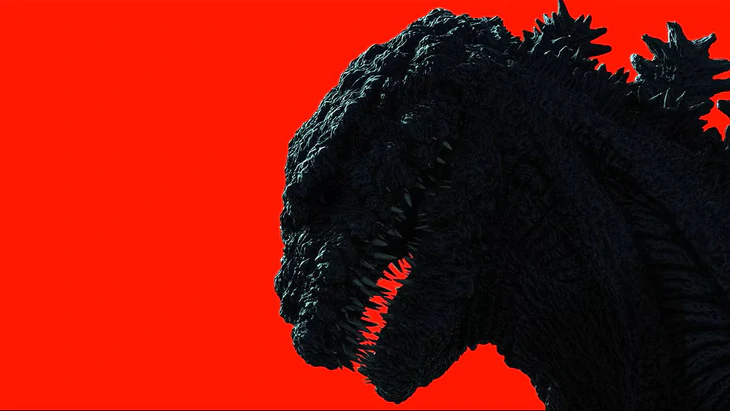
For over seventy years, the towering, radioactive reptile known as Godzilla has stood as one of the most enduring and recognizable pop culture icons in cinematic history. Originating in post-war Japan as a terrifying embodiment of nuclear devastation, the character has undergone numerous transformations across decades of filmmaking. From its initial iteration as a tragic metaphor for the bombings of Hiroshima and Nagasaki to later evolutions as a defender of Earth, a symbol of environmental degradation, and eventually a protagonist in pure entertainment blockbusters, Godzilla has constantly adapted to reflect the changing anxieties of society. However, amid an era dominated by cinematic landscapes increasingly reliant on familiar, nostalgic intellectual property and formulas, Toho’s 2016 masterpiece Shin Godzilla proved that resurrecting a beloved legacy franchise does not require leaning on tired formulas or lazy fan service. Under the visionary direction of Hideaki Anno and co-director Shinji Higuchi, the legendary monster was completely reimagined not as a misunderstood protector or a standard cinematic monster, but as a relentless force of nature, a biological nightmare, and an unyielding manifestation of human helplessness in the face of overwhelming catastrophe.
The Genesis of a Cultural Phenomenon and Historical Evolution
To truly understand the groundbreaking nature of Shin Godzilla, one must examine the historical context from which the original 1954 classic emerged. Directed by Ishiro Honda, the inaugural Godzilla film was a direct response to the collective trauma of World War II and the harrowing hydrogen bomb tests at Bikini Atoll, which exposed a Japanese fishing boat and poisoned its crew. The creature served as a walking, breathing monument to atomic annihilation, capturing the visceral dread of a nation that had experienced the horrors of nuclear warfare firsthand. As decades passed, however, the franchise inevitably evolved. During the Showa era, Godzilla shifted from a terrifying menace into a defender of justice fighting off bizarre extraterrestrial and terrestrial threats, catering largely to family audiences. The subsequent Heisei and Millennium eras offered darker tones and continuity reboots, yet the formula eventually drifted toward epic monster brawls—spectacles that prioritized action and special effects over deep socio-political commentary. By the time Hollywood acquired the rights to produce American adaptations, Godzilla had become firmly entrenched in the global blockbuster ecosystem, functioning primarily as a cinematic titan colliding with other legendary beasts like King Ghidorah and Kong.
Yet, when Toho decided to reclaim its flagship character for Japanese audiences in the mid-2010s, the studio sought a different path. Rather than attempting to replicate the Hollywood style or lean purely into comforting nostalgia, producers handed the reins to Hideaki Anno, the creative mastermind behind the legendary anime franchise Neon Genesis Evangelion. Anno recognized that simply rehashing the past would dilute the raw, unsettling power that made the original 1954 film so potent. Instead, he chose to strip away the creature’s anthropomorphic qualities and repurpose the narrative to address a entirely different kind of national trauma: the devastating Tōhoku earthquake, tsunami, and subsequent Fukushima Daiichi nuclear disaster of March 2011.
Mirroring the Fukushima Catastrophe and Bureaucratic Paralysis
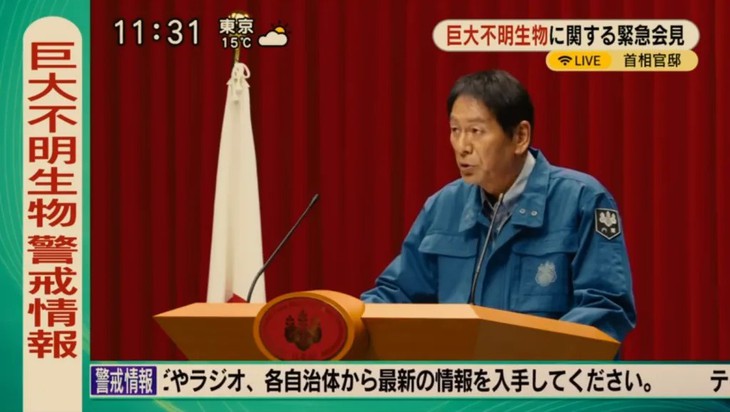
Shin Godzilla opens not with a monstrous roar echoing across a ruined city, but with the sudden, inexplicable discovery of a massive, anomalous aquatic disturbance in Tokyo Bay. The Japanese government is immediately thrust into crisis mode, scrambling to convene urgent meetings to identify the nature of the threat and formulate an appropriate response. Central characters such as Rando Yaguchi, a pragmatic Deputy Chief Cabinet Secretary played by Hiroki Hasegawa, and policy strategist Yusuke Shimura, portrayed by Kengo Kora, work alongside Prime Minister Seiji Ookouchi, played by Ren Osugi, to manage the escalating emergency. However, as they attempt to confront the mutating creature, the narrative exposes the paralyzing inefficiencies, endless red tape, and rigid bureaucratic protocols of modern governance.
The situation grows exponentially more critical as international pressure mounts, particularly from the United States, which prepares to deploy a devastating tactical nuclear strike on Japanese soil to obliterate the beast before it can spread further devastation. Japan is left with a perilously narrow window of time to devise an independent solution before facing a secondary catastrophe of unimaginable proportions. This narrative framework serves as a scathing, deeply layered satire of institutional inertia. While the original 1954 film channeled the immediate aftermath of atomic warfare, Shin Godzilla acts as an unsparing cinematic critique of the Japanese government’s handling of the 2011 Fukushima nuclear disaster. Director Hideaki Anno chose not to directly visualize crashing waves or crumbling fault lines; instead, he utilized Godzilla as an allegorical representation of sudden, unprecedented crises that overwhelm human technological and administrative systems despite the best efforts of modern management and bureaucracy.
A Terrifying Evolution: Redefining the Monster
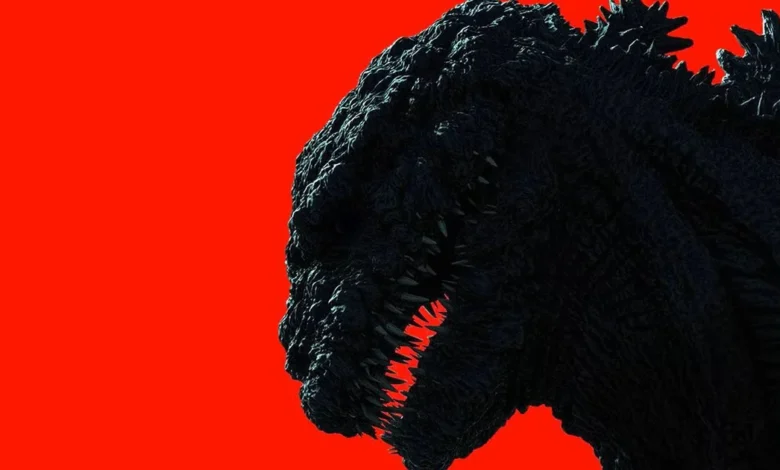
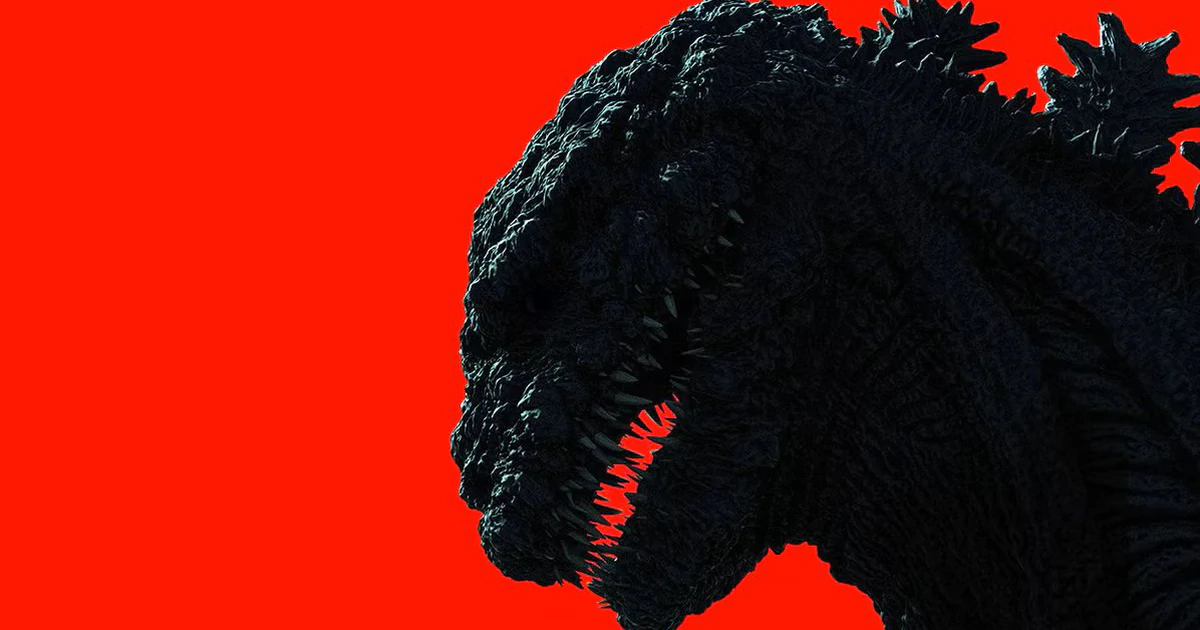
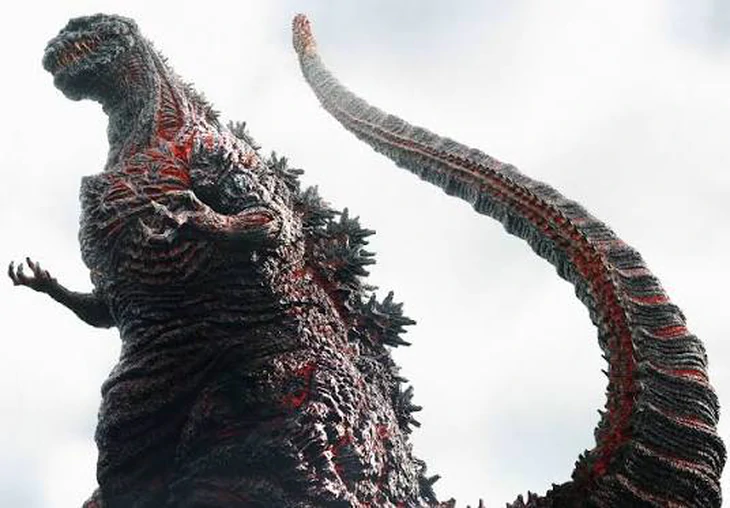
One of the most striking departures in Shin Godzilla lies in the creature’s radical character design and evolutionary progression. Abandoning the static, bipedal lizard-like silhouette that fans had known for decades, Anno’s Godzilla undergoes a disturbing series of biological mutations throughout the film’s runtime. The creature begins its rampage as a bizarre, bulging-eyed, gill-slit-dripping tadpole-like aquatic entity that drags itself clumsily onto land, leaving a trail of radioactive fluids in its wake. As it absorbs energy and adapts to human aggression, it rapidly evolves into a towering, jagged-spined terror whose appearance evokes the cosmic horror masterpieces of author H.P. Lovecraft.
The visual design of Shin Godzilla is deliberately unsettling. Its glowing purple-red dorsal plates resemble cooling volcanic magma and fresh radiation burns, while its unnaturally rigid posture, unblinking dead eyes, and a lower jaw that splits apart unnervingly to unleash destruction create an aura of profound alienation. The cinematography further amplifies this pervasive sense of unease. Eschewing traditional cinematic polish, the film employs frantic hand-held camera angles, mock-broadcast news footage, and dizzying high-altitude surveillance shots that make the viewing experience feel chillingly like witnessing a real-time documentary of an ongoing apocalypse.
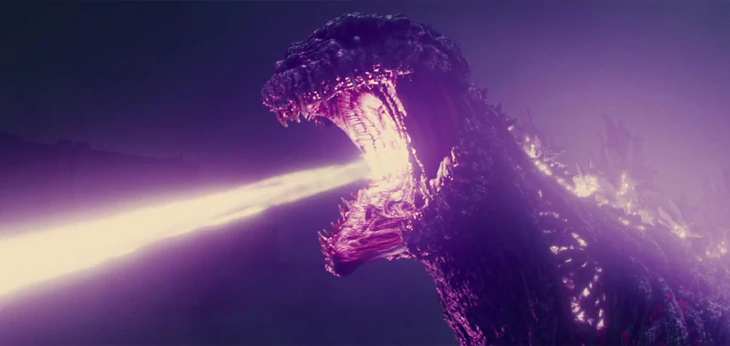
This nightmarish atmosphere reaches its devastating climax during the sequence where Godzilla lays waste to Tokyo using its newly developed atomic breath. Unlike previous cinematic depictions where the radioactive ray is fired as a straightforward beam, Shin Godzilla’s attack begins as a thick, volatile stream of dark smoke that ignites city streets into a sprawling sea of fire. The creature then concentrates its radioactive energy into razor-thin, violet-hued laser beams that slice effortlessly through flying fighter jets and skyscrapers with terrifying precision. Coupled with composer Shiro Sagisu’s haunting, operatic score, the devastation of Tokyo is portrayed not merely as a thrilling action set piece, but as a horrifying, deeply melancholic tragedy that underscores the ultimate cost of human hubris.
Deconstructing the Etymology of a Legend
The Japanese title of the film, Shin Godzilla, carries multiple profound interpretations that align seamlessly with Anno’s artistic vision. Depending on the kanji used, the prefix "Shin" can translate to "new," "true," or "god." All three definitions encapsulate the essence of the creature depicted in the film. It is a completely fresh iteration of the franchise that breaks away from decades of repetition; it is a truer, unvarnished reflection of the terrifying reality of natural and man-made disasters; and it possesses an indifferent, god-like destructive majesty before which humanity is rendered entirely powerless.
The monumental success of Shin Godzilla demonstrated that reviving a legacy intellectual property does not require pandering to audience expectations through nostalgic callbacks or recycled plot points. By anchoring the narrative in contemporary anxieties and viewing the mythos through an uncompromisingly original artistic lens, the filmmakers breathed vital new life into a character that had existed for over half a century.
Broader Implications for Modern Cinema
The cinematic triumph of Shin Godzilla offers a vital lesson that the modern film industry would do well to contemplate. In an era where major studios increasingly prioritize familiar brands with built-in audiences—relying heavily on predictable sequels, cinematic universes, and safe reboots as surefire mechanisms for financial return—this Japanese production proved that commercial and critical success can be achieved by taking bold creative risks.
When studios choose to revisit intellectual properties that have spanned generations, they carry the responsibility of providing compelling, substantive reasons for audiences to re-engage with them. Shin Godzilla did not succeed because it offered comforting familiarity; it triumphed because it challenged viewers, subverted expectations, and used a pop culture icon to hold up an unflinching mirror to contemporary society. As the global entertainment landscape continues to navigate franchise fatigue, the legacy of Shin Godzilla stands as an inspiring testament to the power of visionary direction, proving that even the most venerable cinematic monsters can be successfully resurrected when creators are given the freedom to reinvent them from the ground up.