Police in Ho Chi Minh City dismantle criminal network led by Nguyen Tuan Hiep known as Hiep Den involving fake underworld videos and usury operations


Law enforcement agencies in Ho Chi Minh City have officially dismantled a sophisticated criminal syndicate operating across both physical and digital domains, arresting Nguyen Tuan Hiep—widely recognized by his underworld moniker "Hiep Den" (Black Hiep)—alongside 13 of his close associates. The multi-faceted operation, spearheaded by the Ho Chi Minh City Police Department’s Criminal Police Division under the command of Colonel Nguyen Tien Dat, has shed light on a disturbing trend where modern cyber capabilities intersect with traditional organized crime models.
According to official investigative findings, the syndicate capitalized on social media platforms to project an exaggerated image of power, intimidation, and territorial dominance. While the online presence of "Hiep Den" and his followers was meticulously crafted to mimic classic cinematic portrayals of criminal bosses, the operational reality behind the screens involved severe violations of Vietnamese law, ranging from high-yield illegal lending and unauthorized data dissemination to the illegal possession of military-grade weaponry.
The swift intervention by the Ho Chi Minh City police highlights a broader, ongoing campaign by Vietnamese authorities to eradicate underground financial networks and curb the glorification of lawlessness and violence across digital platforms.

Multi-Pronged Criminal Charges and Legal Framework
The scale of the criminal enterprise necessitated a complex array of legal charges against the primary suspect and his accomplices. Nguyen Tuan Hiep has been formally prosecuted and detained on three distinct criminal counts: unlawfully disseminating information over computer and telecommunications networks; engaging in usury under civil transactions; and the illegal possession of military-grade weapons.
The simultaneous prosecution of 13 associated individuals underscores the systematic organization of the group. Investigators noted that the network operated with distinct functional divisions. While a core group managed the financial inflows and collection mechanisms of the illegal lending business, others were tasked with content creation, video editing, social media management, and the physical staging of confrontational scenarios designed to amplify the syndicate’s public profile.
Legal experts point out that the charges faced by Hiep and his associates carry substantial penal consequences under the Vietnamese Penal Code. Usury in civil transactions, particularly when operating on an organized scale with significant illicit profits, is subject to severe imprisonment terms. Furthermore, the inclusion of charges related to the unlawful distribution of network information reflects the increasing legislative and judicial scrutiny applied to digital activities that threaten public order and social stability.
Chronology of an Underworld Persona: From Obscurity to Infamy
The trajectory of Nguyen Tuan Hiep’s digital notoriety began years prior to his eventual apprehension. Investigative records reveal that starting around 2017, Hiep established a personal Facebook account primarily utilized to upload mundane lifestyle content, including social gatherings, dining experiences, and casual interactions, aimed at garnering initial digital attention.

However, driven by a desire for rapid online fame and societal influence, Hiep and his associates devised a strategy to manufacture a menacing persona. Between 2017 and 2024, the group conceptualized, directed, and produced a series of short films and narrative clips depicting the lives of fictitious underworld figures. These productions were systematically distributed across major digital ecosystems, including YouTube, Facebook, and TikTok.
The narratives featured in these videos consistently revolved around intense conflicts, physical altercations, and the use of improvised weapons and firearms to settle disputes. Through these dramatized portrayals, Hiep cultivated the persona of a supreme underworld leader, acquiring the alias "A2." Over time, the boundary between cinematic fiction and actual criminal behavior began to blur, as the online clout generated by these videos was directly leveraged to facilitate real-world illicit operations, particularly predatory lending schemes.
Unmasking the Reality: Usury and Intimidation Tactics
Beneath the veneer of internet celebrity and cinematic bravado lay a predatory financial operation. The Criminal Police Division uncovered evidence establishing that Nguyen Tuan Hiep, working in tandem with key associates such as Nguyen Son Lam and Nguyen Trung Nghia, operated an extensive, underground credit network targeting vulnerable members of the public.
The syndicate specialized in extending short-term loans characterized by exorbitant, predatory interest rates. Investigators confirmed that the interest charged by the group frequently started at a staggering 10 percent per month, compounding to an annual rate of approximately 120 percent or higher. This practice, colloquially referred to in local financial crimes terminology as "cutting flesh," trapped borrowers in cycles of unmanageable debt.

To enforce collection and maintain compliance among debtors, the syndicate relied on the psychological intimidation generated by their online reputation, alongside direct threats and physical harassment. The fusion of digital notoriety with violent debt-recovery tactics created a coercive environment that prevented many victims from initially seeking assistance from law enforcement authorities.
Police Raids and Seizure of Military-Grade Weapons
The decisive phase of the operation unfolded following months of intelligence gathering and digital footprint analysis by the Ho Chi Minh City Police Department. Armed with search warrants authorized by the judicial system, tactical police units executed simultaneous raids across several locations linked to the syndicate.
A critical breakthrough occurred during the search of Hiep’s temporary accommodation located at the Hong Hanh Hotel in Hiep Phu commune, Ho Chi Minh City. During a meticulous sweep of the premises, law enforcement officers discovered a concealed safe positioned above the ceiling of the sleeping quarters. Upon opening the safe, authorities recovered a military-grade weapon—specifically, a K54 handgun accompanied by live ammunition.
Subsequent ballistic testing and forensic evaluations conducted by specialized arms experts confirmed the weapon’s classification as military-grade ordnance. The presence of a firearm within the suspect’s immediate living quarters elevated the threat assessment of the operation, confirming that the syndicate’s reliance on intimidation extended beyond social media bravado to the actual possession of lethal firepower.
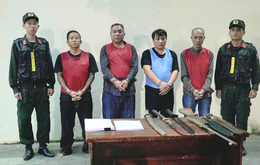
In addition to the firearm, police seized extensive digital evidence, financial ledgers, mobile devices utilized for unauthorized data dissemination, and physical assets tied to the proceeds of the usury operation.
Statements from Authorities and Post-Arrest Remorse
Following his capture and subsequent interrogation by senior police officials, including Colonel Nguyen Tien Dat, Nguyen Tuan Hiep exhibited a notable shift in demeanor compared to the defiant persona projected in his online videos. During initial questioning by the Criminal Police Division, Hiep confessed fully to the charges brought against him and provided detailed accounts regarding the roles played by his various subordinates and associates.
Addressing investigators, Hiep offered a frank admission regarding the theatrical nature of his online identity. He explicitly acknowledged that the prominent gold chains and ostentatious jewelry worn across his social media channels were artificial props utilized exclusively to construct a convincing criminal aesthetic for cinematic purposes.
In a poignant segment of his recorded statements, Hiep expressed profound remorse for his actions and offered a direct warning to others who might be tempted to follow a similar path.

"I deeply regret my actions and the consequences they have brought," Hiep stated during the police interrogation. "When I eventually complete my sentence, I plan to return to a quiet life of farming and tree planting, striving to become an honest, contributing member of society. I strongly urge individuals who have not yet been caught by law enforcement not to engage in the kind of anti-social activities and digital gangsterism that I pursued."
Broader Socio-Economic Implications and Public Safety Impact
The dismantling of the "Hiep Den" syndicate serves as a critical case study regarding the evolving nature of public security challenges in urban centers undergoing rapid digital transformation. The case illustrates how contemporary organized crime utilizes social media platforms not merely as communication tools, but as primary vectors for brand building, intimidation, and the recruitment of impressionable youth into criminal subcultures.
The commercialization of violence through short-form video platforms has become a growing concern for regulatory bodies and law enforcement agencies globally. In recent years, Vietnamese authorities have intensified monitoring efforts to identify content creators who glorify gang culture, vigilantism, or illegal acts under the guise of entertainment. The prosecution of Hiep and his 13 associates establishes a robust legal precedent affirming that digital expression crossing into the facilitation of real-world crimes—such as usury and illegal arms possession—will be met with decisive criminal prosecution.
Furthermore, the suppression of this high-yield lending ring provides immediate relief to vulnerable borrowers who fell victim to the syndicate’s predatory financial practices. The Ho Chi Minh City Police Department has announced that the investigation remains active. Authorities are currently expanding their inquiries to identify any remaining financial backers, associates, or auxiliary networks connected to the broader operations of the syndicate. Citizens who may have been victimized by the group’s lending activities have been encouraged to come forward to assist ongoing judicial proceedings.