Gold prices retreat as US October jobs report exceeds expectations fueling rate hike speculation

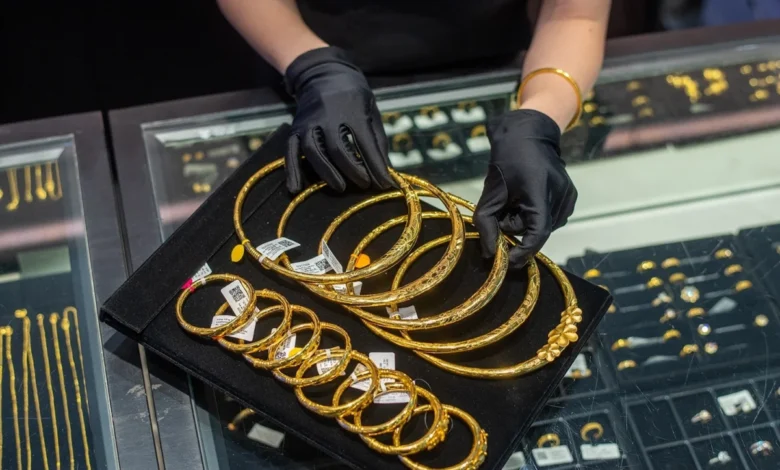
Gold prices have experienced a notable decline on the global market following the release of robust U.S. employment data for October, which significantly outperformed analyst forecasts. The unexpected strength of the labor market has recalibrated investor expectations regarding the Federal Reserve’s monetary policy trajectory, specifically heightening the probability of an interest rate hike in December. This shift in sentiment has triggered a cooling effect on precious metals, with domestic markets in Vietnam mirroring this trend as SJC gold bars saw a reduction of 1.5 million VND per tael across both buying and selling sides on November 6.
Market Chronology and Recent Performance
The volatility observed in the gold market over the past 48 hours is a direct response to the U.S. Bureau of Labor Statistics (BLS) report, which indicated that the economy added 165,000 jobs in October. This figure dwarfed the consensus forecast of 65,000, signaling a resilience in the U.S. economy that few analysts had anticipated. Concurrently, the unemployment rate ticked down from 4.2% to 4.1%, and average hourly earnings rose by 0.4% month-on-month, representing a 3.1% increase year-on-year.
As of 21:30 local time on November 6, spot gold was trading at approximately $4,041 per ounce, reflecting a sharp decline of $48. Similarly, December 2026 futures contracts were hovering around the $4,042 mark. In the domestic Vietnamese market, the impact was immediate. As of the morning of November 7, 2026, gold prices for major brands were reported as follows:
| Product (Million VND/tael) | Buy Price (Nov 7) | Sell Price (Nov 7) | Buy Price (Nov 6) | Sell Price (Nov 6) |
|---|---|---|---|---|
| SJC TPHCM | 138.0 | 141.0 | 138.0 | 141.0 |
| BTMH Kim Gia Bao | 136.5 | 140.5 | 136.5 | 140.5 |
| Doji TPHCM | 136.5 | 140.5 | 136.5 | 140.5 |
The Federal Reserve and Interest Rate Dynamics
The positive employment data has forced market participants to rethink the Federal Reserve’s strategy for the remainder of the year. According to market data analyzed by Reuters, the probability of the Fed implementing a 25-basis-point interest rate hike during its December 8-9 meeting has surged to 74.8%.
Higher interest rates are traditionally a headwind for gold, which is a non-yielding asset. When rates rise, the opportunity cost of holding gold increases, as investors can achieve higher returns through interest-bearing assets like U.S. Treasury bonds. The yield on the 2-year U.S. Treasury note rose by approximately 0.06 percentage points to 4.53% following the job report, further strengthening the U.S. Dollar. As the dollar appreciates, gold—which is priced in the greenback—becomes more expensive for international buyers, thereby dampening demand.
Broader Economic Context and Recent Sell-offs
Prior to this week’s employment data, the financial landscape was dominated by a sell-off in technology and Artificial Intelligence (AI) stocks. This rotation of capital initially drove investors toward safe-haven assets, including government bonds and gold, as market volatility spiked. However, the subsequent release of the jobs data served as a pivot point. With the U.S. economy showing unexpected vigor, the urgency for safe-haven assets has diminished, as investors reallocate funds back into higher-risk, higher-reward sectors or capitalize on the rising yields of fixed-income instruments.
Analysts note that the market is currently in a state of high sensitivity regarding inflationary data. The Federal Reserve has maintained a data-dependent approach, and the upcoming releases of the Consumer Price Index (CPI) on November 10 and the Producer Price Index (PPI) on November 13 will be critical. Should these reports continue to show sticky inflation, the Fed may feel empowered to maintain a hawkish stance for longer than previously projected.
Long-Term Outlook and Institutional Forecasts
Despite the current retracement, institutional long-term projections remain bullish for the precious metal. In its October Commodity Markets Outlook, the World Bank forecasted that the average price of gold in 2026 would reach $4,600 per ounce. This represents a significant 33.6% increase over the 2025 average.
The World Bank’s projection is predicated on a variety of structural factors, including central bank gold accumulation, ongoing geopolitical tensions, and the long-term trend of currency debasement. While short-term fluctuations are inevitable due to U.S. monetary policy adjustments, the broader trend suggests that gold continues to function as a hedge against systemic economic instability.
Fact-Based Analysis of Market Implications
The immediate cooling of gold prices serves as a reminder of the inverse relationship between the strength of the U.S. economy and the valuation of precious metals. The "higher for longer" interest rate environment, if solidified by the upcoming CPI and PPI reports, could place continued downward pressure on gold in the final weeks of 2026.
However, domestic investors in Vietnam should remain cognizant of the gap between global spot prices and local retail pricing. While international markets react instantly to macroeconomic news, local prices are also heavily influenced by import supply, central bank regulations, and local demand dynamics. The 1.5 million VND per tael drop on November 6 illustrates that local market sentiment is increasingly synchronized with global shifts, though retail premiums can often fluctuate based on localized liquidity and inventory levels.
Preparing for Volatility
As investors look toward the final quarter of the year, the primary focus will remain on the Federal Reserve’s communication. Any indication from policymakers that the economy is overheating, which might necessitate more aggressive tightening, will likely continue to weigh on gold. Conversely, any cooling in the CPI or PPI data would provide immediate support for a rebound in gold prices.
For those holding gold as a long-term store of value, the current volatility is viewed by many analysts as a necessary correction following a period of rapid appreciation. The fundamental case for gold—as a safeguard against fiscal uncertainty and as a diversification tool—remains intact, even if the timing of its next rally is dictated by the labor market and inflationary signals currently emanating from the United States.
In summary, the gold market is currently navigating a complex intersection of strong labor data and shifting monetary policy expectations. The decline observed this week is a rational market response to an economy that is performing better than anticipated, thereby reducing the immediate need for the protective hedge that gold provides. Moving forward, the interplay between CPI releases and Federal Reserve policy will be the primary drivers of price action, with the institutional outlook remaining fundamentally positive despite the temporary cooling of prices. Investors are advised to monitor the November 10 and November 13 data releases closely, as these will provide the next definitive clue regarding the future trajectory of global interest rates and, by extension, the price of gold.
Related posts: