Unveiling the Engineering Marvels of Ancient Egypt: How Stone and Water Built the Pyramids

The construction of the monumental pyramids of ancient Egypt has captivated historians, archaeologists, and engineers for millennia. Long before modern machinery, towering cranes, and internal combustion engines, ancient Egyptian builders moved millions of massive limestone blocks across vast landscapes to erect tombs that would withstand the test of time. Recent archaeological discoveries, combined with modern experimental archaeology, continue to reshape our understanding of the logistics, manpower, and ingenuity required to complete these architectural wonders. By examining quarrying techniques, fluvial transport networks, sledges, and inclined ramps, researchers are slowly piecing together the sophisticated supply chain that made the Giza plateau possible.
The Scale of Quarrying and Logistics at Khufu
At the heart of pyramid construction lay the immense logistical challenge of sourcing raw materials. The Great Pyramid of Giza, built for the Fourth Dynasty Pharaoh Khufu around 2570 BCE, required millions of stone blocks. Recent structural analyses of the quarry sites near the Great Pyramid provide profound insights into the sheer efficiency of ancient stone-cutting operations.
Experimental archaeology has demonstrated the viability of these ancient methods. Stonecutter Franck Burgos and his team conducted practical experiments demonstrating that a crew of four workers could detach a 2.5-ton limestone block in just four days, working six-hour shifts. Extrapolating these figures suggests that a workforce of approximately 3,500 stonecutters could systematically produce up to 250 blocks daily. This staggering output highlights an organized, highly specialized labor force capable of maintaining a relentless construction schedule.
While local limestone was quarried directly on the Giza plateau, finer white limestone used for the outer casing stones was transported from the quarries of Tura, situated on the eastern bank of the Nile River. Similarly, massive granite blocks utilized for the interior burial chambers were hauled hundreds of miles from Aswan in the far south.
The Maritime Superhighway: Boats and the Lost Branch of the Nile
For decades, scholars debated how ancient Egyptians managed to move heavy loads over long distances before the widespread use of wheeled transport in construction contexts. The discovery of ancient administrative records has revolutionized this field of study.

In 2013, an archaeological team led by Pierre Tallet unearthed the world’s oldest known papyri at Wadi al-Jarf, an ancient harbor located on the Red Sea coast. Among these documents was the remarkable journal of Merer, a middle-ranking official who commanded a crew of roughly 200 elite sailors. Merer’s logbook meticulously details the daily operations of transporting limestone blocks by boat from the Tura quarries to the Giza construction site during the 27th year of Khufu’s reign. These records proved that water transport was the primary backbone of the heavy logistics network.
Complementing these textual sources, a landmark scientific study published in 2024 reconstructed the ancient landscape surrounding the pyramid complex. Researchers successfully mapped an extinct, long-lost branch of the Nile River—subsequently named the Ahramat Branch. Measuring approximately 64 kilometers in length, this waterway flowed directly adjacent to the string of major pyramid fields. The proximity of this navigable branch explains how cargo boats could dock mere meters from the construction sites, significantly minimizing overland transit distances for extremely heavy loads.
Land Transport: Sledges, Lubrication, and Friction Reduction
Once the stone blocks were offloaded from cargo boats, they faced the grueling overland journey to the pyramid base. Historical depictions and physical experiments confirm that heavy materials were transported across land using wooden sledges.
A famous wall painting inside the tomb of Djehutihotep—an official from the Twelfth Dynasty who lived centuries after Khufu—depicts 172 men hauling a colossal statue weighing an estimated 60 tons. Crucially, the illustration shows a worker standing on the front of the sledge, pouring liquid directly onto the sand in front of the runners. Modern physics and subsequent experiments have confirmed the brilliance of this technique: dampening the sand with the optimal amount of water creates capillary bridges between the sand grains, increasing their stiffness and reducing the pulling force required by half.
This principle was further tested in controlled environments, such as the 1992 NOVA documentary experiments, where teams of 12 to 20 workers successfully moved multi-ton stone blocks across wooden tracks using lubricated sledges. Despite these demonstrations, Egyptologists continue to debate the exact mechanics of elevation once the blocks arrived at the monument itself.
The Ongoing Debate Over Ramp Architecture
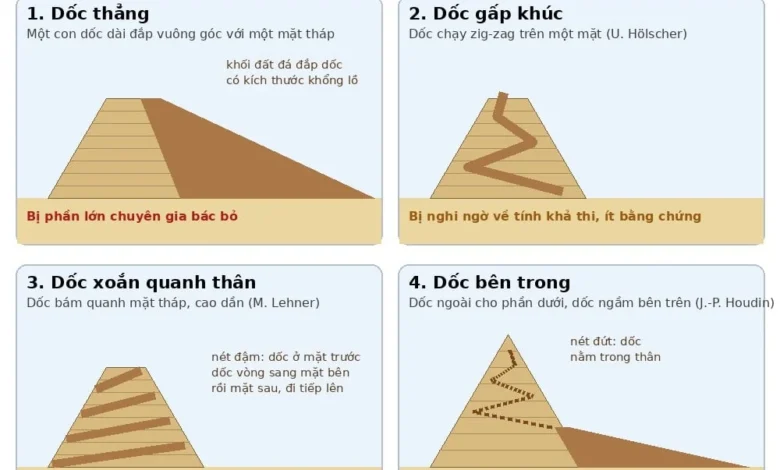
Lifting millions of tons of stone hundreds of feet into the air required ingenious incline systems. While mainstream Egyptologists universally agree that ramps were utilized, the precise architectural design of these ramps remains one of history’s most fiercely debated subjects.

Over the past two centuries, researchers have proposed numerous theoretical models. These include straight ramps, zig-zag ramps, internal spiral ramps, and exterior winding ramps anchored directly to the pyramid core. Each proposed model presents distinct structural advantages and severe engineering drawbacks.
Straight ramps would have required an immense volume of additional material—potentially rivaling the volume of the pyramid itself—and presented monumental stability challenges as they grew higher. Conversely, internal ramps, while mitigating some exterior workspace issues, would have severely restricted the movement of large stone blocks through tight corners and made structural inspection nearly impossible during construction. Because most ramps were dismantled in antiquity, definitive archaeological evidence pointing to a single universal method remains elusive, leaving modern scholars to rely on computer simulations, material stress analyses, and comparative architecture.
Implications and the Legacy of Ancient Engineering
The coordinated effort required to build the pyramids extends far beyond mere physical labor. It represents an unprecedented milestone in centralized state administration, socioeconomic organization, and applied mathematics. Feeding, housing, and organizing tens of thousands of skilled artisans, quarrymen, sailors, and laborers required a sophisticated bureaucratic apparatus capable of resource distribution on a national scale.
Recent findings underscore that the pyramids were not built by enslaved populations, as once popularly believed, but rather by a rotating workforce of conscripted citizens and permanent specialists who viewed their labor as a civic and religious duty to their divine pharaoh. This cooperative social structure ensured ideological unity and operational continuity across decades of construction.
As archaeological technology advances—incorporating ground-penetrating radar, muon radiography, and high-resolution satellite imagery—our appreciation of ancient Egyptian engineering deepens. The pyramids stand not just as monuments to individual rulers, but as timeless testimonies to the collective intellect, logistical mastery, and scientific curiosity of an ancient civilization that unlocked the secrets of moving mountains with stone and water.