Panic on Mountain Pass as Container Truck Collides with Overturned Rig on National Highway 8A

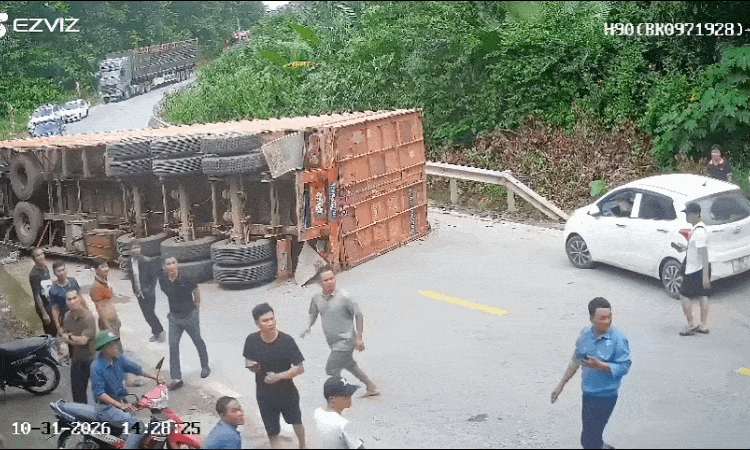
The afternoon tranquility of October 31 along the winding stretches of National Highway 8A in Ha Tinh Province was shattered by a high-stakes traffic collision that instantly turned a routine transit route into a scene of panic. A heavily loaded container truck, failing to negotiate a treacherous mountain curve, slammed directly into the rear of another container vehicle that was already lying overturned and blocking the entirety of the roadway. The violent impact sent shockwaves through a crowd of onlookers and motorists who had gathered dangerously close behind the initial wreckage, forcing a chaotic scramble for safety.
The incident highlights the persistent vulnerabilities of mountainous transport corridors in Vietnam, particularly routes experiencing high volumes of heavy freight traffic. As logistics networks expand and cross-border trade via international gateways intensifies, steep inclines and blind curves continue to pose extraordinary challenges to heavy commercial vehicles, frequently testing the limits of mechanical endurance and driver vigilance.
Chronology of Events on National Highway 8A
The sequence of events began on the afternoon of October 31 at a notoriously hazardous mountain pass located within Son Kim 1 Commune, Huong Son District, Ha Tinh Province. Situated approximately 14 kilometers from the bustling Cau Treo International Border Gate—a critical trade and transit nexus connecting Vietnam and Laos—the location is characterized by sharp elevation drops and severe visual obstructions.
According to preliminary traffic observations and eyewitness accounts, the initial mishap occurred when a large container truck, navigating the descending slope, lost stability at a sharp curve. The vehicle tipped onto its side, sliding across the asphalt and coming to a complete rest in a position that entirely blocked both lanes of National Highway 8A.

As is common in such isolated stretches where local residents and passing drivers often congregate to inspect accidents, offer assistance, or wait for passage to resume, a crowd of onlookers and various vehicles quickly accumulated immediately behind the overturned hulk.
Just minutes after the first vehicle came to rest, a second container truck approached the blind curve from further up the pass. Operating under the constraints of heavy momentum and limited visibility, the driver of the oncoming vehicle failed to detect the massive obstruction in time. Unable to deploy effective braking maneuvers given the downward trajectory and weight of the load, the second truck smashed squarely into the rear and chassis of the overturned vehicle. The second impact generated a deafening crash, prompting the gathering crowd of pedestrians and drivers to scatter in sheer panic to avoid flying debris and potential secondary crushes.
Geographic and Infrastructural Context
National Highway 8A serves as a vital economic artery in central Vietnam, facilitating significant cargo movement, international commerce, and passenger transport between coastal provinces and the Lao border. However, the geographic profile of the route through Huong Son District presents formidable engineering and operational hurdles.
Mountainous terrain inherently limits sightlines, reduces effective braking performance for heavy commercial vehicles, and amplifies the risks associated with brake fade, mechanical failure, and driver fatigue. Transport regulators have long designated several sections of National Highway 8A as high-risk collision zones. The juxtaposition of heavy freight traffic—frequently operating at maximum gross vehicle weights—with narrow mountain geometries creates an environment where a single miscalculation can paralyze regional transit for hours.
Safety Analysis and Expert Recommendations
In the wake of the collision, safety experts from major automotive organizations, including Mitsubishi Motors Vietnam, reiterated critical defensive driving protocols designed to mitigate the risks associated with mountain descents and unexpected roadside obstacles.

According to automotive safety analysts, professional drivers operating heavy commercial vehicles on mountain passes must strictly adhere to preventive speed management. When traversing descending slopes and blind curves, drivers are advised to utilize engine braking, maintain generous following distances, and continuously monitor the road ahead to prepare for sudden hazards. In emergency scenarios where a stationary obstruction blocks the roadway, drivers must apply progressive braking early while maintaining directional stability, strictly avoiding abrupt steering adjustments or panic braking at high speeds.
For pedestrians, bystanders, and other motorists, the incident underscores the severe dangers of loitering near accident scenes on highways. Safety specialists strongly advise against stopping or gathering immediately behind disabled or crashed vehicles, particularly on blind curves, narrow mountain roads, or the middle of active lanes. Approaching vehicles traveling from behind frequently lack the necessary visibility or stopping distance to evade a secondary collision, turning curious bystanders into vulnerable victims of chain-reaction crashes.
Broader Implications for Road Safety and Freight Management
Traffic safety advocates note that incidents involving heavy container trucks on mountain passes carry profound implications for infrastructure management, regulatory enforcement, and driver training standards.
The physical dimensions and momentum of container trucks mean that accidents on narrow mountain corridors frequently result in total road closures, disrupting supply chains and stranding commercial cargo for extended periods. Beyond immediate property damage and potential casualties, such events strain local emergency response resources and highlight the pressing need for enhanced infrastructural safeguards, such as emergency escape ramps, improved warning signage, convex mirrors at blind spots, and stricter oversight of vehicle maintenance schedules.
Furthermore, transport authorities face ongoing challenges in enforcing load limits and ensuring that commercial drivers undergo rigorous specialized training for mountainous terrain operations. As regional trade volumes continue to grow, the integration of advanced driver assistance systems, real-time traffic monitoring, and proactive incident management will be essential to preventing similar catastrophes along Vietnam’s critical mountain passes.
Related posts: