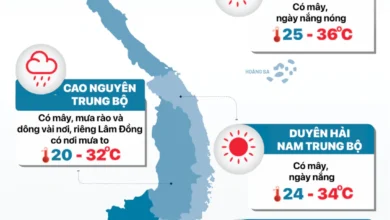
October 2026 has officially etched its place in the meteorological history books of Vietnam, as a relentless and anomalous heatwave shattered nearly 160 temperature records across the country. Data released by the National Center for Hydro-Meteorological Forecasting reveals that the month was characterized by sustained, extreme heat that pushed thermometers 1 to 3 degrees Celsius above long-term historical averages in many regions. This unprecedented thermal event not only disrupted seasonal norms but also underscored the accelerating trend of climate instability in Southeast Asia.
A Historic Meteorological Anomaly
The most striking feature of the October 2026 heatwave was its geographic scale and intensity. From the mountainous terrain of the Northwest to the coastal plains of the North, stations reported temperatures that were previously unthinkable for a month typically associated with the onset of autumn.
Between September 28 and October 2, the Northern region experienced a widespread heatwave where peak temperatures consistently hovered between 35 and 37 degrees Celsius, with some localized areas breaching the 37-degree threshold. For climatologists monitoring the region, this was a landmark event: it marked the first time since comprehensive record-keeping began in 1991 that such a widespread, intense heatwave has occurred across the entire Northern region during the month of October.
Chronology of the Heatwave
The progression of the heat began in late September, as a high-pressure system settled over the region, effectively suppressing rainfall and cloud cover. By the first week of October, the situation had intensified.

- October 2: The Muong Te station in Lai Chau recorded a staggering 38 degrees Celsius, obliterating the previous record of 37.2 degrees set in 1991.
- October 3: The Yen Chau station in Son La reached 38.3 degrees Celsius, significantly higher than its previous historical high of 37.5 degrees.
- Widespread Records: By mid-month, the phenomenon had expanded. Hon Dau (Hai Phong) recorded 37.2 degrees, exceeding its previous record by 2.4 degrees, while Mu Cang Chai (Lao Cai) registered 34.2 degrees—an increase of 2.9 degrees over its historical baseline.
In the capital city of Hanoi, the Lang station recorded 37.1 degrees Celsius, surpassing its historical peak by 0.7 degrees. Similarly, stations in Hoai Duc, Ha Dong, Vinh Yen, and Cao Bang all reported temperatures that forced meteorologists to re-evaluate local climate models.
Broad-Spectrum Temperature Rises
The record-breaking trend was not limited to daytime peaks. Average monthly temperatures for October at 98 weather stations met or exceeded historical values for the same period. In the northern province of Tuyen Quang, both Bac Me and Dong Van saw significant increases in their average monthly temperature, rising 1.6 degrees Celsius to reach 29.5 and 24.7 degrees, respectively.
The consistency of these rises suggests that the heat was not merely a brief spike but a fundamental shift in the regional thermal environment for the duration of the month. Other regions, including Viet Tri, Hoa Binh, and parts of the mountainous North, saw their monthly averages rise by 1 to 1.3 degrees Celsius compared to historical records.
The Driving Forces: El Nino and Atmospheric Dynamics
According to experts at the National Center for Hydro-Meteorological Forecasting, the primary driver of this heat is the intense activity of the El Nino phenomenon. By mid-October, sea surface temperatures in the Nino 3.4 region of the equatorial Pacific were approximately 2.4 degrees Celsius higher than the multi-year average. This thermal imbalance in the Pacific Ocean acts as a global catalyst for rising temperatures, directly impacting weather patterns in Vietnam by favoring higher-than-normal heat.
Furthermore, atmospheric conditions played a critical role. During late September and early October, the Northern region was influenced by the southern edge of a low-pressure trough, combined with high-altitude heat-retaining atmospheric pressure. These conditions resulted in decreased cloud cover, which allowed for increased solar radiation to reach the surface, effectively baking the landscape.

The lack of cold air surges, which usually characterize October in Northern Vietnam, meant that there were no significant cooling mechanisms to break the cycle of heat. The result was a period of prolonged, dry, and intense weather that left the region unusually warm.
Implications and Future Projections
The implications of such sustained heat are multifaceted. Agricultural experts have noted that the combination of high temperatures and low rainfall poses a challenge to crop cycles, particularly for autumn-winter agricultural planning. Furthermore, the persistent heat increases the risk of dehydration and heat-related illnesses among vulnerable populations, leading to increased demand on healthcare and energy infrastructure.
Climatologists emphasize that these events serve as a bellwether for long-term climate change. The fact that dozens of stations are simultaneously breaking records—often by significant margins—points to an environment that is becoming increasingly susceptible to "heat extremes." As the planet warms, the probability of these high-pressure, low-precipitation events occurring during traditionally cooler months rises.
Looking Ahead: November and Beyond
As the country moves into November 2026, the forecast remains consistent with the patterns observed in October. Meteorological data suggests that average temperatures across the country will continue to track 1 to 2 degrees Celsius above historical norms for November. In the Southern region, which typically follows a different climate cycle, the deviation is expected to be slightly more moderate, ranging from 0.5 to 1 degree Celsius.
The National Center for Hydro-Meteorological Forecasting continues to monitor the situation closely, advising local authorities to remain vigilant regarding potential impacts on water management and energy consumption. While the immediate intensity of the October heatwave has begun to subside, the data remains a critical reminder of the shifting climate reality facing the region. The records broken this month are not just numbers on a chart; they are indicators of a changing atmospheric landscape that will require adaptive strategies in urban planning, agriculture, and public health policy in the years to come.
Related posts: