Ninh Binh General Hospital Nurse Honored for Heroic Emergency Rescue of Seizing Patient in Diagnostic Imaging Wing


In a dramatic turn of events at the Ninh Binh Provincial General Hospital, a seasoned nurse has been lauded as a hero after her swift and decisive actions saved the life of an elderly patient who suffered a sudden medical crisis. The incident, which occurred in the late afternoon of July 22, has drawn widespread attention across Vietnamese social media, highlighting the critical importance of emergency preparedness and the unwavering dedication of healthcare professionals. Nurse Trieu Thi Phuong Mai, a dedicated member of the hospital’s Oncology Department, became the center of public admiration after a video of her performing life-saving chest compressions on a hospital floor went viral, illustrating the high-pressure environment of provincial healthcare and the thin line between life and death.
The emergency unfolded at approximately 5:00 PM on Monday, July 22, within the Diagnostic Imaging Department of Ninh Binh Provincial General Hospital. Mr. T.V.B., a 60-year-old patient, was seated in the waiting area, anticipating a scheduled Magnetic Resonance Imaging (MRI) scan. Without warning, Mr. B. collapsed and began experiencing violent convulsions. Witnesses reported that the patient quickly lost consciousness, his skin turning a concerning shade of blue (cyanosis), indicating a severe lack of oxygen and potential cardiac or respiratory arrest. As the patient’s family members cried out for help, the corridor of the diagnostic wing was momentarily gripped by panic.
A Decisive Intervention in the Golden Minutes
At the moment the crisis began, Nurse Trieu Thi Phuong Mai was in her office, located approximately 50 meters away from the MRI waiting area. Despite the distance and the fact that she was not assigned to the Diagnostic Imaging Department, the urgency in the voices of the family members prompted an immediate response. Nurse Mai, born in 1991 and possessing over 13 years of experience in the nursing profession, did not hesitate. She sprinted toward the source of the commotion, bypassing the standard bureaucratic boundaries of hospital departments to provide aid where it was most desperately needed.
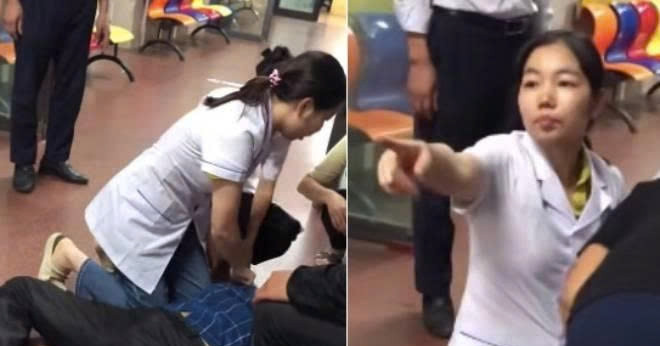
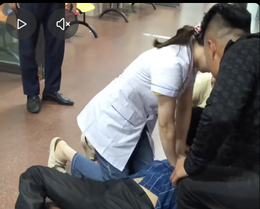
Upon reaching the scene, Nurse Mai found Mr. B. in a critical state. Recognizing the symptoms of a life-threatening event—unconsciousness, lack of pulse, and cyanosis—she immediately bypassed the need for a stretcher or a formal treatment room. In a move captured by a bystander’s mobile phone, Nurse Mai dropped to her knees on the hard floor of the hospital corridor and began administering rhythmic chest compressions. Her calm and methodical approach was a testament to her extensive training and more than a decade of experience in oncology, a field where patients often face sudden and complex medical emergencies.
The intervention lasted several intense minutes. Fortunately, the immediate application of Cardiopulmonary Resuscitation (CPR) proved successful. Mr. B. began to show signs of life, his complexion returned to a more natural hue, and he eventually regained consciousness. Once the patient was stabilized, Nurse Mai, assisted by other hospital staff who had arrived at the scene, coordinated the patient’s transfer to the Oncology Center for further monitoring and oxygen therapy.
The Chronology of a Life-Saving Act
To understand the impact of the event, it is essential to look at the timeline of the rescue, which underscores the "Golden Hour" principle in emergency medicine—the brief window where medical intervention has the highest likelihood of preventing death or permanent brain damage.
- 17:00 PM: Mr. T.V.B. arrives at the Diagnostic Imaging Department for an MRI scan. He is reportedly stable but awaiting diagnostic clarity for underlying health issues.
- 17:05 PM: The patient suddenly experiences a seizure and loses consciousness while seated in the waiting area.
- 17:06 PM: Family members alert the staff with loud cries for help. Nurse Trieu Thi Phuong Mai hears the distress from 50 meters away.
- 17:07 PM: Nurse Mai arrives at the scene, assesses the patient’s lack of responsiveness and cyanosis, and immediately begins chest compressions on the floor.
- 17:12 PM: After several cycles of compressions and emergency stabilization, the patient regains consciousness and his vital signs begin to stabilize.
- 17:20 PM: Mr. B. is moved to a specialized ward, placed on supplemental oxygen, and reviewed by the oncology medical team.
- July 24: Video footage of the incident is shared on social media platforms, garnering thousands of views and sparking a national conversation about the bravery of medical workers.
Institutional Recognition and Professional Modesty
The leadership of Ninh Binh Provincial General Hospital was quick to recognize Nurse Mai’s exemplary conduct. In an official statement, the hospital administration commended her for her "quick-thinking, professional composure, and effective handling" of the emergency. They emphasized that such a situation could happen at any time and in any part of the hospital, and that the presence of a skilled practitioner in those specific moments is what offers patients a "precious chance at life."
Despite the accolades and the viral fame, Nurse Mai remained remarkably humble. Speaking to local media on July 24, she downplayed her heroism, framing it instead as a standard fulfillment of her professional duty. "That is our daily work," she stated. "Anyone in that situation would have done the same. When I heard the cry for help, I ran immediately. It didn’t matter which department the patient belonged to; I only knew that someone needed medical assistance."
Her 13-year career has likely seen many such moments, though few are captured on camera for the public to see. Nurse Mai’s background in the Oncology Department is particularly relevant, as oncology nurses are trained to deal with patients whose immune systems are compromised and whose conditions can fluctuate rapidly, requiring a high degree of vigilance and emergency readiness.
The Significance of CPR and Emergency Training
The incident at Ninh Binh Provincial General Hospital serves as a powerful case study for the necessity of universal CPR training among all hospital staff, regardless of their specific department. In many medical facilities, specialized emergency response teams (often called "Code Blue" teams) are tasked with responding to arrests. However, as this event demonstrated, the first few seconds are the most critical. Had Nurse Mai waited for a specialized team to arrive from another part of the building, the outcome for Mr. B. might have been significantly different.
Medical data suggests that for every minute that passes without CPR following a cardiac arrest, the chance of survival decreases by 7% to 10%. By intervening within the first sixty seconds, Nurse Mai ensured that oxygenated blood continued to flow to the patient’s brain, preventing the onset of permanent neurological damage. This event highlights a broader trend in global healthcare: the push for "First Responder" mentalities among all clinical and non-clinical staff in hospital settings.
Broader Implications for the Vietnamese Healthcare Sector
The public’s reaction to the video of Nurse Mai also reflects a deeper societal appreciation for healthcare workers in Vietnam. In recent years, the medical profession has faced significant challenges, including high workloads, the lingering stresses of the COVID-19 pandemic, and occasional reports of workplace violence against staff. Stories like Nurse Mai’s serve to restore public trust and highlight the intrinsic value of the nursing profession.
Nurses are often the backbone of the hospital system, providing the most direct and continuous care to patients. In Vietnam, where the ratio of nurses to patients is often lower than in many Western nations, the pressure to perform is immense. Nurse Mai’s ability to maintain her composure and execute her training flawlessly under the gaze of a panicked crowd is a testament to the resilience of Vietnamese medical professionals.
Furthermore, the hospital’s statement touched on a vital point regarding medical ethics: the responsibility of a healthcare worker extends beyond their shift and their specific ward. The "readiness to serve" is a core tenet of the Hippocratic oath and its nursing equivalents. In this instance, the "spirit of responsibility" was not confined to a 50-meter radius or an official job description; it was an instinctive response to human suffering.
Analysis of the Diagnostic Imaging Environment
The fact that the incident occurred in the Diagnostic Imaging Department is also noteworthy. This area of a hospital often sees patients who are in a state of physical or emotional distress, awaiting news about their health. MRI machines and other high-tech diagnostic tools are located in specialized suites that can sometimes be isolated from the main emergency or intensive care units.
This event may prompt hospitals to review their emergency protocols within diagnostic wings. Ensuring that these areas are equipped with immediate-use defibrillators (AEDs) and that all technicians and administrative staff are refreshed in basic life support (BLS) can create an extra layer of safety. While Nurse Mai provided the physical compressions, the availability of oxygen and a quick transition to the Oncology Center were also vital components of the "chain of survival."
Conclusion: A Reminder of the Value of Every Second
As of the latest reports, Mr. T.V.B. is in stable condition and continues to receive care at the Ninh Binh Provincial General Hospital’s Oncology Center. The quick intervention by Nurse Trieu Thi Phuong Mai not only saved a life but also provided a moment of profound inspiration for her colleagues and the community at large.
The story of the "Oncology Nurse in the MRI Wing" will likely be used as a training example for future nursing students in the province. It serves as a stark reminder that in the medical field, knowledge and skill are only half of the equation; the other half is the courage to act without hesitation. In the quiet corridors of a provincial hospital, a 33-year-old nurse proved that heroism does not always require a grand stage—sometimes, it only requires a pair of willing hands and a few minutes on a cold floor.
The recognition from the Ninh Binh Provincial General Hospital leadership is a step toward validating the hard work of thousands of nurses who perform similar, though often unseen, acts of service every day. As healthcare systems continue to evolve, the human element—the quick feet and steady hands of practitioners like Trieu Thi Phuong Mai—remains the most critical diagnostic and therapeutic tool available.