The Ministry of Construction has officially approved a significant adjustment to the investment plan for the Tan Van – Nhon Trach section of the Third Ring Road project in Ho Chi Minh City, elevating its technical classification from a Class 3 road to a full-scale expressway. This strategic upgrade is designed to accommodate speeds of up to 100 km/h, reflecting the evolving infrastructure demands of the Southern Key Economic Zone. The total investment for the project has been revised upward by approximately 2,000 billion VND, reaching a total of 8,912 billion VND.
Project Overview and Scope
The Tan Van – Nhon Trach segment, designated as Project Component 1A, spans approximately 8.75 kilometers. The route connects Dong Nai Province and Ho Chi Minh City, serving as a critical arterial link to improve regional mobility. Of the total distance, 6.3 kilometers fall within the jurisdiction of Dong Nai, while 2.45 kilometers are situated within Ho Chi Minh City. The project requires the acquisition of roughly 77 hectares of land to facilitate construction and the installation of safety corridors.
At the core of the project is the construction of the Nhon Trach Bridge, a vital structure approximately 2.6 kilometers in length that will serve as the primary conduit between the two localities. Under the original design, the route was planned as a Class 3 road with a design speed of 80 km/h and a roadbed width between 20.5 and 26 meters, featuring four lanes for motorized traffic and two lanes for mixed use.
Financial Restructuring and Funding
The decision to adjust the investment capital from the previous estimate of 6,955 billion VND to 8,912 billion VND follows a comprehensive review by the Ministry of Construction. This financial expansion is largely driven by the necessity to meet higher expressway safety and operational standards.
The funding structure for the project is primarily supported by Official Development Assistance (ODA) from the Economic Development Cooperation Fund (EDCF) of South Korea, which accounts for approximately 253 million USD (equivalent to 6,108 billion VND). The remaining 2,803 billion VND is sourced from domestic counterpart funds. Authorities are currently coordinating with the financier to ensure the terms and conditions of the additional loan are finalized, ensuring that the funding remains stable throughout the construction phase.
Engineering Upgrades and Expressway Standards
To align with the updated designation as a high-speed expressway, the project scope has been expanded. A significant engineering addition is the construction of a second, parallel Nhon Trach Bridge. This new structure, spanning 19.75 meters in width, will be positioned alongside the existing bridge to handle increased traffic volumes and comply with dual-carriageway safety requirements.
Furthermore, the project includes several technical enhancements:
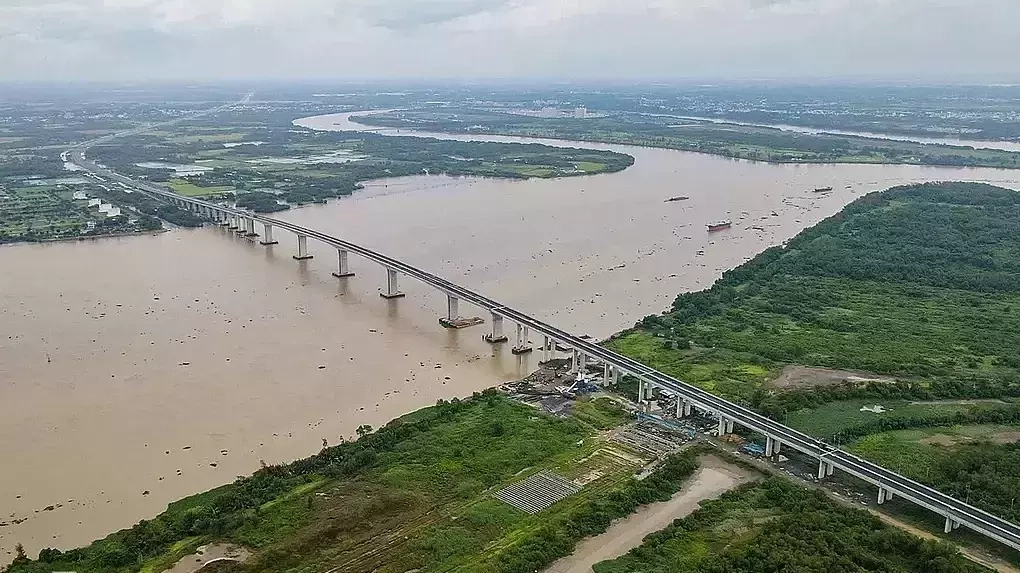
- Infrastructure Connectivity: The route incorporates the Rach Chay Bridge, four additional bridges for slip roads, and a complex grade-separated interchange designed to integrate seamlessly with the existing Ho Chi Minh City – Long Thanh – Dau Giay Expressway.
- Smart Systems: A state-of-the-art Intelligent Transport System (ITS) will be installed, including non-stop electronic toll collection (ETC) infrastructure and automated vehicle weigh-in-motion stations to prevent road damage caused by overloaded freight.
Strategic Importance to the Southern Key Economic Zone
The Third Ring Road project is arguably the most significant infrastructure undertaking in Southern Vietnam in the current decade. By upgrading the Tan Van – Nhon Trach section to expressway standards, the government aims to achieve several long-term socioeconomic objectives:
- Reduction of Travel Time: The project will drastically shorten the commute between Nhon Trach and Ho Chi Minh City, effectively integrating the industrial hubs of Dong Nai with the logistics and commercial centers of the city.
- Traffic Decongestion: By providing a high-speed bypass, the route will effectively divert long-distance traffic away from the saturated urban core of Ho Chi Minh City, reducing the heavy load on existing national highways and provincial roads.
- Regional Synergy: The project serves as a "spine" for the region, enhancing the connectivity of the entire Ring Road 3 circuit. This, in turn, boosts the attractiveness of the region for foreign direct investment (FDI) and promotes balanced industrial development across the Dong Nai and HCMC corridor.
Implementation Timeline and Management
The Management Board of My Thuan Project, the lead agency tasked with overseeing the execution, has been instructed to expedite all administrative procedures. The primary challenge remains the compressed timeline for completion, as the construction must remain synchronized with the broader progress of the Ring Road 3 project to ensure that the infrastructure becomes operational as a cohesive system rather than in isolated segments.
"The upgrade is not merely a change in speed limit; it is a fundamental shift in how we approach regional connectivity," noted a representative involved in the project planning. "By integrating advanced electronic tolling and high-standard engineering, we are ensuring that this corridor remains viable for the next several decades of industrial growth."
Economic and Logistical Implications
From a logistics perspective, the Tan Van – Nhon Trach segment is a linchpin for the movement of goods. Dong Nai is home to some of the country’s largest manufacturing zones, while Ho Chi Minh City serves as the primary export gateway. Currently, the bottlenecking of traffic at existing crossings acts as a "hidden tax" on manufacturers due to wasted fuel and transit time. The transition to a 100 km/h expressway will allow for more predictable supply chain schedules and lower operational costs for logistics providers.
Furthermore, the implementation of automated weigh stations signifies a shift toward more sustainable infrastructure management. By strictly controlling vehicle loads, the government aims to extend the lifespan of the road surface and reduce the frequency of costly maintenance cycles.
Future Outlook
As the project moves into the next phase of construction, stakeholders are focused on the integration of the newly approved budget and the technical requirements for the secondary bridge. The collaboration between the Vietnamese government and the EDCF remains a model for infrastructure development in the region, highlighting the importance of international partnerships in financing large-scale capital projects.
The Ministry of Construction, in coordination with the local authorities of Dong Nai and Ho Chi Minh City, continues to monitor land clearance progress and construction quality. The completion of the Tan Van – Nhon Trach section is expected to act as a catalyst for the real estate and industrial sectors, providing a much-needed boost to the local economy and setting a new benchmark for expressway development in the southern provinces.
In conclusion, the decision to upgrade the Tan Van – Nhon Trach segment is a forward-thinking move that recognizes the limitations of previous designs in the face of rapid urbanization. While the increased investment is significant, the long-term economic gains—through improved efficiency, safety, and regional connectivity—far outweigh the initial capital outlay. The successful delivery of this segment will mark a major milestone in the realization of the broader Third Ring Road vision, transforming the landscape of southern transportation.