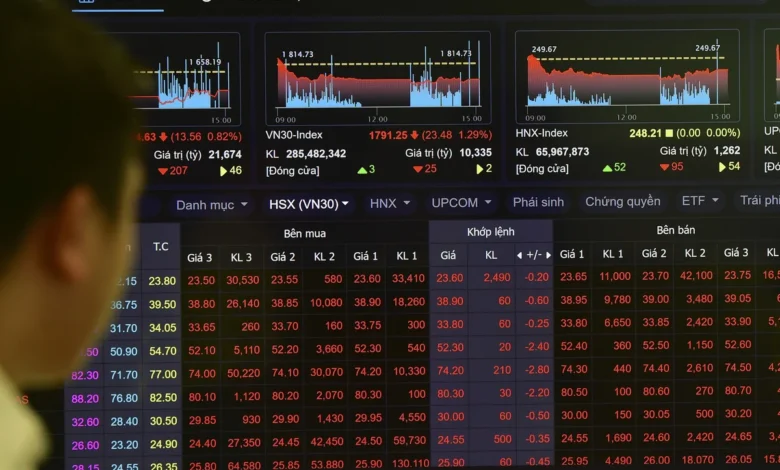
The VN-Index has experienced its third consecutive session of decline, falling to 1,730 points, marking its lowest level since FTSE Russell confirmed Vietnam’s eligibility for an emerging market upgrade on April 8. This significant downturn has wiped out gains accrued following the positive market classification news, raising concerns among investors about the immediate future trajectory of the Vietnamese stock market.
A Sharp Reversal After Initial Hopes
The week began with a notable market correction, pushing the VN-Index down to 1,743 points. Despite this initial dip, market analysts and investors had held optimistic expectations for a swift recovery, anticipating a bounce back to the 1,780-point range. This forecast was largely predicated on the belief that numerous stocks had entered an "oversold" state, which typically triggers a rebound as bargain hunters and value investors step in. Such a scenario was expected to reactivate foreign capital inflows, providing a much-needed impetus for market stabilization and growth.
However, these optimistic projections failed to materialize. On the day in question, the Ho Chi Minh Stock Exchange (HoSE) index briefly showed signs of strength, trading in the green and even surpassing the 1,750-point mark during early trading hours. This brief period of positive momentum, fueled by cautious optimism, was short-lived. The upward trend proved unsustainable as significant selling pressure emerged from domestic investors across several key sectors. This persistent sell-off gradually eroded the early gains, causing the VN-Index to reverse its course from mid-morning onwards. By the close of the trading session, the index had settled at 1,730 points, registering a loss of nearly 13 points compared to its reference level. This decline effectively pushed the benchmark index back to the valuation levels observed prior to FTSE Russell’s announcement regarding Vietnam’s upgrade eligibility, highlighting a disconnect between fundamental classification improvements and immediate market sentiment.
Diving Deeper into the Day’s Performance
The broad market performance on HoSE painted a predominantly bearish picture. Nearly 190 stocks concluded the day below their reference prices, with nine equities hitting their daily allowable floor price, signifying severe selling pressure. In stark contrast, only about 100 stocks managed to post gains, primarily consisting of mid-cap and small-cap companies, indicating a lack of broad-based market support. This concentrated buying in smaller segments suggests that capital flows were not widely distributed, but rather focused on specific, potentially undervalued, opportunities or speculative plays, failing to provide the necessary momentum to lift the broader market.
From a sectoral perspective, the energy sector, particularly oil and gas, was among the hardest hit. The entire sector saw a collective decline of over 4%. Individual stocks within this segment experienced even steeper losses, with PVGAS, a major player, plummeting to its floor price of 68,000 VND. This sector’s vulnerability could be attributed to fluctuating global oil prices, which often trigger investor caution and profit-taking in energy-related assets.
Further exacerbating the market’s decline were prominent companies within the Vingroup ecosystem. Vingroup (VIC), a bellwether stock, contributed significantly to the index’s negative performance, dropping by 1.2% to approximately 217,000 VND. Its subsidiaries, Vinhomes (VHM) and Vincom Retail (VRE), also saw adjustments, declining by 0.4% and 1% respectively. The collective underperformance of these large-cap entities, often seen as indicators of overall market health, sent a clear negative signal to investors.
Despite the widespread red, some sectors, including real estate, banking, and securities, showed signs that the intense selling pressure might be easing compared to the previous day. While these sectors generally remained in negative territory, certain large-cap banking stocks offered a glimpse of resilience. For instance, CTG, HDB, VPB, and LPB managed to reverse their earlier declines, transitioning from red to green. Their partial recovery helped to somewhat mitigate the broader downward spiral of the index, preventing an even steeper fall.
A particularly striking development involved PNJ, a leading jewelry retailer. The stock, which had initially traded positively, reversed sharply to hit its floor price, with a substantial volume of over 9 million shares being traded. PNJ closed at 38,150 VND, marking its lowest level in five years. This drastic fall was largely driven by investor concerns regarding the company’s liquidity, stemming from an unprecedented increase in the demand for diamond resales. This unique challenge, potentially linked to broader economic uncertainties or specific company-related issues, added another layer of complexity to the market’s woes.
Total trading volume on HoSE reached over 789 million shares, corresponding to a value of 23,000 billion VND. A significant observation was the dominance of large-cap stocks, which accounted for nearly 74% of the total trading value. This concentration of capital in large-cap segments, rather than a broad dispersion across the market, suggests that while trading activity was robust, it was also highly focused, limiting the potential for a widespread recovery. SHB led the market in terms of trading value, with nearly 790 billion VND exchanged, followed by VIC and HPG, underscoring the focus on these prominent equities.
The Significance of the FTSE Russell Review
The recent market performance stands in stark contrast to the wave of optimism that followed FTSE Russell’s announcement on April 8. This announcement confirmed Vietnam’s inclusion on the Watch List for possible reclassification from a Frontier Market to a Secondary Emerging Market. For years, Vietnam has been actively pursuing this upgrade, which is seen as a critical milestone for its capital markets. An upgrade by major index providers like FTSE Russell or MSCI would significantly enhance Vietnam’s global market standing, attracting substantial inflows of foreign institutional investment. Emerging market status typically leads to increased liquidity, lower cost of capital for Vietnamese companies, and improved market governance as the country strives to meet international standards.
The path to an actual upgrade, however, is not without its hurdles. Key challenges often include improving market accessibility for foreign investors, particularly addressing pre-funding requirements, enhancing transparency, and ensuring efficient settlement processes. While the Watch List inclusion is a positive step, it merely signals eligibility; the actual reclassification could still be several years away, contingent upon Vietnam successfully implementing these structural reforms. The current market dip, therefore, serves as a poignant reminder that while the long-term prospects tied to an upgrade are strong, the market remains susceptible to short-term domestic and global pressures, irrespective of fundamental classification achievements.
Analyst Insights and Market Outlook
According to analysts at ACB Securities Company, the short-term outlook suggests that the current downward trend is likely to continue, potentially pushing the VN-Index to test stronger support levels in the range of 1,630-1,650 points. This forecast implies that the market has not yet found its bottom and that further consolidation or decline may be expected before a more sustained recovery can begin.
Broader market sentiment suggests that the primary drivers of the recent decline are a combination of domestic selling pressure, which appears to be driven by profit-taking or concerns over economic slowdowns, and a lack of fresh catalysts to attract new capital. Global market uncertainties, including inflationary pressures, interest rate hikes by major central banks, and geopolitical tensions, also contribute to a cautious investment climate, influencing both domestic and foreign investor behavior. The concentrated cash flow observed in large-cap stocks, rather than a broad market rally, further underscores the cautious approach adopted by many investors, who prefer to allocate capital to established, liquid assets rather than taking on higher risks across a wider range of smaller companies.
Foreign Investors Provide a Glimmer of Hope
Amidst the prevailing bearish sentiment, a notable positive signal emerged from the foreign investment segment. Foreign investors broke a six-session selling streak, turning net buyers with an approximate value of 70 billion VND. This marked their strongest net buying activity in nearly two weeks, offering a potential glimmer of hope for market stabilization. This shift in foreign investor behavior could be interpreted in several ways: it might indicate that foreign institutions are beginning to see value in the current depressed prices, viewing the correction as a buying opportunity; it could also suggest a long-term confidence in Vietnam’s economic fundamentals and its eventual upgrade to an emerging market. While the amount of net buying was relatively modest compared to the overall market turnover, it represents a significant psychological shift, potentially signaling a reversal of the recent capital outflow trend and a renewed interest in Vietnamese assets.
Sectoral Spotlight: Oil, Real Estate, and Banking Under Pressure
The oil and gas sector’s sharp decline reflects its sensitivity to global commodity price fluctuations and investor sentiment regarding future energy demand. The specific case of PVGAS hitting its floor price highlights how major players within a sector can disproportionately impact overall market performance.
In the real estate sector, while overall selling pressure eased, the continued presence of red across many stocks suggests ongoing challenges. These challenges could stem from tighter credit policies, concerns about property market bubbles, or broader economic uncertainties affecting consumer purchasing power. The Vingroup family of stocks, being major real estate and diversified conglomerate players, often acts as a bellwether for the sector and the broader economy, and their underperformance signals caution.
The banking sector, despite showing some resilience from individual large-cap banks like CTG and HDB, also faced considerable pressure. This is particularly noteworthy given that banks are often seen as pillars of economic stability. However, concerns about asset quality, potential impacts of interest rate changes, and the broader economic environment can weigh heavily on banking stocks. The ability of some major banks to turn positive suggests that underlying fundamentals might still be strong for select institutions, or that they are attracting specific investor interest.
The unique situation of PNJ is a stark reminder of how company-specific factors can interact with broader market trends. The surge in diamond resale demand, possibly driven by individuals seeking to liquidate assets for cash during uncertain economic times, directly impacts PNJ’s business model and liquidity. Such an event, while potentially isolated to one company, can spook investors across the market, leading to a flight to safety or a reevaluation of other consumer-discretionary stocks.
Broader Economic Context and Future Implications
Vietnam’s economy has demonstrated remarkable resilience in recent years, with robust GDP growth and increasing integration into the global supply chain. The government and market regulators, such as the State Securities Commission (SSC), are committed to fostering a stable and attractive capital market. While they typically avoid direct intervention in daily market movements, their long-term policies focus on enhancing market infrastructure, improving regulatory frameworks, and promoting transparency to support sustainable growth and attract foreign investment. The current market volatility, while concerning in the short term, is likely viewed by authorities as a temporary adjustment within a larger upward trajectory driven by strong economic fundamentals and the strategic goal of achieving emerging market status.
The long-term vision for Vietnam’s capital markets remains optimistic. The journey towards an emerging market upgrade, despite current setbacks, continues to be a powerful catalyst for structural reforms. These reforms, aimed at aligning Vietnam’s market practices with international standards, will ultimately benefit all market participants by enhancing efficiency, liquidity, and investor protection. However, investors will need to navigate periods of increased volatility, which are often characteristic of markets undergoing significant transition and development.
The Road Ahead: Navigating Volatility and Pursuing Growth
The recent sharp decline of the VN-Index to a post-FTSE Russell upgrade eligibility low underscores the inherent volatility of emerging markets and the complex interplay of domestic and global factors. While the long-term prospects for Vietnam’s capital market remain bright, underpinned by strong economic growth and the pursuit of an emerging market upgrade, the short to medium term is likely to be characterized by continued caution and potential fluctuations.
Investors will need to pay close attention to several key indicators: the sustained behavior of foreign investors, which could provide crucial support; the evolving economic policies and credit conditions domestically; and the performance of bellwether sectors like banking and real estate. The ability of the market to consolidate around key support levels and attract consistent buying interest, particularly from institutional investors, will be critical for a sustainable recovery. While the immediate outlook may seem challenging, the strategic importance of Vietnam’s market within Southeast Asia and its ongoing efforts toward global integration suggest that the current downturn could present opportunities for patient, long-term investors. The path ahead requires resilience from market participants and continued commitment from policymakers to build a robust and internationally competitive capital market.
Related posts: