Sony Revives the Legendary 1979 Walkman Aesthetic with the New MDR-3R On-Ear Wired Headphones Featuring USB-C Connectivity

Sony Electronics has officially announced the global release of the MDR-3R, a lightweight, wired on-ear headphone that directly resurrects the industrial design philosophy of the historic MDR-3—the iconic audio accessory bundled with the world’s very first portable cassette player, the Walkman TPS-L2, launched in 1979. Breaking away from the current industry obsession with active noise cancellation, bulky over-ear studio monitors, and complex wireless Bluetooth codecs, Sony has chosen to pivot toward a minimalist, nostalgic, and refreshingly uncomplicated user experience.

The announcement, made public through an official corporate press release, bridges more than four decades of portable audio history. By breathing new life into the visual language of the late 1970s while integrating modern digital standards such as USB Type-C connectivity, Sony aims to capture a distinct segment of consumers who value vintage aesthetics, plug-and-play convenience, and lightweight ergonomics over algorithmic sound processing and battery management.
Unpacking the Roots: Historical Context and Product Lineage
To fully understand the significance of the MDR-3R, it is necessary to examine the historical nomenclature established by Sony in the late 1970s. The designation "MDR-3" serves as an umbrella term historically encompassing variants such as the MDR-3, MDR-3L1, and MDR-3L2. When the revolutionary Walkman TPS-L2 hit the consumer market in 1979, the exact headphone model accompanying it in the box was the MDR-3L2.

Sony has explicitly clarified that the new MDR-3R is a direct stylistic successor to this foundational 1979 lineage, rather than a continuation of the modern MDR-1R series, the professional-grade MDR-M1ST studio monitor, or the consumer-favorite WH-1000XM wireless ANC line. This distinction is crucial for audiophiles and industry analysts tracking Sony’s product taxonomy. The company is not attempting to introduce a bleeding-edge acoustic flagship disguised in retro clothing; instead, it is curating an authentic heritage product that honors the exact physical profile of the original device while adapting its interface for modern digital hardware.
Minimalist Design and Featherweight Ergonomics
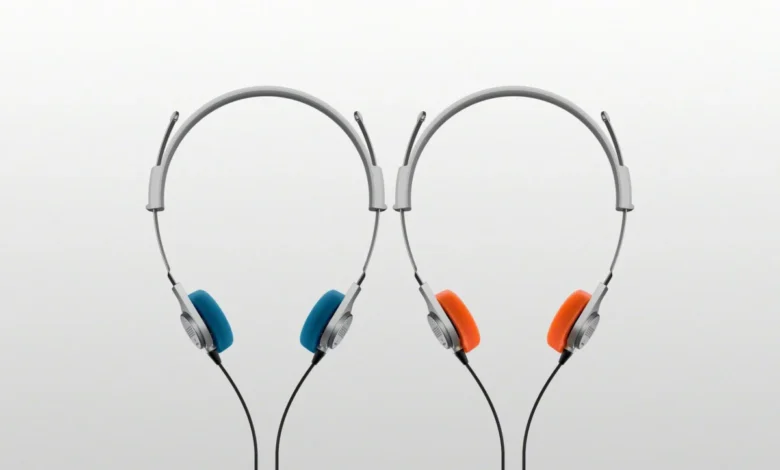
At first glance, the MDR-3R immediately stands out in a market saturated by matte-black plastic and heavy circumaural earmuffs. The headphones feature a remarkably slender headband crafted from durable stainless steel and aluminum, paired with remarkably small, open-air on-ear cushions. Weighing in at a mere 38 grams (excluding the cable), the headset represents a masterclass in minimalist structural engineering.

Sony’s design team meticulously re-created the original headband geometry, the classic corporate logo, the embossed "Dynamic Stereo Headphones" lettering, and the signature acoustic vent holes found on the 1979 predecessors. Rather than relying on faux-vintage marketing tropes, Sony has delivered a physically delicate and visually striking silhouette that prioritizes portability and understated elegance.
The standard retail package includes thoughtful modular customization options. Out of the box, the silver-finished headset ships with interchangeable blue and orange foam ear pads, allowing users to personalize their look without purchasing separate accessories. Furthermore, the product packaging, instruction manuals, and outer cartons have been designed to emulate the tactile and visual spirit of the original 1979 release, providing an immersive unboxing experience from the moment the box is opened.

The Shift to USB Type-C Connectivity
The most significant technological departure from the original 1979 hardware is the integration of a modern USB Type-C interface. The MDR-3R utilizes a fixed Y-type cable measuring approximately 1.2 meters in length, terminating in a USB-C connector rather than a traditional 3.5mm analog headphone jack.
Compatibility relies on host devices supporting USB Audio Class 1.0, enabling direct plug-and-play functionality with a wide variety of modern smartphones, tablets, and personal computers. Sony notes that while the USB-C standard ensures broad digital compatibility, operational behavior may vary depending on the host operating system and specific software applications, occasionally requiring manual audio routing or device configuration by the user.

Integrated directly into the cable is a streamlined inline microphone and remote control module. This hardware allows users to manage media playback—such as playing, pausing, and skipping tracks—adjust volume levels, and handle hands-free phone calls. To mitigate mechanical noise caused by friction against clothing, Sony has incorporated subtle micro-grooves along the surface of the cable. While these additions make the headphones highly practical for modern tasks like video conferencing, mobile media consumption, and casual listening, real-world call clarity in loud urban environments remains subject to independent user evaluation.
Crucially, the decision to implement a wired USB-C connection means users must fundamentally abandon traditional concerns regarding battery degradation, charging cycles, and Bluetooth pairing failures. There is no internal battery to charge, no firmware to update, and no wireless latency to manage. However, in a surprising advisory note, Sony explicitly clarifies that the MDR-3R is not officially recommended for use with vintage or modern portable cassette players bearing the Walkman brand name, despite its visual homage to the era. The physical resemblance to legacy hardware does not imply backward compatibility with analog tape decks.

Acoustic Architecture and Performance Expectations
Beneath the retro exterior, the MDR-3R houses compact 23mm dynamic driver units equipped with high-energy neodymium magnets. According to technical specifications provided by Sony’s regional divisions, these drivers were engineered by referencing the acoustic blueprints of the original MDR-3 while fine-tuning the tuning profile to match contemporary listening preferences.
Sony characterizes the resulting sound signature as natural, balanced, and emotionally resonant, aiming to reproduce the directness of early portable audio systems. However, industry analysts and audio reviewers emphasize that the open-air, on-ear architecture inherently dictates specific acoustic limitations. Because the MDR-3R is an open-design headphone with exceptionally light foam padding, it is not engineered to achieve deep sub-bass extension, high passive noise isolation, or massive soundstages comparable to closed-back studio monitors.

The open-air design allows ambient environmental noise to bleed into the listener’s consciousness while letting music leak outward into the immediate surroundings. Consequently, Sony does not position the MDR-3R as a replacement for dedicated active noise-canceling headphones intended for air travel or noisy commutes. Users are advised to manage expectations regarding isolation, recognizing that the primary value proposition lies in the pure, unadulterated tactile and auditory experience of a simpler era of personal audio.
The Stranger Things Limited Edition Collaboration
Capitalizing heavily on the 1980s cultural renaissance driven by pop culture phenomena, Sony has also announced a specialized variant: the MDR-3R Stranger Things Edition. Developed in direct collaboration with the hit Netflix series, this limited version draws visual inspiration from the fictional Hawkins timeline, reflecting the personal style of characters like Max and the eerie aesthetic of the Upside Down.

The Stranger Things Edition features bespoke branding, including series-specific logos emblazoned across the headband, contrasting red and black foam earpads, and custom-designed outer packaging. While the acoustic hardware and technical specifications remain identical to the standard consumer model, the collaboration highlights Sony’s strategic marketing approach to leverage nostalgic media to attract younger demographics and collectors.
Sustainability and Environmental Initiatives
In alignment with corporate global sustainability goals, Sony has incorporated recycled plastics into select structural components of the MDR-3R. Furthermore, the product packaging has been transitioned to plastic-free materials, utilizing molded paper pulp, vegetable-based inks, and regionally optimized adhesives.

While these environmental measures reflect progressive manufacturing standards in the consumer electronics sector, industry observers note that long-term product repairability—such as the ease of replacing worn-out cables or deteriorated foam ear pads in local markets—remains to be verified upon wider global retail availability.
Market Implications and Concluding Analysis
The introduction of the Sony MDR-3R represents a fascinating counter-programming strategy in an audio market otherwise dominated by wireless earbuds, lossless Bluetooth codecs, and complex digital signal processing. By stripping away batteries, wireless radios, and heavy dampening materials, Sony has resurrected a historical form factor that prioritizes tactile engagement, extreme lightweight comfort, and zero-latency plug-and-play simplicity.

For consumers who cherish mid-century industrial design, yearn for an escape from constant battery maintenance, and desire a lightweight secondary headset for casual desk work or mobile viewing, the MDR-3R offers a compelling, culturally rich alternative. Conversely, users whose workflows demand robust active noise cancellation, deep bass response, or wireless freedom will find that the MDR-3R belongs to an entirely different philosophy of listening. Ultimately, the true value of the MDR-3R lies not in technological supremacy, but in its successful preservation of a simpler, more direct relationship between the listener and their music.