Apple Enters the Foldable Market with iPhone Duo: A Comprehensive Review of Hardware Excellence Versus Software Maturity

The global smartphone landscape has reached a significant turning point as major manufacturers continue to refine the form factor of foldable devices. Apple, long anticipated to enter this specialized segment, has officially introduced its first foldable offering, the iPhone Duo. Following a week of rigorous real-world evaluation by industry analysts, specifically Dominic Preston of The Verge, a clearer picture has emerged regarding how Apple’s hardware craftsmanship stands up against established Android competitors like the Samsung Galaxy Z Fold 8 and various iterations from Chinese manufacturers such as Xiaomi and OPPO. While Apple’s engineering prowess and hardware finishes have raised the bar for physical device design, the accompanying software experience reveals that bridging the gap between a traditional smartphone interface and a large foldable canvas remains a complex undertaking.
Background and Context of Apple’s Foldable Entry
For years, the foldable smartphone market was pioneered almost exclusively by Android OEMs, allowing companies like Samsung, Huawei, OPPO, and Xiaomi to iterate through multiple generations of hardware and software optimization. Consumers and enterprise users grew accustomed to multitasking paradigms, cover-screen usability, and split-screen workflows tailored specifically for dual-screen and foldable devices.

Apple’s entry into this arena with the iPhone Duo marks a pivotal validation of the foldable concept. Industry observers noted that while Apple arrived later to the party, the company brought its signature manufacturing standards and ecosystem integration. According to formal declarations provided by Apple to technology publications, the App Store already hosts upwards of 100,000 applications optimized or adjusted for the Duo at launch. However, a distinction must be drawn between the raw quantity of available applications and the qualitative execution of their layouts when expanded across a foldable display.
Hardware Masterpiece vs. Ergonomic Realities
At first glance, the physical attributes of the iPhone Duo command immediate respect. Dominic Preston’s comparative analysis highlighted the device’s refined curved frame, durable Ceramic Shield rear panel, and the exceptionally satisfying mechanical resistance of its hinge mechanism. When benchmarked against contemporary Android flagships such as the Galaxy Z Fold 8 and the Xiaomi 18 Fold, Apple’s mechanical execution feels exceptionally polished, demonstrating the meticulous attention to detail typical of the Cupertino-based tech giant.
Despite these engineering triumphs, physical perfection does not automatically translate into long-term ergonomic comfort. Weighing in at 254 grams according to Apple’s official specifications, the Duo introduces a noticeable heft that becomes apparent during extended one-handed operation. The device is wider and thinner than the Galaxy Z Fold 8, aligning its footprint more closely with the Xiaomi 18 Fold. While this wider body provides a more spacious cover screen for quick tasks like messaging or checking notifications, the transition to one-handed use requires deliberate physical adjustments from the user.

Furthermore, while the Duo boasts an IP68 dust and water resistance rating, durability questions regarding the flexible inner display persist across the foldable industry. Apple, much like its competitors, continues to advise users regarding the delicate nature of folding screens, noting that internal warranties and service policies for screen replacements remain a critical factor for early adopters to consider.
Display Innovation and the Persistence of the Crease
One of the most notable hardware highlights of the iPhone Duo is its innovative internal display technology. Apple confirmed that the device features a 7.6-inch OLED panel equipped with an advanced nano-texture surface coating. In practical observation, this matte texturing effectively diffuses ambient light, significantly minimizing the visual prominence of the screen crease when the display is illuminated.
Nevertheless, the physical crease has not been entirely eliminated. When viewed at acute angles or interacted with via touch, users can still perceive the indentation along the fold. Particular attention was drawn to the under-display camera housing, which sits within a localized area that lacks the matte nano-texture found across the rest of the panel, creating a slight visual discontinuity in the continuous surface of the screen.

In terms of ecosystem accessories, the Duo introduces support for the Apple Pencil USB-C, a capability traditionally reserved for Apple’s tablet lineup rather than its smartphones. While this expands the productivity scope of the device for note-taking and sketching, reviewers noted that comprehensive testing of writing latency and stylus ergonomics requires prolonged evaluation alongside competing stylus-enabled foldables.
Software Maturation: Applications and Screen Real Estate
The core divergence between the iPhone Duo and its Android counterparts lies in the maturity of the software interface. Foldable devices derive their primary utility from the seamless utilization of expanded screen space, yet the Duo frequently struggles to maximize this canvas across various third-party applications.
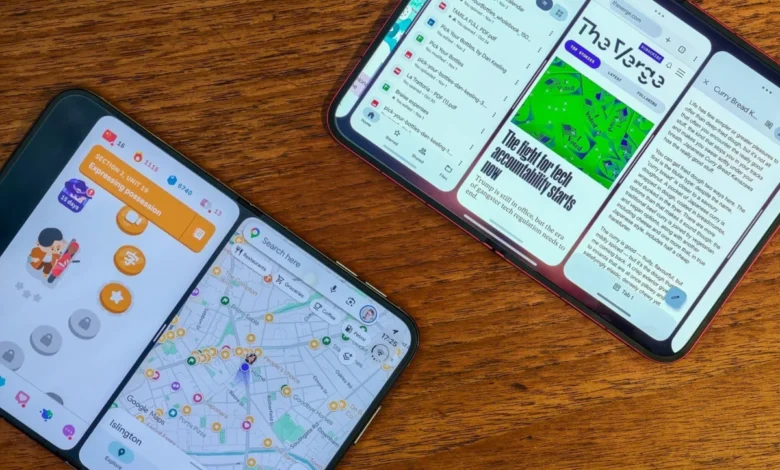
A primary example involves the placement of control interfaces and navigation elements. On the iPhone Duo, certain applications fail to scale dynamically when opened on the inner display. Popular platforms such as Bluesky and Duolingo often appear constrained within centered letterboxed windows flanked by substantial black borders, rather than expanding fluidly to fill the entire usable area as seen on comparable Android foldables. This results in a frustrating user experience: the physical body of the device requires a two-handed grip, yet the functional application interface does not expand proportionally to justify the expanded footprint.

Conversely, optimized applications demonstrate the potential of the hardware. Software such as Slack exhibits a dual-column layout closely mirroring a desktop computer experience, outperforming Android equivalents that frequently rely on stretched smartphone interfaces. Additionally, software updates rolled out by developers for major utilities like Google Maps, Google Translate, and Instagram in the days leading up to the initial reviews indicate a rapid adaptation cycle among third-party developers.
Multitasking and Navigation Fluidity
Multitasking capabilities on the iPhone Duo reflect a somewhat rigid implementation compared to the fluid multi-window environments found in modern Android operating systems. When rotated horizontally, the Duo executes side-by-side app splitting, with each application occupying exactly half of the display. While functional for basic concurrent tasks, this approach can feel inflexible when a user requires a granular division of screen space—such as a small messaging window paired with a large document workspace.
In contrast, competitive Android interfaces from brands like OPPO and Xiaomi permit floating windows, split-screen combinations of up to six concurrent applications, and highly customizable layouts. Reviewers noted that while users rarely require six simultaneous applications, the underlying value lies in layout flexibility rather than sheer numerical app capacity.

Navigation gestures on the Duo also present a learning curve for users transitioning from traditional smartphones or Android ecosystems. Depending on the current application state, returning to a previous screen may require tapping an on-screen button in the upper-left corner, reaching for a gesture area, or swiping from a specific screen edge. On a wide foldable device, the absence of uniform back-gesture mechanics across all applications necessitates frequent adjustments in how the user grips and interacts with the phone.
Camera Systems and Battery Performance Implications
In the realm of mobile photography, the iPhone Duo features a dual rear camera system housing 48-megapixel primary and ultra-wide sensors. While analytical evaluations rank this optical array as highly capable, it lacks the multi-lens versatility—such as dedicated periscope telephoto lenses—found on competing triple-camera foldable flagships. The discrepancy highlights that raw megapixel counts do not automatically equate to superior photographic flexibility across varying focal lengths.
Battery longevity presents another nuanced picture. Under mixed daily usage conditions, the Duo reliably provides a full day of power. However, direct comparisons with devices like the Honor Magic V6 indicate that battery endurance can vary significantly depending on screen-on time, display brightness settings, and the efficiency of the internal chip architecture. Because standardized cross-platform battery testing protocols remain variable across independent review bodies, real-world longevity continues to be evaluated on a case-by-case basis.

Broader Industry Impact and Future Outlook
The launch of the iPhone Duo signifies a monumental step for Apple and validates the long-term viability of the foldable smartphone category. By establishing a high benchmark in industrial design, mechanical engineering, and hardware durability, Apple has immediately challenged market leaders like Samsung and Chinese OEMs.
However, the core takeaway from initial evaluations is that superior hardware finishing alone cannot entirely erase the software maturity gap. The true potential of the iPhone Duo will only be unlocked as Apple continues to evolve iOS specifically for foldable form factors, moving beyond simply scaling traditional interfaces onto larger screens. As third-party developers continue to optimize their ecosystems and Apple refines its operating system architecture, the trajectory of the iPhone Duo will depend heavily on software adaptability, marking a critical phase of evolution for the modern mobile industry.