
The Anatomy of a Viral Financial Narrative
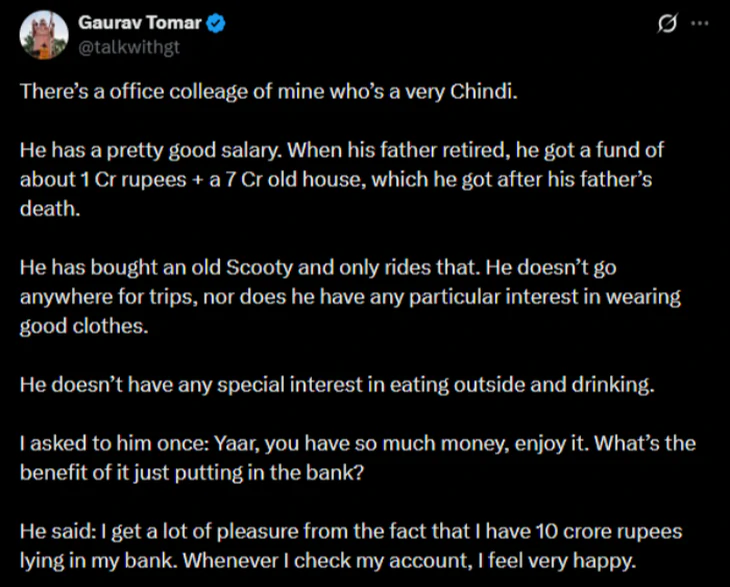
The story, initially brought to public attention by user Gaurav Tomar (@talkwithgt), documents the daily life of a colleague who possesses a substantial net worth but chooses to maintain a lifestyle indistinguishable from the average middle-class commuter. According to reports cited by News18, the individual in question is a high-earner who recently came into a significant inheritance following the retirement and subsequent passing of his father.
The core of the controversy lies in the disparity between the subject’s bank balance and his outward spending habits. Despite being in possession of assets totaling approximately 80 million rupees (equivalent to nearly $950,000 USD or 23 billion Vietnamese Dong), the individual continues to utilize an aging motorcycle for his daily commute. He reportedly shows little interest in upgrading to a luxury automobile, purchasing high-end designer apparel, or frequenting upscale dining establishments. When questioned by peers about his refusal to indulge in the "fruits of his labor," his response centered on the psychological satisfaction derived from seeing his savings grow, rather than the transient joy of material acquisition.
Chronology of a Financial Paradox
The subject’s financial journey reached a significant turning point upon the settlement of his father’s estate. The inheritance consisted of two primary components: a retirement fund valued at approximately 10 million rupees (2.8 billion VND) and a family property estimated to be worth 70 million rupees (20 billion VND). Combined with his personal savings accumulated prior to this windfall, his total net worth sits in the neighborhood of 28 billion VND.
Despite this influx of capital, the subject’s behavior did not shift. He maintained his existing employment, continued to ride his older motorcycle, and kept his daily expenses strictly capped. For many observers, this behavior presents a paradox: the accumulation of wealth is generally viewed as a means to increase one’s standard of living, yet for this individual, the accumulation itself has become the end goal.

The Psychology of Frugality and Wealth Management
Financial experts often categorize this behavior as a form of "extreme saving" or "FIRE-adjacent" (Financial Independence, Retire Early) philosophy, though in this case, it appears to be rooted more in emotional security than a specific plan to exit the workforce.
In an interview-style exchange captured by his colleague, the subject admitted that he feels a profound sense of happiness every time he checks his bank statement. "I am very happy to have 100 million rupees in my bank account. Every time I check the balance, I feel secure," he explained. This sentiment highlights a shift in modern financial values where the "security" of a digital number acts as a more powerful psychological buffer against the uncertainties of life than the consumption of luxury goods.
From a behavioral economics standpoint, this individual is prioritizing long-term asset stability over the diminishing returns of hedonic consumption. By avoiding lifestyle inflation—the tendency to increase spending as income rises—he effectively insulates himself from the stresses of economic volatility, medical emergencies, or unexpected life crises.
Public Reaction: A Divided Digital Audience
The reaction on social media platforms has been deeply polarized, reflecting broader societal disagreements about the purpose of money.
The Critique of Austerity
One faction of the online community argues that the subject’s behavior is bordering on "miserly." This group contends that wealth is meant to be utilized to improve the quality of life, care for one’s health, and create memories through travel and experiences. From this perspective, hoarding capital at the expense of living in the present is a missed opportunity. Critics argue that once a person reaches a certain level of financial security, they have a responsibility to themselves to enhance their well-being, suggesting that a failure to do so is a symptom of a scarcity mindset that prevents personal growth.
The Defense of Prudence
Conversely, a significant portion of the audience has rallied to the subject’s defense. This group highlights that societal pressure to "look" wealthy—through luxury cars, expensive watches, or fine dining—is often a performative trap. Supporters argue that the subject’s choice to ride an old motorcycle is a sign of liberation from these social expectations. They point out that the feeling of "financial safety" is a valid and highly desirable state of being, especially in an era of global economic uncertainty. To these commenters, the internal satisfaction of knowing one can handle any emergency is worth far more than the fleeting status associated with material upgrades.
Broader Socio-Economic Implications
The viral nature of this story speaks to a growing collective anxiety regarding wealth and status. In many developing economies, there is a traditional emphasis on visible displays of success. However, as the digital age matures, there is a visible shift toward "stealth wealth"—the practice of keeping one’s financial status private.
Furthermore, the debate touches upon the role of financial literacy. By choosing to keep his capital in his accounts rather than spending it on depreciating assets like new vehicles, the subject is effectively ensuring that his wealth continues to compound. In the long term, this strategy creates a massive safety net that could potentially support his family for generations.
Sociologists observing this trend note that the "motorcycle vs. luxury car" debate is merely a proxy for deeper questions:
- Utility vs. Status: Does a purchase serve a functional purpose, or is it intended to signal social status?
- Security vs. Experience: Is happiness found in the accumulation of resources or the consumption of experiences?
- The Definition of "Enough": At what point does saving become a burden rather than a benefit?
Expert Perspectives on Financial Health
While the subject’s specific case is extreme, financial planners often advise a "middle path." The general consensus among wealth managers is that an individual should balance three pillars:

- Safety: Maintaining an emergency fund and insurance to cover unforeseen events.
- Growth: Investing assets in diversified portfolios to outpace inflation.
- Living: Allocating a portion of income to improve the current quality of life, which is essential for mental health and preventing burnout.
The individual in the story has clearly mastered the first two pillars. His adherence to his frugal lifestyle is, according to some financial psychologists, a way of maintaining control in an uncontrollable world. By refusing to increase his "burn rate," he ensures that his financial freedom is absolute.
Conclusion
The story of the wealthy man on the old motorcycle serves as a Rorschach test for how we view money. For some, it is a cautionary tale of a life unlived; for others, it is an aspirational model of financial discipline and personal freedom. As the debate continues to unfold, it highlights an important truth: wealth is not merely what one owns, but the degree of control and security one feels over their own future. Whether or not one agrees with the subject’s choice to remain modest in his consumption, his story provides a compelling case for the power of financial autonomy in an increasingly expensive world. Regardless of the outcome of the online debate, the subject remains content, finding more value in the numbers on his screen than in the opinions of those who believe he should be living differently.