KIA Carens Clavis and Mitsubishi Xpander AT Premium: A Comparative Analysis of the Under-700-Million-VND Seven-Seater Segment


The automotive landscape for budget-conscious families in Southeast Asia has witnessed a significant shift with the recent introduction of the KIA Carens Clavis. Positioned as a direct competitor to the long-standing segment leader, the Mitsubishi Xpander AT Premium, this new arrival has intensified the rivalry in the sub-700-million-VND (approx. $27,500 USD) seven-seater MPV market. For families seeking a balance between affordability, utility, and modern technology, the choice between these two vehicles has become a focal point of debate in the current automotive landscape.
Historical Context and Market Evolution
The seven-seater MPV segment has been the primary battleground for Japanese and Korean manufacturers for over a decade. Mitsubishi revolutionized the category in 2017 with the launch of the Xpander, which effectively bridged the gap between a traditional utilitarian minivan and the aesthetics of a sport-utility vehicle (SUV). Its "Dynamic Shield" design and robust suspension tuning set a benchmark that competitors struggled to match.

Conversely, KIA has navigated this segment by focusing on feature-rich interiors and high-end tech integration. The Carens line, which underwent a significant revitalization in recent years, serves as KIA’s answer to the rising demand for family vehicles that do not compromise on driving dynamics or cabin comfort. The launch of the Clavis trim represents a strategic attempt by THACO Auto, the distributor of KIA in Vietnam, to capture the middle-market demographic that prioritizes advanced driver assistance systems (ADAS) over traditional brand loyalty.
Comparative Dimensions and Chassis Dynamics
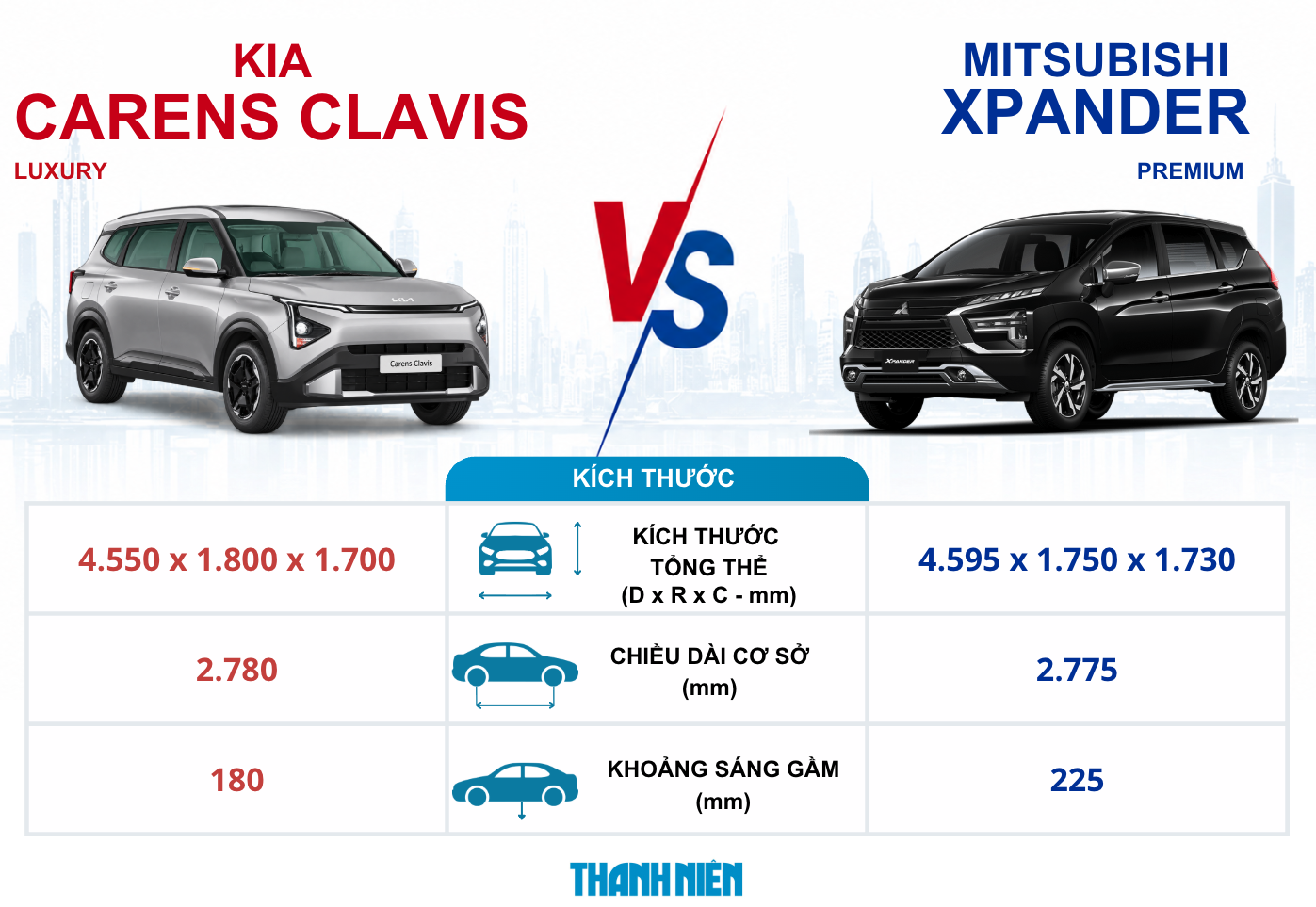
When evaluating the physical dimensions of both vehicles, the differences reflect the distinct engineering philosophies of each brand. The KIA Carens Clavis Luxury measures slightly shorter in total length than the Mitsubishi Xpander AT Premium, yet it compensates with a wider stance—an advantage of 50 mm—which translates into improved shoulder room for passengers in the first two rows.
However, the Mitsubishi Xpander maintains a critical advantage in terms of ground clearance. With 225 mm of clearance, compared to the 180 mm offered by the Carens Clavis, the Xpander remains the more capable vehicle for navigating urban flood zones and unpaved, uneven road surfaces often found in rural or developing infrastructure. The wheelbase disparity between the two is negligible, separated by only 5 mm, indicating that both manufacturers have optimized their platforms to provide maximum interior legroom within the constraints of the compact MPV footprint.

Interior Appointments and Technological Integration
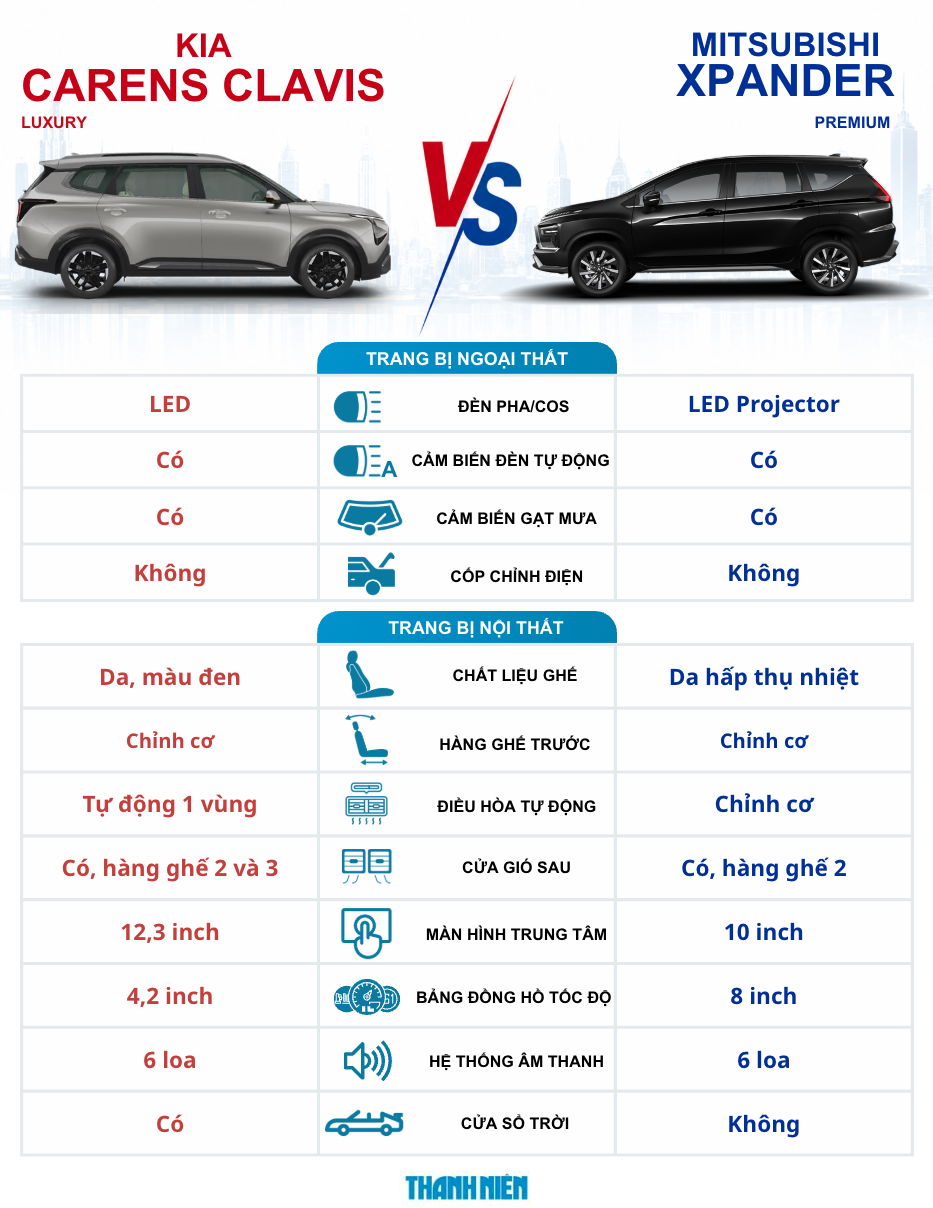
Inside the cabin, the two models offer diverging experiences. The KIA Carens Clavis leans heavily into the digital era, boasting a 12.3-inch infotainment display that serves as the centerpiece of its dashboard. This is complemented by automatic climate control and a wireless charging pad, catering to tech-savvy users who prioritize connectivity.
The Mitsubishi Xpander, meanwhile, adheres to a more ergonomic and functional design language. It features an 8-inch digital instrument cluster that provides clear, driver-focused feedback, which is significantly more informative than the 4.2-inch cluster found in the Carens. Furthermore, Mitsubishi has invested in high-quality synthetic leather seating designed with heat-reduction properties, a subtle but vital feature for tropical climates where vehicle interiors can reach extreme temperatures during peak daylight hours.
Performance and Powertrain Specifications
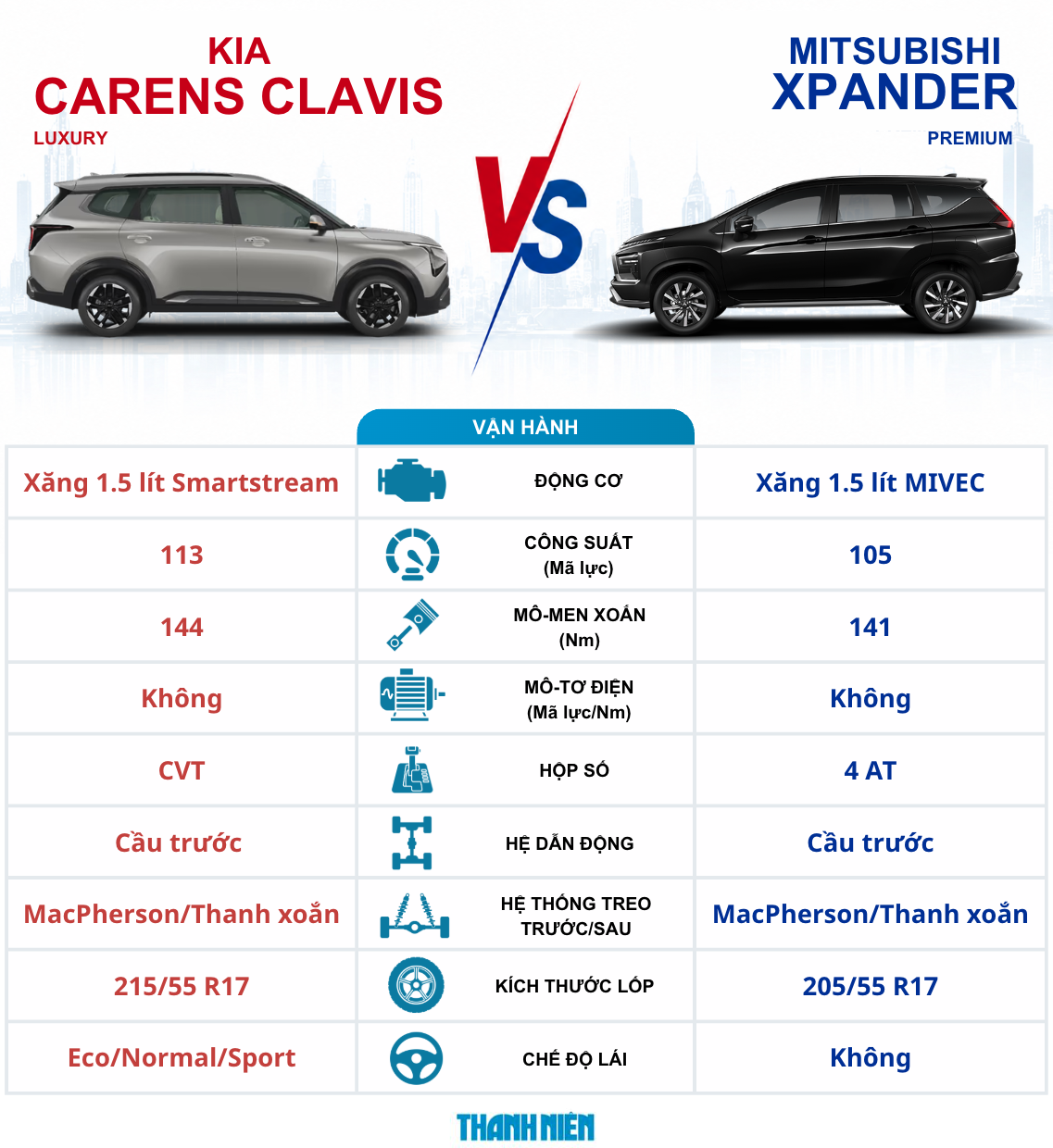
Both vehicles are equipped with 1.5-liter naturally aspirated gasoline engines, a standard configuration for this price bracket designed to prioritize fuel efficiency over raw power. While the output figures are largely comparable, the transmission choices mark the most significant departure in their driving profiles.
The KIA Carens Clavis employs a Continuously Variable Transmission (CVT), which offers smoother, shift-free acceleration and is generally more efficient in stop-and-go city traffic. In contrast, the Mitsubishi Xpander continues to utilize a traditional 4-speed automatic transmission. While the 4-speed unit may feel dated compared to a CVT or a 6-speed automatic, it is widely regarded for its reliability, low maintenance costs, and predictable behavior—traits that have contributed to the Xpander’s enduring popularity in commercial and ride-hailing sectors.
Furthermore, the Carens Clavis provides a more customizable driving experience with three distinct drive modes: Eco, Normal, and Sport. This allows the driver to modulate throttle response and transmission behavior based on the driving environment. Both vehicles share a similar MacPherson strut front and torsion beam rear suspension geometry, ensuring a predictable, if not sporty, ride quality suited for family transport.
Safety and Advanced Driver Assistance Systems (ADAS)
The most striking divergence between the two models lies in their safety suites. Both cars come standard with six airbags, Anti-lock Braking System (ABS), Electronic Stability Control (ESC), and Hill-Start Assist. However, the KIA Carens Clavis significantly outperforms its competitor by incorporating a comprehensive suite of Advanced Driver Assistance Systems (ADAS).
The Carens Clavis features adaptive cruise control, lane-keep assist, forward collision avoidance assist, and rear cross-traffic alerts. These features are generally reserved for vehicles in higher, more expensive segments. The Mitsubishi Xpander, while lacking the full ADAS suite, counters with its proprietary Active Yaw Control (AYC). This system improves cornering stability by managing the braking force on the front wheels, providing a more composed handling experience during spirited driving or emergency maneuvers.
Market Implications and Pricing Strategy
The KIA Carens Clavis Luxury is currently listed at 679 million VND, while the Mitsubishi Xpander AT Premium sits at 659 million VND. The 20-million-VND price differential is relatively narrow given the current market climate.
From an industry analyst perspective, the pricing suggests that KIA is banking on the "value-for-money" proposition. By offering advanced safety technology—features that usually cost significantly more—KIA is attempting to disrupt the Xpander’s dominance. Mitsubishi, however, benefits from years of established brand equity, a massive service network, and a reputation for longevity that continues to influence first-time buyers.
Strategic Outlook for Families
For the modern consumer, the choice is ultimately one of priority. The Mitsubishi Xpander remains the quintessential "safe bet." Its higher ground clearance and proven mechanical reliability make it ideal for those who frequently travel outside of well-paved urban centers or who view their vehicle as a long-term asset that will be easier to service and eventually resell.
Conversely, the KIA Carens Clavis is tailored for the urban family that prioritizes safety, convenience, and modern aesthetics. The inclusion of ADAS technology provides a layer of active protection that the Xpander currently lacks, making it a compelling option for parents who spend a significant amount of time in heavy traffic or on highways.
As both manufacturers look toward the future, the competition between these two models will likely force further innovation. It is expected that future iterations of the Xpander will inevitably adopt more advanced driver assistance features to remain competitive, while KIA will likely focus on expanding its service infrastructure to challenge the logistical dominance of the Japanese incumbent. For now, the sub-700-million-VND market remains a robust and vibrant segment, providing families with more sophisticated options than ever before.
Related posts: