Urban resilience against natural disasters has long been a paramount engineering focus in Japan, a nation frequently besieged by torrential monsoons, violent typhoons, and devastating flash floods. As global climate patterns shift and extreme weather events become increasingly frequent and severe, the vulnerabilities of urban infrastructure and private property are laid bare. A striking manifestation of this vulnerability occurred recently in the Chubu region, specifically around Nagoya, where torrential rainfall paralyzed local transportation networks. Critical railway lines were suspended, major thoroughfares transformed into impassable waterways, and countless automotive dealerships found their sprawling vehicle lots submerged under feet of turbid water. In such emergency scenarios, when automobiles cannot be swiftly relocated to elevated positions or multi-story parking structures, the risk of catastrophic mechanical, electrical, and structural damage is exceptionally high.
Entering the market as a groundbreaking response to this recurring hazard is the Monarte Floating Floor, an innovative automotive parking solution developed in Japan. Engineered primarily from high-density, waterproof foam materials combined with robust structural reinforcements, this dynamic parking platform possesses the remarkable capability to elevate itself and the vehicle parked upon it whenever floodwaters rise. Boasting a structural weight capacity exceeding 3,000 kilograms (approximately 6,600 pounds), the system is specifically designed to accommodate the substantial mass profile of modern passenger vehicles, including heavy large-scale electric vehicles and luxury SUVs. This technological marvel represents a paradigm shift in how urban planners and automotive custodians conceptualize flood mitigation, moving away from reactive recovery toward passive, automated protection.
To fully understand the gravity of the problem that the Monarte Floating Floor addresses, one must examine the severe financial and technical consequences of vehicular flooding. Flash floods can inflict ruinous damage on automobiles, even when the vehicles remain submerged for only a brief duration. Modern vehicles are essentially computers on wheels, heavily reliant on complex electrical wiring harnesses, sophisticated sensors, sensitive electronic control units (ECUs), and extensive interior leather and fabric configurations that are utterly ruined upon contact with water. Furthermore, stagnant or rapidly moving floodwaters often carry corrosive chemical residues, silt, and sharp debris that compromise structural integrity. In worst-case scenarios, forceful currents can completely sweep away parked vehicles, turning multi-ton chunks of metal into dangerous floating hazards that threaten human life and property. Traditional preventative measures—such as moving cars to higher ground or relying on municipal storm barriers—often fail when flash flooding strikes unexpectedly during the dead of night, leaving vehicle owners and commercial dealerships completely helpless.
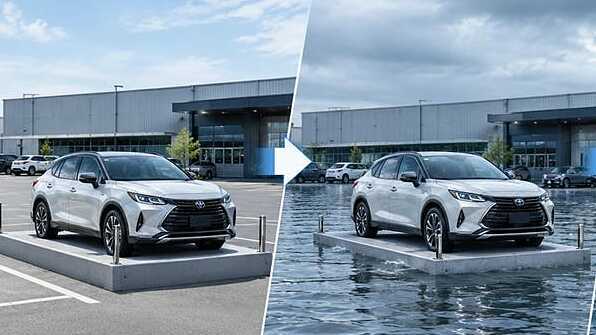
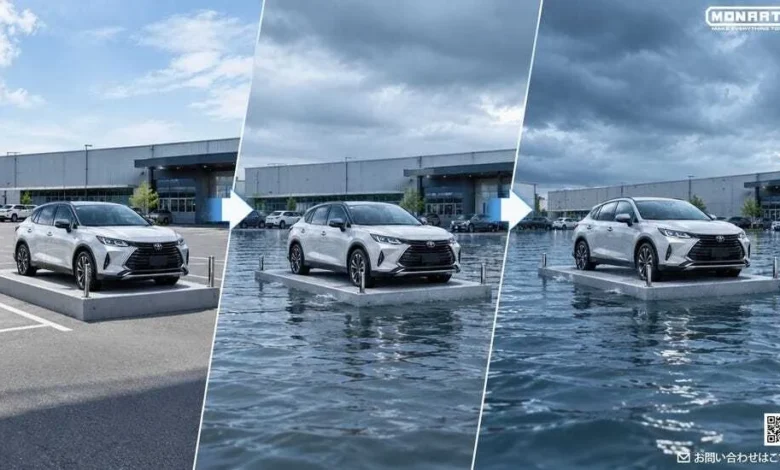
The engineering brilliance of the Monarte Floating Floor lies in its sheer simplicity and absolute reliability. The system requires no manual activation protocols when storm warnings are issued; rather, it functions seamlessly as an ordinary, everyday parking platform under normal atmospheric conditions. The platform is constructed from a specialized marine-grade, waterproof foam core covered with a durable, high-friction resin surface. Four sturdy steel guide columns are strategically positioned at the corners of the platform to maintain vertical alignment and prevent lateral drift when water levels begin to rise. As floodwaters accumulate beneath the structure, the buoyant foam core responds automatically, lifting the platform and the vehicle in tandem.
Crucially, the system operates entirely without external power sources, complex hydraulic machinery, inflatable pontoons, or electronic water sensors. This mechanical independence ensures that even if local power grids fail completely during a severe tempest, the floating floor remains fully operational. When a sudden inundation occurs, the car rises smoothly along with the deck and maintains its elevated, floating state until the floodwaters eventually recede and the platform settles back onto its foundation. This ingenious design is uniquely suited for flood-prone regions, effectively safeguarding dealership inventories, underground residential parking garages, and commercial fleet depots. Aside from the vertical steel guide columns, the installation alters none of the fundamental functionalities of a standard parking space, blending seamlessly into daily urban environments while standing ready to transform into a life-saving buoyant stage when disaster strikes.
The corporate lineage behind this innovation adds significant credibility to its engineering pedigree. Monarte is a specialized subsidiary of Tajima Motor Corporation, an esteemed enterprise founded by Nobuhiro "Monster" Tajima, a legendary racing driver renowned for his numerous championship victories and historic record-breaking ascents at the grueling Pikes Peak International Hill Climb. While the parent company maintains a diverse portfolio spanning high-performance racing equipment, electric vehicle development, and automotive engineering, Monarte is explicitly dedicated to pioneering disaster prevention technologies and risk-mitigation systems designed to minimize property loss from floods, typhoons, and other natural catastrophes. This motorsport background translates into a rigorous, performance-driven approach to product development, ensuring that every structural component of the floating floor can withstand extreme physical stresses.
While the Monarte Floating Floor has currently been introduced primarily within the domestic Japanese market, its global implications are profound. As coastal cities and inland metropolitan areas worldwide grapple with escalating flood risks driven by climate change, solutions that offer passive, fail-safe protection for high-value assets are in unprecedented demand. Automotive dealerships, luxury car collectors, and municipal fleet managers in flood-vulnerable regions across Southeast Asia, North America, and Europe are closely monitoring the deployment of this technology. Although the maximum lifting height is constrained by the vertical length of the steel guide columns and pricing details vary based on custom installation requirements, the system represents a highly viable investment for safeguarding depreciating automotive assets against the unpredictable fury of nature. By bridging the gap between passive urban architecture and active disaster resilience, the Monarte Floating Floor establishes a new benchmark for protecting automotive investments in an increasingly volatile climate era.