The Shifting Landscape of South Korean Automobiles in Vietnam: From Market Darlings to a Complex Turnaround

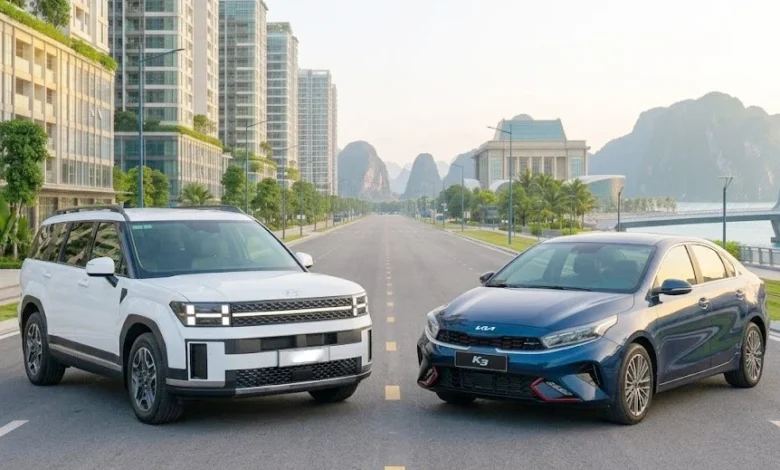
Five to seven years ago, naming a first-time car purchase in Vietnam was a predictable exercise. Models such as the Hyundai Accent, Kona, Santa Fe, and KIA Cerato, Morning, and Seltos dominated urban streets and suburban driveways alike. These vehicles served as the default standard for urban professionals, ride-hailing fleets, and families looking for modern styling and high-value feature lists. However, the Vietnamese automotive market has undergone a seismic shift, leaving many once-dominant South Korean nameplates facing significant commercial contractions. While these brands are far from irrelevant, their journey from undisputed market leaders to struggling contenders highlights the dynamic, unforgiving nature of Vietnam’s modern automotive landscape.
The Rise and Fall of the Korean Golden Era
The zenith of South Korean vehicle dominance in Vietnam can be clearly traced back to around 2022. During this period, Hyundai Thanh Cong recorded impressive figures across nearly every segment in which it competed. The Hyundai Accent stood tall as a market titan, registering 22,645 sales in 2022 alone to crown itself the best-selling B-segment sedan and one of the absolute favorites nationwide. Meanwhile, the Hyundai Creta entered the market to successfully replace the discontinued Kona, securing 12,096 sales. The mid-size SUV Santa Fe moved 10,603 units, and the Tucson added another 8,438 units to the conglomerate’s tally. KIA experienced a parallel triumph, with models like the K3 dominating the C-segment sedan category by moving 11,404 units in 2022, and the Seltos making waves as a breakthrough B-SUV with 12,398 sales.
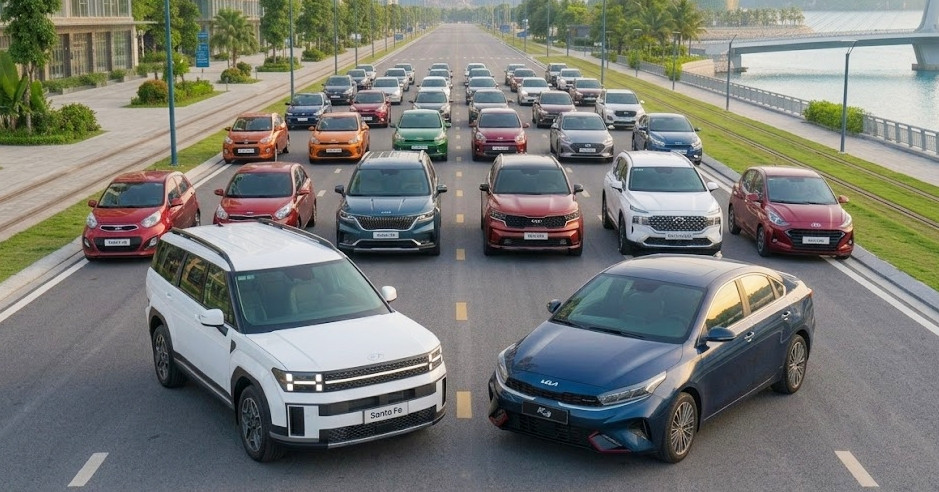
This prosperity was built on a proven and highly effective formula: striking, youth-oriented design, an abundance of advanced technology features, and aggressive pricing strategies. For years, traditional Japanese competitors were frequently criticized for conservative styling and sparse equipment lists. Hyundai and KIA capitalized on this by offering features typically reserved for luxury vehicles—such as large panoramic sunroofs, ventilated seating, massive infotainment screens, and advanced driver assistance systems—at a significantly lower price point. For budget-conscious consumers who prioritized aesthetic appeal and comfort, South Korean cars represented an unbeatable value proposition.
A Rapid Contraction Across Core Segments
The ensuing years, however, exposed vulnerabilities in this volume-driven strategy. By 2025, the sales landscape had shifted dramatically. Hyundai’s overall portfolio volume had retracted significantly, with reliance narrowing heavily toward its high-riding crossover offerings, the Creta and Tucson, though even their numbers were subdued compared to historical peaks.
The most drastic contractions were felt in historical volume drivers. The Accent saw its sales plummet from 22,645 units in 2022 to just 7,088 units by 2025—a staggering drop of nearly 70% in three years. The Santa Fe suffered a similarly steep decline, falling from over 10,600 units in 2022 to approximately 2,600 units in 2025, representing a 75% reduction. The entry-level Grand i10 experienced a parallel fate, with 2025 sales hovering at 3,358 units, roughly one-third of its performance three years prior.
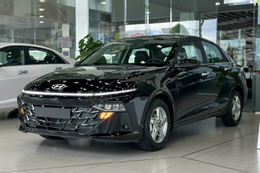
This downward trajectory extended deeply into 2026. Performance data from the first seven months of 2026 underscored ongoing challenges, with the Accent registering a modest 2,290 units, the Grand i10 at 1,381 units, and the Santa Fe struggling at 1,179 units.
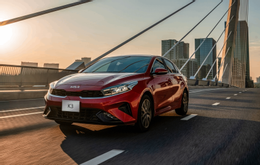
KIA faced a nearly identical narrative. The KIA K3, once the undisputed king of the C-segment sedan category, watched its sales tumble to 3,205 units in 2023. By 2026, the model’s performance had slowed to the point where it was no longer reported individually, but rather grouped alongside the Morning and Soluto, which collectively managed a meager 931 units over a seven-month span—averaging roughly 310 units per model. The Seltos, which previously spearheaded sales for the brand, saw its numbers slide from 12,398 units in 2022 to 6,577 units later on, before stabilizing at 5,271 units during the first seven months of 2026.
Macroeconomic Factors and Expanding Market Competition
Industry analysts point out that the headwinds faced by Hyundai and KIA are largely symptomatic of a vastly more crowded and sophisticated marketplace. The Vietnamese automotive consumer has evolved beyond superficial feature lists and aggressive pricing. Today’s buyers place significantly higher importance on long-term operating costs, fuel efficiency, resale value, build quality, and safety ratings.
At the same time, traditional Japanese rivals have successfully modernized. Toyota aggressively revitalized its portfolio, refreshing its sedan lineups, expanding its high-riding utility vehicles, and capturing consumer imagination by pioneering the mainstream hybrid vehicle segment in Vietnam. Other Japanese marques, including Honda, Mitsubishi, and Mazda, alongside regional specialists like Ford—whose Ranger, Everest, and Territory models continue to dominate their respective segments—have refined their offerings to counter the styling and technology advantages once exclusively held by South Korean brands.
Furthermore, structural changes in the market have completely altered the competitive landscape. The meteoric rise of domestic electric vehicle manufacturer VinStart introduced an entirely new paradigm, capturing significant market share with comprehensive EV lineups and robust charging infrastructures. Concurrently, an influx of European brands and an aggressive expansion of Chinese automakers have flooded the market with choices. In the B-SUV segment alone, consumers now face choices from nearly 20 different competing models, eroding the unique selling propositions that once allowed cars like the Seltos to easily command the segment.
Strategic Pivots: The Hybrid and SUV Offensive
Despite the steep sales declines in legacy volume segments, automotive experts emphasize that this contraction does not signal the demise of South Korean brands in Vietnam. Rather, Hyundai and KIA are actively executing strategic pivots, shifting their operational focus away from traditional sedans and entry-level hatchbacks toward high-demand SUV segments and electrified powertrains.
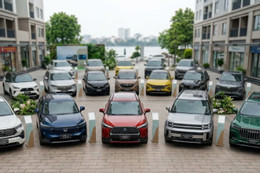
Recognizing the consumer shift toward eco-friendly, fuel-efficient mobility, both automakers have moved aggressively into the hybrid space. Hyundai has introduced hybrid variants of its flagship models, including the Santa Fe Hybrid, Tucson Hybrid, and the large Palisade Hybrid. Similarly, KIA has broadened its eco-conscious portfolio by rolling out the Sportage Hybrid alongside the Sorento Hybrid and Plug-in Hybrid Electric Vehicle (PHEV) variants.
This product diversification represents more than a mere expansion of trim levels; it is a calculated response to evolving consumer demands. As Vietnamese motorists increasingly prioritize fuel economy amid fluctuating energy costs and environmental considerations, the integration of hybrid technology provides a crucial pathway for growth. If these new electrified SUVs can maintain competitive pricing structures and convince buyers of their long-term reliability and low operating costs, Hyundai and KIA retain a viable opportunity to stage a robust market recovery.
Conclusion: A New Chapter for Korean Brands in Vietnam
The narrative of South Korean automobiles in Vietnam is transitioning from an era of unchecked, explosive growth into a mature, highly competitive chapter. The days of easily securing market dominance through flashy aesthetics and low initial price points have officially drawn to a close. However, by adapting to macro-level trends, embracing vehicle electrification, and realigning their product offerings with the modern consumer’s demand for efficiency and utility, Hyundai and KIA are actively rewriting their market strategy. The race in Vietnam’s automotive sector is far from over; instead, it has entered a sophisticated new phase where long-term survival depends entirely on continuous innovation and genuine value delivery.