Electric Vehicle Depreciation Crisis in the UK: Luxury Models Suffer Steep Value Losses After Three Years

The automotive landscape in the United Kingdom is experiencing a profound shift, characterized not only by the rapid adoption of zero-emission vehicles but also by a dramatic collapse in their residual values on the secondary market. Recent data compiled by automotive intelligence firm CDL and analyzed by leading industry publications reveals that numerous battery electric vehicles (BEVs), particularly those hailing from prestigious luxury marques, are shedding value at an unprecedented rate. After a standard ownership period of three years and approximately 36,000 miles (roughly 57,936 kilometers) of use, a significant cohort of electric cars is retaining less than 30% of its original manufacturer’s suggested retail price (MSRP).
While the average depreciation rate for a conventional internal combustion engine (ICE) automobile in the UK hovers around 45% over a three-year span, the upper echelon of depreciating electric models registers losses ranging from a staggering 69% to a phenomenal 72.7%. For early adopters and fleet operators alike, this economic reality translates into monumental financial losses amounting to tens of thousands of pounds within a relatively brief operational window. This phenomenon is reshaping consumer behavior, redefining the dynamics of automotive financing, and creating both severe liabilities for new car buyers and unexpected bargains for budget-conscious pre-owned shoppers.
Understanding the Anatomy of Electric Vehicle Depreciation
Depreciation has historically represented the single largest ownership cost for any motor vehicle, easily surpassing routine maintenance, insurance, and fuel expenditures. However, the trajectory of battery electric vehicle depreciation has defied traditional automotive forecasting models. According to Steve Walker, a representative for automotive publication Auto Express, the rapid erosion of residual values in the EV sector is driven by a convergence of distinct market pressures.

Among the primary catalysts is the blistering pace of technological advancement within the battery and electric propulsion sectors. Vehicles manufactured just three years ago frequently feature charging speeds, thermal management systems, and driving ranges that are vastly outperformed by newer iterations hitting dealership floors. Consequently, used car buyers exhibit hesitation toward older battery technology, fearing diminished battery health and costly out-of-warranty replacements, even though real-world data frequently demonstrates that modern lithium-ion packs degrade at much slower rates than initially feared.
Furthermore, aggressive pricing strategies, frequent manufacturer discounts, and expansive government or corporate incentive programs for brand-new electric vehicles have inadvertently crippled their secondary market valuations. When a manufacturer slashes the price of a brand-new EV or introduces sweeping lease subsidies, the residual value of existing pre-owned models plummets in tandem, forcing used car dealers to continually adjust pricing downward to clear inventory.
The Top Depreciators: Luxury and Mainstream Models Hit Hardest
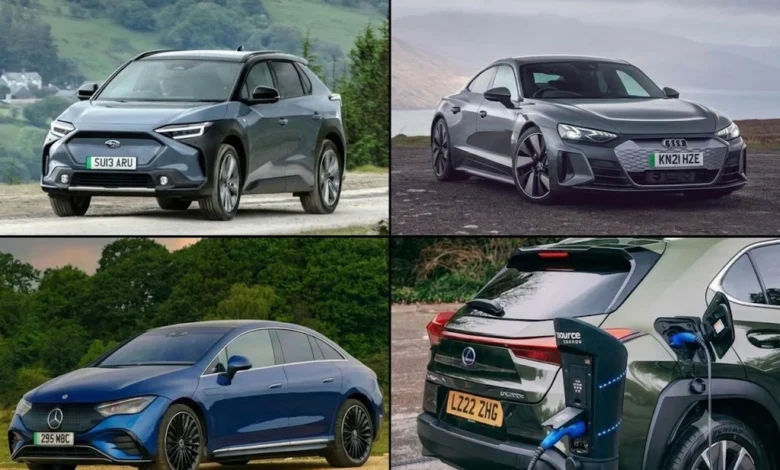
A comprehensive analysis of the UK market highlights specific models that have borne the brunt of this depreciation wave. At the very apex of the depreciation rankings stands the Lexus UX 300e. As the inaugural battery-electric offering from Toyota’s luxury division, the UX 300e commanded an average new price of £51,145 (approximately $65,000 USD or 1.79 billion VND) upon its release. However, after three years of operation and 36,000 miles on the odometer, the average trade-in value for these units collapses to a mere £13,950 (approximately 488 million VND). This equates to a staggering depreciation rate of 72.7%, leaving owners with just 27.3% of their initial capital investment. Compounding its market challenges, Lexus announced the discontinuation of the UX 300e model line toward the end of 2025, further dampening long-term collector and consumer confidence. Industry analysts point to its relatively modest driving range and constrained cabin space—limitations stemming from its adaptation of an internal combustion engine platform rather than a dedicated EV architecture—as primary factors behind its steep value decline.
Following closely behind in the second position is the Citroen e-C4, which registers a depreciation rate of 72.3%. New models retailed at an average of £32,895, but trade-in valuations after three years drop precipitously to roughly £9,125. Securing the third spot is the Vauxhall Astra Electric, shedding 72% of its value with an initial purchase price of £37,250 dwindling down to a residual value of £10,425. Its stablemate, the Vauxhall Corsa Electric, claims the fourth position with a 71.6% depreciation rate, dropping from a starting average of £32,635 to £9,275 after the standard three-year evaluation window.

Intriguingly, the top ten list of rapidly depreciating vehicles is not exclusively populated by electric models. Securing the fifth position is the Audi A8, representing one of the sole internal combustion engine vehicles to make the list, with a depreciation rate of 70.7%. This flagship luxury sedan commanded an average price of £103,620 when new, yet retained a trade-in value of only £30,325 after three years. Audi officially phased out sales of the combustion-engine A8 in the UK market at the beginning of 2026, marking the end of an era for the executive cruiser.
Further down the ranking, the Subaru Solterra—an electric SUV sharing its underlying technical architecture and platform development with the Toyota bZ4X—ranks sixth with a 70.3% depreciation rate, falling from a £52,495 retail price to £15,575. The retro-styled Fiat 500e urban runabout takes seventh place with a 69.8% loss, dropping from £28,035 to £8,475. High-performance battery machinery also proves vulnerable; the Audi e-tron GT luxury grand tourer ranks eighth, losing 69.3% of its value as its initial £107,875 price tag recedes to an average trade-in valuation of £33,150.
The final two positions in the top ten are occupied by flagships from Mercedes-Benz. The Mercedes-Benz EQS luxury saloon, which debuted with an average price tag of £104,540, retains just £32,375 after three years, reflecting a 69% loss. Similarly, its sibling, the Mercedes-Benz EQE, started life at an average of £86,615 before shedding 69% of its value to rest at a trade-in valuation of £26,850.
Market Implications: A Double-Edged Sword for Consumers
The aggressive devaluation of three-year-old electric vehicles creates a deeply polarized financial reality within the automotive ecosystem. For initial purchasers who bought these vehicles brand new during their market launch phases, the financial hit is severe. Fleet managers and corporate leasing companies, who frequently calculate residual values to structure monthly business contract hires, have similarly absorbed significant losses, prompting many leasing providers to recalibrate their risk models and increase monthly rates for newly introduced electric fleets.

Conversely, this steep depreciation curve has opened a lucrative gateway for budget-conscious motorists looking to enter the electric vehicle market without bearing the crushing cost of a brand-new purchase. A pre-owned luxury electric sedan or crossover that originally cost upwards of £50,000 to £100,000 can now be acquired on the secondary market for the price of a modest, mass-market supermini. Industry observers note that this democratization of electric mobility is gradually expanding the demographic reach of zero-emission vehicles, moving them beyond affluent early adopters into the driveways of everyday drivers.
However, market dynamics are rarely uniform. While data from mainstream trade monitors highlights widespread depreciation across the broader spectrum of used EVs, secondary trends indicate that market direction is not universally downward. Parallel market data published by consumer advocacy platforms reveals that select segments of the used EV market have experienced sudden value surges—in some cases climbing by up to 28% over rolling six-month periods. This counter-trend typically manifests during periods of macroeconomic volatility, particularly when fluctuations in global crude oil prices drive traditional petrol and diesel fuel costs to elevated levels. When refueling internal combustion engines becomes increasingly expensive, consumer demand shifts perceptibly toward second-hand electric vehicles as buyers prioritize lower operating and commuting expenses over initial acquisition concerns.
Industry Outlook and Future Projections
As the United Kingdom edges closer to its regulatory milestones regarding the phase-out of new internal combustion engine vehicle sales, the automotive manufacturing sector continues to adapt its production, pricing, and distribution frameworks. Automakers are increasingly cognizant of the fact that residual value stability is crucial for long-term brand equity and customer retention.
To combat excessive depreciation, several manufacturers are beginning to introduce enhanced battery warranty extensions, certified pre-owned (CPO) inspection guarantees, and software update policies designed to keep older electric vehicles technologically relevant for longer periods. Additionally, as the used car market matures and independent mechanics become increasingly proficient in high-voltage battery diagnostics, repair, and refurbishment, consumer anxiety surrounding used EV ownership is expected to gradually dissipate.

For now, the three-year ownership benchmark serves as a stark reminder of the financial risks inherent in purchasing cutting-edge automotive technology during its nascent commercial phases. Whether future generations of electric vehicles will achieve the structural residual value stability traditionally enjoyed by mature combustion-engine counterparts remains one of the most closely watched questions in the modern automotive economy.