China has officially launched two primary power generation units at the Huaneng Jintan energy storage facility in Changzhou, Jiangsu province, marking a significant milestone in the country’s transition toward a modernized, flexible power grid. This large-scale compressed air energy storage (CAES) project, boasting a total installed capacity of 700 MW, represents a sophisticated engineering feat that leverages subterranean geological formations to stabilize renewable energy supplies. As China accelerates its commitment to carbon neutrality, such infrastructure projects are becoming the backbone of a reliable, green energy ecosystem.
The Mechanics of Subterranean Energy Storage
The fundamental principle behind the Huaneng Jintan project is the conversion of surplus electricity—often generated during off-peak hours—into mechanical energy stored in the form of high-pressure air. When electricity demand is low, the facility utilizes surplus grid power to drive high-performance compressors, forcing air into vast underground salt caverns located approximately 1,000 meters beneath the surface. These caverns are pressurized to levels exceeding 130 atmospheres.
When the grid experiences a surge in demand, the process is reversed. The high-pressure air is released from the caverns to drive a series of specialized turbines, which in turn generate electricity to feed back into the national grid. The choice of salt caverns is strategic; their natural geological composition offers exceptional sealing properties and structural stability, effectively preventing gas leakage over extended periods. This makes them ideal for the repetitive, high-cycle nature of modern power storage requirements.
Technical Innovations and Operational Efficiency
The efficiency of the Jintan facility is what distinguishes it from previous iterations of energy storage technology. With a conversion efficiency rate exceeding 70%, the plant is frequently referred to by industry experts as a "super power bank" for the electrical grid. To achieve this, engineers have integrated a comprehensive thermal management system.
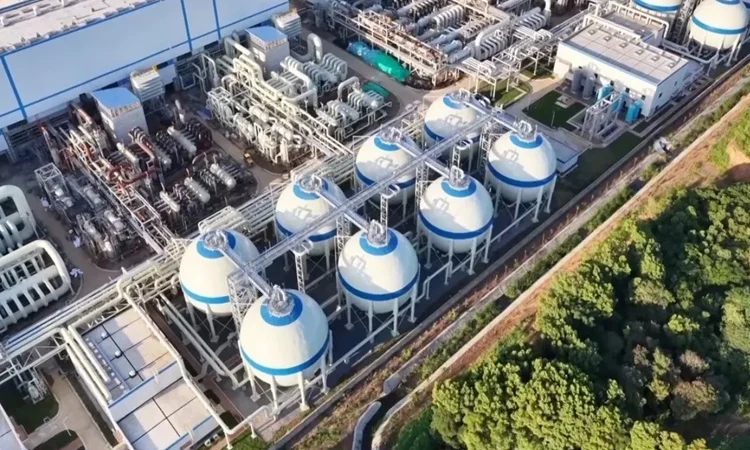
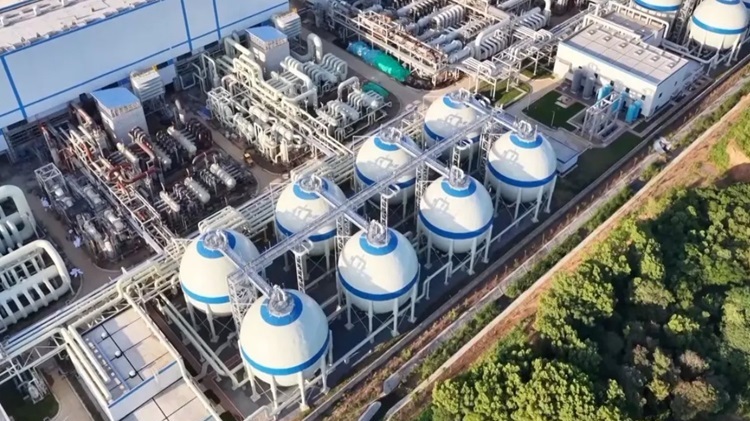
During the air compression process, heat is generated as a natural byproduct. Rather than allowing this thermal energy to dissipate, the Jintan facility captures and stores it using a matrix of 16 spherical thermal-storage water tanks. These tanks have a collective volume of 56,000 cubic meters, currently standing as the largest such installation in Asia. By retaining this heat, the facility significantly reduces energy loss during the power generation phase, ensuring that the thermal energy can be re-injected into the air stream to reheat it before it hits the turbine, thereby increasing the overall cycle efficiency.
Furthermore, the facility is equipped with an advanced gas processing system capable of continuous operation with the largest gas wells in China. Engineers have developed specialized corrosion-resistant linings and treatment protocols for these wells, allowing them to process up to 2.16 million cubic meters of air per hour. This allows for a robust operational schedule, with the facility capable of undergoing approximately 330 charging-discharging cycles annually, providing a storage capacity of 2.8 million kilowatt-hours (kWh) per cycle.
Chronology and Development Roadmap
The development of the Jintan facility did not occur in a vacuum; it is the culmination of years of targeted research and development in China’s energy sector.
- Initial Research Phase (2015-2018): Chinese state-owned enterprises, including the China Huaneng Group, began intensive geological surveys to identify suitable salt cavern formations across the Jiangsu and Hubei provinces.
- Feasibility and Pilot Testing (2019-2020): Small-scale prototypes were constructed to test the integrity of salt caverns under fluctuating high-pressure conditions. Data regarding vibration, temperature, and pressure at depth were meticulously gathered.
- Project Launch (2021-2023): Construction of the full-scale Jintan facility commenced. The project was designated a key national initiative to support the integration of renewable energy sources into the grid.
- Operational Milestone (September 2026): The activation of the two primary power generation units signals the facility’s transition from a testing environment to a fully integrated grid asset.
Strategic Implications for China’s Energy Grid
The shift toward compressed air energy storage is a direct response to the volatility inherent in renewable energy. As China rapidly scales its wind and solar power capacity, the intermittency of these sources poses a challenge to grid stability. Traditional power plants, such as coal-fired stations, lack the agility to fluctuate production rapidly to match the sharp peaks and troughs of renewable supply.
Unlike fossil fuel-based plants, which require combustion and lengthy startup times, the Jintan CAES facility can respond to grid frequency requirements in near real-time. This flexibility is essential for preventing blackouts and reducing the reliance on "peaker" plants that typically burn coal or natural gas, thereby reducing the overall carbon footprint of the energy sector.
Industry analysts suggest that the success of the Jintan project will serve as a template for other regions. By utilizing underground space, China is effectively bypassing the land-use constraints that often hinder the development of massive battery-storage parks. Moreover, the long operational lifespan of salt-cavern storage—often estimated to be several decades—offers a more sustainable capital expenditure profile compared to lithium-ion battery arrays, which require more frequent replacement.
Official Responses and Future Goals
Government authorities have emphasized that the Jintan facility is a cornerstone of China’s "14th Five-Year Plan" for energy development. The Ministry of Industry and Information Technology has publicly stated that the project demonstrates China’s mastery of the entire technology chain for large-scale energy storage.
The broader national objective is to add more than 180 gigawatts (GW) of new energy storage capacity by 2027. This ambitious target is designed to foster a competitive, innovative market for storage technologies. While lithium-ion batteries remain the dominant player for short-duration storage, the government is actively incentivizing "long-duration" storage solutions like CAES, pumped hydro, and flow batteries to handle the seasonal and daily fluctuations of a green grid.
Looking Ahead: The Future of Long-Duration Storage
The implications of the Jintan facility extend beyond China’s borders. As global nations grapple with the same transition challenges, the engineering specifications and operational data derived from the Jintan site are being watched closely by the international energy community.
The integration of advanced monitoring systems at the Jintan site—which allows technicians to track real-time data from both surface equipment and subterranean sensors—represents the next frontier of "smart grid" management. By utilizing centralized, automated control centers, operators can make split-second decisions to optimize energy discharge, effectively creating a self-regulating loop that balances supply and demand without human intervention.
While challenges remain, such as the geographic specificity required for salt cavern storage, the success of this facility proves that the marriage of geological engineering and modern power electronics is a viable path forward. As the world moves away from a carbon-intensive economy, the ability to "bank" energy in the earth itself may prove to be one of the most critical technologies of the 21st century. The Jintan project is not merely an engineering achievement; it is a vital component of a resilient, decarbonized future that ensures power remains constant even when the wind stops blowing and the sun sets.