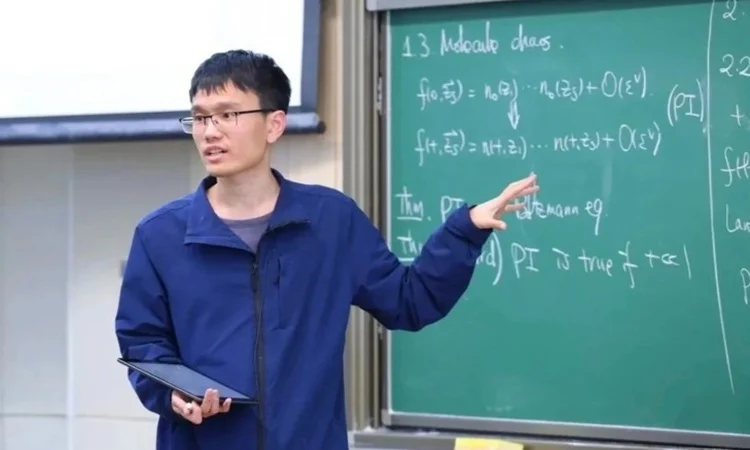
Ma Tie, a 28-year-old mathematical prodigy whose work recently solved a centuries-old scientific enigma, has made the strategic decision to depart the United States to join the University of Science and Technology of China (USTC) in Hefei, Anhui province. His appointment, announced by the university on November 1, marks a significant shift in his career trajectory, as he transitions from traditional pure mathematics toward the burgeoning field of Artificial General Intelligence (AGI).
Ma has been appointed as a joint professor at USTC’s Institute of General Artificial Intelligence and the Institute of Geometry and Physics. This move is widely viewed by the global scientific community as a bellwether for the increasing convergence between high-level theoretical mathematics and the computational power of generative AI.
A Path Defined by Mathematical Brilliance
Ma’s ascent into the upper echelons of global mathematics began in his youth in Xinxiang, Henan province. A precocious talent, he demonstrated an aptitude for calculus as early as the sixth grade. In 2014, at the age of 16, he was admitted to the prestigious USTC gifted youth program, an institution established in 1978 that annually recruits approximately 40 of China’s most brilliant young minds before they complete their secondary education.
Following his graduation from USTC in 2018, Ma pursued his doctoral studies at Princeton University. It was during his tenure at Princeton that he began his intensive work on the “Hilbert’s Sixth Problem,” a daunting challenge that has perplexed mathematicians for over a century. The problem centers on establishing a rigorous bridge between the chaotic nature of atomic systems and the deterministic laws of fluid dynamics, such as water and airflow.
In 2024, Ma, alongside his mentor Zaher Hani and collaborator Dong Yu, announced a breakthrough in this field. The findings, published in the Annals of Mathematics, were heralded as a masterclass in modern analytical theory. The success of this collaboration was instrumental in Dong Yu winning the prestigious 2026 Fields Medal, and it secured Ma a position as a researcher at the University of Michigan.
The Strategic Pivot to Artificial Intelligence
Ma’s decision to move to Hefei is not merely a professional relocation; it represents a fundamental change in his research focus. While he has achieved success in traditional mathematics, Ma has become increasingly convinced that the future of discovery lies in the hands of machines.
“In the short term, AI will certainly reach a very high level of performance, and I do not rule out the possibility that it will independently solve problems on the scale of Hilbert’s Sixth,” Ma stated in a recent interview.
His research at USTC will prioritize the development of “agentic” systems—AI that can perform complex scientific tasks with minimal human intervention. Ma has already developed a prototype system, internally referred to as qmd-prover, designed specifically to automate the verification of mathematical proofs. His objective is to integrate the entire lifecycle of a proof—conceptualization, logical derivation, verification, and formal documentation—into an automated, AI-driven pipeline.
The Institutional Shift: USTC’s Vision for AGI
The establishment of the Institute of General Artificial Intelligence at USTC in January 2026 highlights a broader national push to integrate machine intelligence into fundamental scientific research. The institution aims to move beyond standard language models, focusing instead on “embodied” intelligence—AI systems capable of interacting with the physical world to facilitate breakthroughs in physics, chemistry, and materials science.
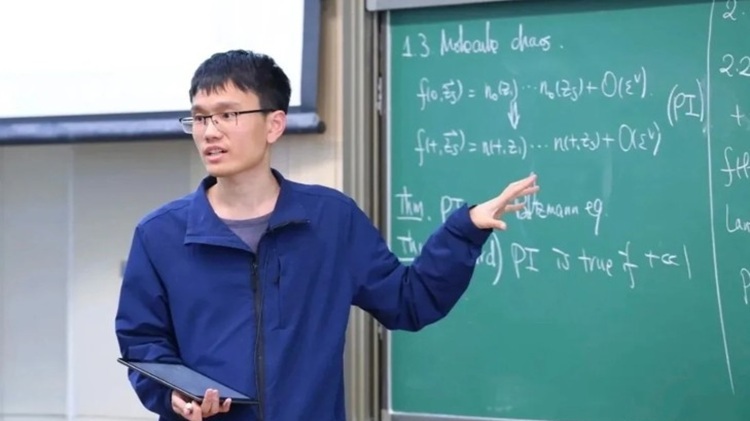
For USTC, the recruitment of a mathematician of Ma’s caliber is a key component of their broader strategy to lead in the development of "AI for Science" (AI4S). The university has explicitly stated that its goal is to create a new paradigm where AI is no longer just a tool for computation, but a collaborator in the discovery of new physical laws.
Implications for the Mathematical Community
The transition of a top-tier mathematician like Ma into the AI sector has prompted a debate within academic circles regarding the future of scientific inquiry. Traditionalists argue that the human element of mathematical intuition is irreplaceable. However, proponents of the AI-led approach, including Ma, argue that the complexity of modern problems has reached a threshold where human cognitive limitations necessitate artificial assistance.
Ma has been vocal about the necessity of this adaptation for the next generation of researchers. “When I accept new students, I require them to be proficient in tools like Codex, Claude Code, and Git,” Ma noted. “If you do not know how to leverage these tools, you are at risk of becoming a ‘technological illiterate’ in this new era.”
Broader Impact and Global Context
The move also underscores the intensifying global competition for talent in the AI sector. While Western universities have long served as the primary training grounds for international scholars, China’s recent investments in infrastructure and academic prestige are increasingly successful in attracting home-grown talent back to domestic institutions.
The geopolitical implications of such a brain-gain are substantial. If researchers like Ma successfully automate the process of scientific discovery through AGI, the nation that controls the infrastructure for these systems will likely gain a decisive advantage in technological innovation.
Future Outlook: What Lies Ahead
Ma’s immediate goal for the next two to three years is to transition his core research focus entirely to agentic systems. He plans to work closely with the engineering teams at USTC to scale the qmd-prover system, with the intent of deploying it in wider, more complex domains beyond geometry and physics.
His colleagues remain optimistic but cautious. Dong Yu, reflecting on their collaboration, noted, “Without Ma’s unique ability to bridge abstract theory with computational logic, our progress on Hilbert’s problem would have been significantly delayed. His transition to AI is a logical, albeit bold, evolution of his previous work.”
As Ma settles into his new role at USTC, the academic world will be watching closely. Whether he succeeds in creating an AI that can function as a creative, independent mathematician remains to be seen. However, his departure from traditional academia marks a pivotal moment in the history of science—a signal that the era of human-only mathematical discovery is rapidly evolving into a new, hybrid epoch defined by the synergy of human ingenuity and artificial intelligence.
The integration of Ma’s rigorous mathematical training with the technical demands of AGI development is expected to yield results that could redefine how researchers approach the most fundamental questions of the universe. With a clear vision and the backing of one of China’s top research universities, Ma is positioned to lead the front lines of this technological frontier.
Related posts: