BYD Officially Responds to Viral Video of Tang EV Rear Motor Detachment During Flood Navigation in China

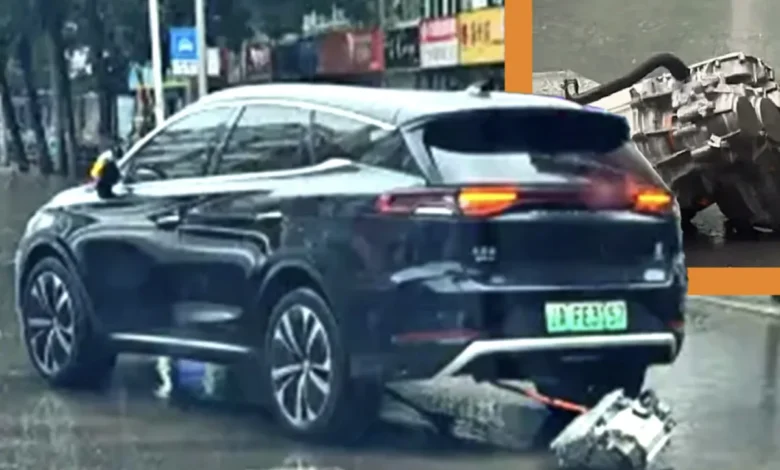
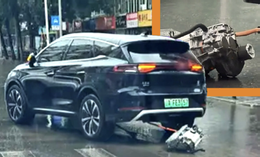
The global automotive community and social media users across China have been focused on a peculiar and concerning incident involving a BYD Tang electric SUV. Footage that recently went viral on platforms such as Weibo and Douyin depicted the flagship electric vehicle navigating a flooded street in Shenyang, Liaoning Province, while its rear electric motor appeared to have detached from the chassis. The motor was seen dragging behind the vehicle, suspended only by its heavy-duty high-voltage wiring, even as the SUV continued to move forward through the water. Following days of intense speculation regarding the structural integrity of the vehicle, BYD has officially released a statement clarifying the circumstances surrounding the mechanical failure.
According to the official explanation provided by the Shenzhen-based automaker, the incident was not a result of a manufacturing defect or spontaneous structural failure caused by water ingress. Instead, BYD asserts that the vehicle suffered a severe undercarriage impact while the driver was attempting to traverse the flooded section of the road. The company’s investigation suggests that the vehicle struck a submerged object or a significant road deformity with enough force to shear the mounting brackets that secure the rear drive unit to the subframe. Because the BYD Tang EV in the video is a dual-motor, all-wheel-drive (AWD) variant, the front motor remained operational and provided the necessary traction to keep the vehicle moving, despite the rear motor having "fallen" out of its designated housing.
The Chronology of the Incident in Shenyang
The incident occurred during a period of heavy seasonal rainfall in northeastern China, which led to localized flooding in several urban centers, including Shenyang. As is common in such weather events, many drivers attempted to navigate waterlogged streets, often unaware of the depth of the water or the hazards hidden beneath the surface.
The viral video begins with the BYD Tang EV—a prominent model in BYD’s "Dynasty" series—making its way through water that reached approximately halfway up the wheels. Observers filming from the sidewalk noticed a large, metallic component dragging behind the rear axle. Closer inspection of the footage revealed that this component was the entire rear electric drive assembly. Despite the catastrophic mechanical detachment, the vehicle did not lose power immediately. It continued to crawl forward, demonstrating the independent nature of dual-motor EV powertrains.
The video quickly sparked a debate regarding EV safety and durability. Some netizens questioned whether the weight of the electric motors, combined with the force of moving water, was too much for the mounting bolts to handle. Others pointed out the potential electrical hazards, as the orange high-voltage cables were clearly visible and under significant tension as they held the weight of the motor against the ground.
Technical Analysis of the Structural Failure
A detailed look at the aftermath and the images circulating alongside the video reveals that the rear motor of the BYD Tang EV is typically bolted to a subframe using high-strength steel or aluminum alloy mounts. In this specific case, the mounts appear to have snapped or "bung" (burst) out of their positions. The only thing preventing the motor from being left behind entirely in the floodwaters were the high-voltage orange cables and potentially some sensor wiring.
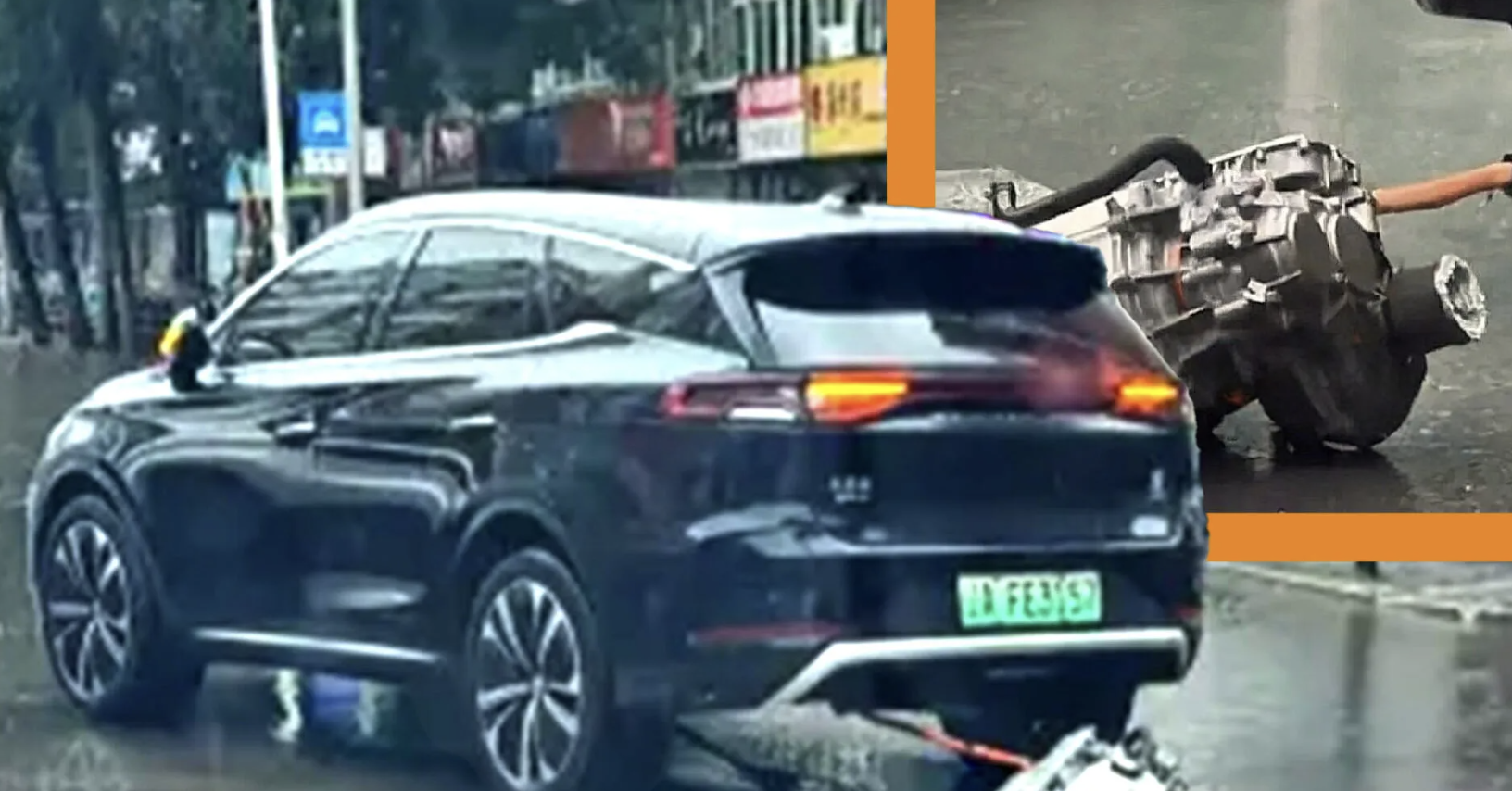
In modern electric vehicle design, orange cabling is the industry standard for high-voltage systems, typically carrying between 400 and 800 volts. These cables are designed with high tensile strength and heavy insulation to prevent electrocution and fire in the event of a crash. In this incident, the cables proved remarkably resilient, supporting a motor that likely weighs between 150 and 250 kilograms (approximately 330 to 550 pounds) while being dragged across the pavement and through water.
The fact that the car remained mobile is a testament to the redundancy of dual-motor systems. In a traditional internal combustion engine (ICE) vehicle, the loss of a transmission or a primary drive shaft would immediately immobilize the car. In a dual-motor EV, the front and rear axles are often digitally synchronized but mechanically independent. When the rear motor detached, the front motor—which was still securely mounted and receiving power from the battery—continued to pull the vehicle’s weight.
BYD’s Official Investigation and Findings
In response to the public outcry, BYD’s technical team conducted an assessment of the vehicle. The company stated that they proactively contacted the owner as soon as the incident was reported to provide assistance and begin a forensic analysis of the damage.
The official statement emphasizes that "the motor detachment was caused by a very strong impact to the undercarriage while passing through the flooded area." BYD suggests that the vehicle may have hit a manhole cover that had been displaced by water pressure, a curb, or a large piece of debris. The force of the impact was reportedly concentrated on the rear drive unit’s mounting points. BYD’s engineers noted that the structural integrity of the vehicle’s main chassis and battery pack remained intact, but the localized force was sufficient to overcome the shear strength of the motor mounts.
While BYD has not publicly disclosed the exact cost of the repairs, automotive experts suggest that the bill will be substantial. Beyond replacing the motor mounts and the rear subframe, the rear electric motor itself may have suffered internal damage from being dragged and submerged. Furthermore, the high-voltage cable harness, which was stretched and stressed, will almost certainly require a complete replacement to ensure the vehicle meets safety standards for future use.
Contextualizing the BYD Tang and the Chinese EV Market
The BYD Tang is one of the most successful SUVs in China, available in Plug-in Hybrid (PHEV) and Battery Electric (BEV) versions. As a flagship model, it is often marketed for its performance and robustness. This incident is particularly sensitive for BYD, which recently surpassed Tesla in quarterly global EV production and is currently expanding aggressively into European and Southeast Asian markets.
This event highlights a growing concern in the EV era: the vulnerability of undercarriage components to road hazards. Unlike ICE vehicles, where the heavy engine is protected by the front crumple zone and a robust engine cradle, EVs distribute weight differently. The battery pack usually occupies the floor, and the motors are positioned between the wheels. While this low center of gravity improves handling, it places critical, heavy, and expensive components in areas that are susceptible to impacts from road debris or "hydro-locking" forces in deep water.
Supporting Data: EV Safety in Floods
The Shenyang incident has reignited discussions about the IP (Ingress Protection) ratings of electric vehicles. Most modern EVs, including those from BYD, are designed to meet IP67 or IP68 standards, meaning their electrical components can be submerged in up to one meter of water for 30 minutes without failing. However, these ratings apply to "static" water.
When a vehicle moves through water, it creates a "bow wave" that increases the pressure on the undercarriage. If the vehicle strikes a solid object while moving through the resistance of the water, the kinetic energy involved is significantly higher than on dry land. Data from automotive safety institutes suggests that many EV owners overestimate the "amphibious" capabilities of their cars. While some specialized vehicles, like the BYD-owned Yangwang U8, feature an emergency "boating mode" that allows the car to float and navigate deep water for short periods, the standard BYD Tang is not designed for such extreme conditions.
Broader Implications for the Industry and Consumers
The viral nature of the Tang EV incident serves as a cautionary tale for both manufacturers and consumers. For manufacturers, it may lead to a re-evaluation of motor mount designs, perhaps incorporating additional "catch" mechanisms or reinforced shielding for vehicles sold in regions prone to flooding.
For consumers, the takeaway is a reminder of the physical limits of automotive engineering. Journalistic investigations into flood-related car damage often find that insurance companies are increasingly wary of "voluntary" flood crossings. If an investigation proves that a driver entered deep water despite warnings, the claim for a detached motor or a fried battery pack could be denied under "negligence" clauses.
Furthermore, the incident raises questions about the long-term reliability of EVs in changing climates. As extreme weather events and urban flooding become more frequent, the "ground clearance" and "underbody protection" of EVs will likely become as important to buyers as range and charging speed.
Conclusion and Future Outlook
BYD’s quick response to the Shenyang incident reflects the company’s awareness of its brand reputation. By attributing the failure to an external impact rather than a design flaw, BYD is attempting to reassure millions of current and prospective owners that their vehicles are safe under normal operating conditions.
As the vehicle undergoes repairs and the investigation concludes, the automotive industry will likely monitor whether BYD issues any technical service bulletins or minor design updates for newer iterations of the Tang SUV. For now, the "dragging motor" video remains a stark visual representation of the unexpected challenges that can arise when high-tech electric powertrains meet the unpredictable forces of nature and urban infrastructure failure. The resilience of the high-voltage cables may be the only silver lining in an otherwise costly and embarrassing mechanical failure for one of the world’s most prominent EV manufacturers.