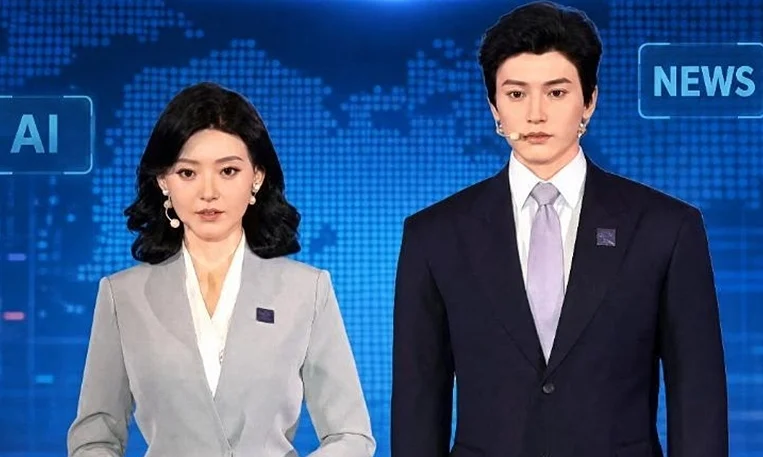
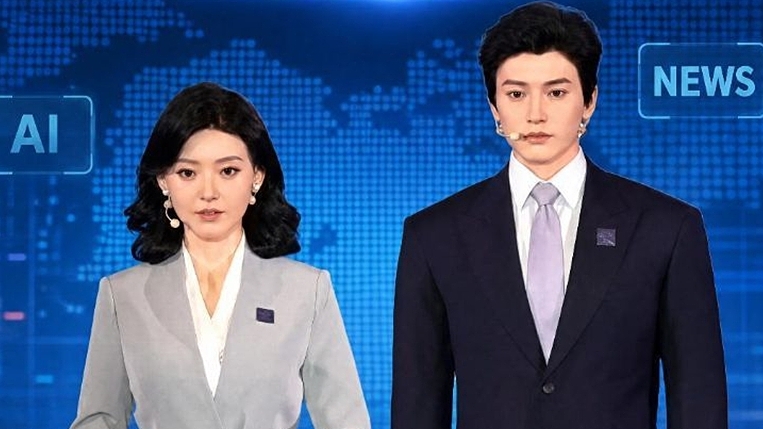
At the seventh World Media Summit held in Beijing, China, from November 5 to November 9, Xinhua News Agency unveiled a groundbreaking advancement in media technology: the world’s first human-like AI news anchors. These lifelike, humanoid robots, designed to represent both male and female broadcasters, marked a significant departure from previous digital avatars by physically stepping onto the stage to address an audience, signaling a new era in the fusion of robotics, artificial intelligence, and journalism.
The Debut and Technical Mastery
The demonstration at the summit was a choreographed display of technological sophistication. The female robot, named Xinyan, ascended a podium to engage directly with the audience, demonstrating her ability to interact in real-time before transitioning seamlessly into a news broadcast. The project, led by director Zhang Meng, focused on the intersection of aesthetic design and mechanical engineering to create a sense of natural presence.
The development team prioritized the "human touch," focusing on the nuances of movement, facial expressions, and vocal intonation. According to reports from the Asia Business Daily, Zhang Meng’s team sought to capture not just the visual fidelity of a human broadcaster but also the intangible "atmosphere" of a professional newsroom. This involved intensive work on the robots’ kinematic structures, allowing them to mirror the subtle gestures and fluid motions that distinguish a human presenter from a static machine.
Chronology of AI Integration in Chinese Media
The integration of AI into Xinhua’s news operations has been a multi-year project, reflecting China’s broader strategic investment in AI technologies.
- November 2018: Xinhua shocked the global media landscape by introducing its first AI news anchors. These early iterations were digital simulations—composite images of real human presenters paired with synthetic voices. At the time, the underlying technology remained a closely guarded secret, but the impact on the industry was immediate.
- June 2026: Xinhua launched "Xinhua Yudian," a smart, AI-driven content processing and editing platform. This system served as the backbone for the new generation of humanoid robots, providing them with real-time access to verified news databases.
- November 2026: The World Media Summit in Beijing serves as the public unveiling of the physical, humanoid iteration of these anchors, moving from screen-based avatars to fully mobile, robotic entities capable of physical interaction.
Supporting Data and Technological Infrastructure
The technical prowess of these robots is supported by a robust infrastructure developed in partnership with UBTech, a leader in humanoid robotics. Zhou Jian, Chairman and founder of UBTech, explained that the "brain-emotion-control" system integrated into the robots is designed to ensure accuracy. The robots pull information from verified news sources in real-time, which is then processed through the Xinhua Yudian platform. This architecture is specifically designed to mitigate the risks associated with generative AI, such as the spread of misinformation or "hallucinations," which have plagued other AI-driven content tools.
The robots are equipped with high-fidelity synthetic skin designed to mimic the appearance and texture of human skin, providing a sense of realism that is crucial for building viewer trust. Furthermore, the robots feature sophisticated language processing capabilities that allow them to handle multi-lingual broadcasts, making them versatile tools for international news dissemination.
Official Responses and Strategic Vision
During the summit, officials from Xinhua emphasized that these robots are not intended to replace human journalists. Qian Tong, Director of the Media Integration Center at Xinhua, reiterated that human reporters and editors remain the "key decision-makers" in the newsroom. The robots, according to the agency, serve as high-efficiency assistants capable of performing labor-intensive tasks such as continuous news updates, data presentation, and multilingual translation, allowing human staff to focus on high-level investigative journalism, ethics, and fact-checking.
Industry experts attending the summit reached a consensus regarding the "human-led, machine-assisted" model. The prevailing sentiment among the delegates was that while AI can provide unmatched speed in data retrieval and delivery, the core tenets of journalism—critical thinking, on-the-ground verification, and moral accountability—are functions that cannot and should not be delegated to machines.
Implications for the Global Media Industry
The introduction of humanoid AI anchors carries profound implications for the future of journalism.
Economic Efficiency and Scalability
The ability to deploy a news anchor that can operate 24/7 without fatigue or human error represents a significant shift in operational costs for major media outlets. By automating the delivery of standard news bulletins, organizations can allocate human talent to more complex, resource-heavy reporting tasks.
The Challenge of Public Trust
While the technological advancement is impressive, it brings the challenge of public perception to the forefront. The "uncanny valley"—the phenomenon where human-like robots create a sense of unease in human observers—remains a hurdle. However, as these robots become more refined, the line between digital synthetic content and reality continues to blur. Xinhua’s focus on verifiable data sources is a direct response to global concerns regarding deepfakes and AI-generated disinformation.
The Future of Human-AI Collaboration
The collaboration between media organizations and robotics firms like UBTech suggests a future where the "newsroom" is a hybrid environment. As AI handles the mechanical aspects of information processing, the role of the human journalist may evolve into that of an "editor-in-chief" or "fact-check auditor," ensuring that the automated systems adhere to the rigorous standards of journalistic integrity.
Conclusion
The unveiling of these humanoid news anchors at the seventh World Media Summit marks a milestone in the evolution of news technology. While the industry remains cautious about the role of AI in journalism, the shift toward a "machine-assisted" model appears to be an inevitable progression. By balancing the speed and efficiency of AI with the critical judgment of human oversight, institutions like Xinhua are attempting to chart a path that embraces technological innovation without compromising the foundational values of truth and accountability.
As the technology continues to mature, the focus will likely shift from the "novelty" of the robotic anchor to the reliability of the underlying AI systems. The success of this initiative will ultimately be measured not by how human the robots appear, but by their ability to consistently deliver accurate, high-quality information to a global audience in an increasingly complex and fast-paced digital environment. The future of the newsroom is no longer purely human, but it remains, for now, human-directed.
Related posts: