In the complex ecosystem of public transportation, particularly within the inter-provincial bus networks of Southeast Asia, a small orange or red tool often goes unnoticed until the moment it becomes the most valuable object in the world. The emergency escape hammer, a specialized device designed to shatter tempered glass windows during accidents, is legally required to be accessible to every passenger. However, a disturbing trend has emerged across many transport providers where these lifelines are being intentionally obstructed, removed, or "locked" away. This practice, driven by a desire to prevent petty theft, represents a profound failure in safety culture and a direct violation of transport regulations, effectively turning passenger cabins into potential traps during life-threatening emergencies.
The Vital Role of the Emergency Hammer in Transport Safety
To understand the gravity of the current situation, one must first understand the engineering behind modern passenger buses. Most long-distance buses are equipped with large panes of tempered glass. Unlike standard glass, tempered glass is processed by controlled thermal or chemical treatments to increase its strength. While this makes the windows durable against road debris and wind pressure, it also makes them nearly impossible to break with a fist, a kick, or a standard heavy object.
The emergency hammer is specifically engineered with a hardened steel point. This concentrated point of impact creates a microscopic fracture in the surface tension of the tempered glass, causing the entire pane to instantly disintegrate into small, relatively harmless granules. In the event of a vehicle fire, a plunge into water, or a rollover where the main doors are jammed or inaccessible, these hammers are the only viable means of egress.
Safety experts emphasize that in a bus fire, smoke inhalation can render passengers unconscious within 60 to 90 seconds. The ability to shatter a window and exit the vehicle immediately is often the difference between a minor incident and a mass-casualty disaster. Despite this, investigations into various bus fleets have revealed a systemic disregard for this critical safety component.
The Current Reality: Locked, Chained, and Hidden
Recent inspections and passenger reports have highlighted several ways in which bus operators are "neutralizing" these safety tools. In many instances, the brackets designed to hold the hammers are empty. When questioned, drivers often reveal that the hammers are kept in the driver’s glove box or a locked cabinet to "prevent passengers from stealing them." This logic is fundamentally flawed; in a chaotic accident where the driver may be incapacitated or the cabin is filled with thick smoke, a hammer located at the front of the bus is useless to a passenger trapped in the rear.
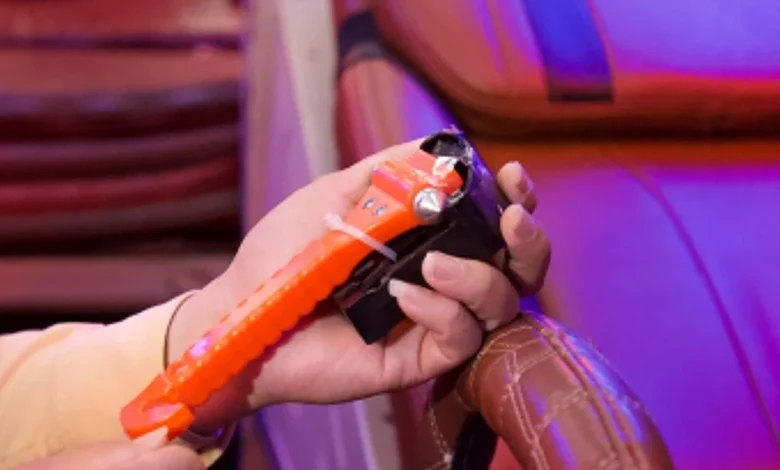
More egregious is the practice of "locking" the hammers in place. Some operators use plastic zip-ties, steel wire, or even small padlocks and chains to secure the hammers to their mounting brackets. While this effectively prevents theft, it also prevents the tool from being deployed in an emergency. A passenger in a state of panic, perhaps injured or struggling to breathe, cannot be expected to untie wire or break a industrial-grade zip-tie to access a tool that should be available with a single tug.
Economic Rationalization vs. Human Life
The motivation behind these actions is almost exclusively economic, yet the figures involved are jarringly disproportionate. In the Vietnamese market, a standard, certified emergency escape hammer costs between 50,000 and 150,000 VND (approximately $2 to $6 USD). Meanwhile, a modern sleeper bus or high-quality passenger coach can cost upwards of 3 billion VND ($120,000 USD).
Bus owners argue that the frequent loss of these hammers due to passenger theft adds up to a significant operational nuisance. However, from a risk-management perspective, the decision to prioritize a $5 tool over the lives of 40 passengers is an indefensible calculation. Critics point out that if a transport company cannot afford to replace a stolen hammer, they likely lack the financial stability to maintain the vehicle’s brakes, tires, and engines—components that are even more critical to passenger safety.
The Regulatory Gap and Ineffective Penalties
Under current Vietnamese law, specifically Decree 100/2019/ND-CP (later amended by Decree 123/2021/ND-CP), the failure to equip a passenger vehicle with required safety and fire-fighting equipment carries a fine. Currently, the administrative fine for missing or non-functional escape tools ranges from 500,000 to 1,000,000 VND.
Legal analysts argue that this penalty is far too low to act as a deterrent. For many bus owners, a 500,000 VND fine is seen as a "cost of doing business." There is a calculated gamble: the likelihood of being inspected on any given day is low, and the cost of the fine is only marginally higher than replacing a few stolen hammers. This creates a culture of non-compliance where safety is treated as a secondary concern to minor asset protection.
Furthermore, the inspection process itself is often criticized for being "point-in-time." Vehicles are thoroughly checked during their periodic registration (Dang kiem), at which point all hammers are present and accessible. Once the vehicle clears inspection and returns to its route, the hammers are promptly removed or locked away. Without spontaneous, roadside inspections specifically targeting safety equipment, the regulations remain "paper tigers."
Historical Context: Lessons Not Learned
The danger of obstructed exits is not theoretical. Over the past decade, several tragic incidents in the region have underscored the necessity of functional escape routes. In one notable 2016 bus fire in Binh Thuan province, survivors recounted the horror of trying to break windows with their bare hands as the fire spread. In cases where the bus flips on its side, the doors are often pressed against the pavement or deformed by the impact, making the windows the only way out.
In many of these past tragedies, post-accident investigations found that the absence of escape tools contributed significantly to the death toll. Despite the outcry following these events, the habit of "hiding" hammers persists. This indicates a deep-seated issue with the safety mindset of transport operators, who often view accidents as "something that happens to others" until it happens to them.
Stakeholder Reactions and Public Outcry
The public reaction to the "forbidden hammer" phenomenon has been one of growing frustration and fear. Passenger advocacy groups have begun calling for "blacklists" of transport companies that fail to provide accessible safety equipment. Social media has become a platform for whistleblowing, with passengers posting photos of empty hammer brackets or hammers bound by wires.
Transport experts suggest that the responsibility should not fall solely on the drivers. "The culture of safety must come from the top," says a representative from a regional transport safety committee. "If a company owner penalizes a driver for a missing hammer, the driver will naturally lock it up to protect their paycheck. The company must instead treat these tools as consumables, like fuel or oil, and factor the cost of occasional theft into their operating budget."
From a legal standpoint, some suggest that if a death occurs because a hammer was intentionally locked or removed, the bus owner should face criminal charges for "negligent homicide" or "violating regulations on road traffic safety resulting in serious consequences," rather than simple administrative fines.
Comparative Analysis: International Standards
In many developed nations, the standards for emergency exits are significantly more stringent. In the European Union and the United States, emergency hammers are often being phased out in favor of "push-out" windows or integrated lever systems that do not require a separate tool. For vehicles that still use hammers, they are often equipped with electronic sensors; if a hammer is removed from its bracket, an alarm sounds at the driver’s console. This allows the driver to monitor theft without compromising the accessibility of the tool.
Furthermore, international safety regulations often require that the hammers be attached to the vehicle by a thin, retractable cord. This cord is strong enough to discourage a casual thief from walking away with the tool but long enough and weak enough to be used or broken away in a genuine emergency. Adopting such technology in local bus fleets could bridge the gap between asset protection and passenger safety.
Moving Toward a Culture of Safety
To rectify this dangerous situation, a multi-pronged approach is required. First, the Ministry of Transport and relevant authorities must consider a significant increase in fines for tampering with safety equipment. A fine should be high enough to make the "theft risk" negligible by comparison.
Second, the "responsibility of the passenger" must be addressed. Public awareness campaigns should educate travelers on the importance of these tools and the severe consequences of stealing them. Theft of an emergency hammer should be viewed not as a petty crime, but as an act of endangerment against dozens of fellow citizens.
Third, transport companies must be mandated to use "tamper-evident" seals rather than "tamper-proof" locks. A thin plastic seal that breaks easily upon use can show the driver if a hammer has been moved while still allowing a passenger to deploy it in seconds.
Finally, passengers must take an active role in their own safety. Before a bus departs, passengers should verify the location of the nearest emergency hammer and ensure it is not obstructed. If the tool is missing or locked, passengers have the right—and the responsibility—to demand the driver rectify the situation or report the vehicle to the transport hotline.
The emergency hammer is more than just a piece of plastic and steel; it is a symbol of the "social contract" between a transport provider and its clients. When a bus company locks that hammer, they are effectively telling their passengers that their $5 asset is worth more than the lives of those on board. It is a practice that has no place in a modern, civilized transport system and one that must be eliminated before the next avoidable tragedy occurs. Only through strict enforcement, better equipment design, and a fundamental shift in safety priorities can we ensure that when the "forbidden" moment of a crash arrives, the path to escape remains open.