ASUS Zenbook A16 Review: A High-Performance Windows ARM Laptop That Blends Premium Design with Processing Power

The introduction of the ASUS Zenbook A16 marks a significant milestone in the evolution of Windows-powered ARM laptops, offering consumers a larger display, considerably enhanced processing capabilities, and a refined build compared to its smaller 14-inch predecessor. Priced at approximately 53 million VND in the Vietnamese market for the configuration featuring the Snapdragon X2 Elite Extreme processor, 24GB of RAM, and a 512GB solid-state drive, this device positions itself firmly in the ultra-premium segment. While its high-end specifications and substantial price tag target a niche demographic of power users and creative professionals, the laptop raises important questions regarding the balance between raw hardware potential and software ecosystem maturity in the modern computing landscape.

Main Facts and Hardware Specifications
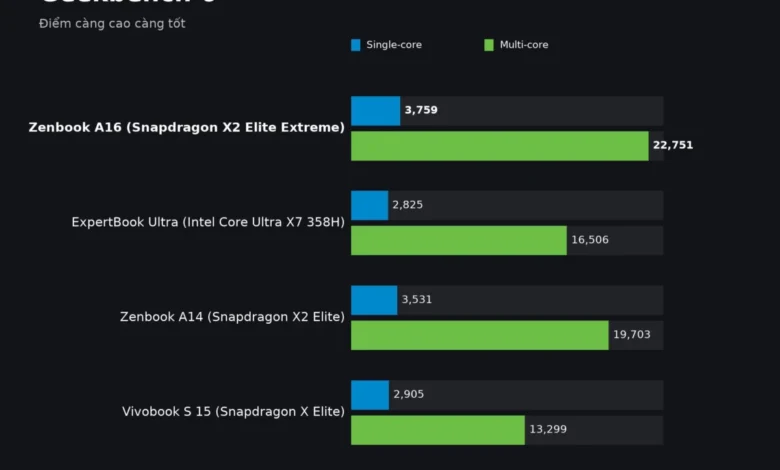
At the heart of the ASUS Zenbook A16 lies Qualcomm’s Snapdragon X2 Elite Extreme processor, widely considered one of the most powerful system-on-chip (SoC) architectures currently available for the Windows laptop market. Operating at a maximum power consumption of roughly 50 watts in Performance mode—and scaling back to a more efficient 25 to 35 watts in Standard mode—the processor delivers multi-core and single-core performance metrics that rival contemporary x86 offerings from Intel and AMD within the same power envelope.

Complementing the robust processor is an expansive 16-inch OLED display boasting a smooth 120Hz refresh rate and a peak HDR brightness of up to 1,100 nits. Despite its large screen estate, the Zenbook A16 maintains an exceptionally lightweight profile at just 1.2 kilograms. This is largely attributed to ASUS’s proprietary Ceraluminum material, a high-tech ceramic-aluminum hybrid designed to enhance scratch resistance, structural rigidity, and overall durability without adding unnecessary mass. The chassis also retains a comprehensive selection of input/output ports, including USB-A, USB-C, HDMI, and a full-sized SD card reader tailored specifically for content creators who require rapid media offloading.

Background Context and Chronology of Windows ARM
The journey of Windows on ARM architecture has been a gradual evolution, tracing back through several generations of Qualcomm Snapdragon processors from the early 8cx iterations to the current X2 Elite series. Historically, the primary bottleneck for ARM-based Windows machines has never been raw hardware performance or power efficiency, but rather software compatibility.

Over the past few years, Microsoft and various software developers have steadily increased the number of applications optimized with native ARM support. However, closing the gap with traditional x86 architecture remains an ongoing process, particularly within the realms of specialized professional software, plug-ins, extensions, and PC gaming. While the integrated graphics processor (GPU) on the Snapdragon X2 Elite Extreme is theoretically capable, it lacks the specialized upscaling technologies—such as NVIDIA’s DLSS, AMD’s FSR, or Intel’s XeSS—that have become industry standards for modern gaming. Consequently, many titles must run through emulation layers, which inevitably introduces performance overhead and diminishes the overall gaming experience compared to dedicated x86 systems paired with discrete graphics cards.

Performance Analysis and Thermal Management
In practical testing, the Zenbook A16 demonstrates exceptional thermal management and acoustic performance. Operating the device in Standard mode rather than Performance mode results in a performance trade-off of only about 15 percent, while significantly reducing fan noise and lowering chassis temperatures. This makes the Standard profile an ideal setting for intensive daily workflows, balancing sustained processing power with impressive power efficiency.

Battery life is another area where the Snapdragon architecture shines. Under mixed workloads with high screen brightness and demanding office tasks, the Zenbook A16 consistently delivers between eight and ten hours of continuous usage. While this battery longevity is increasingly matched by modern x86 processors, the Qualcomm platform maintains a distinct advantage in maintaining high performance levels while running cool and quiet under sustained loads.

However, limitations in memory configurations have drawn scrutiny from industry analysts. The review unit’s 24GB RAM allocation, while sufficient for many standard tasks, represents a potential bottleneck for heavy multitasking or resource-intensive creative suites. Upgrading to higher RAM tiers pushes the retail price past the 60 million VND mark, prompting prospective buyers to carefully weigh the cost against the inherent software limitations of the Windows ARM platform.

Broader Impact and Market Implications
The launch of the ASUS Zenbook A16 underscores the growing maturity—as well as the remaining growing pains—of the Windows ARM ecosystem. For professionals whose workflows rely entirely on natively supported applications, the machine offers an extraordinary combination of processing muscle, multi-day battery potential, premium aesthetics, and a spacious, high-fidelity display. The inclusion of a robust keyboard with a 1.3mm key travel, an oversized precision glass touchpad, and secure facial recognition via Windows Hello further elevates the daily user experience.

Conversely, for users who depend on legacy plugins, specialized extensions, or PC gaming as a primary use case, the device serves as a cautionary tale of hardware constrained by software readiness. While emulation layers allow non-native programs to function, the real-world performance penalty cannot be ignored.

Ultimately, the ASUS Zenbook A16 represents a bold step forward for ultra-thin, large-screen productivity laptops. It proves that ARM processors can successfully compete with established x86 giants in terms of raw computing power and efficiency. As software developers continue to expand native ARM support, devices of this caliber will likely become the industry standard. For now, however, consumers are advised to verify application compatibility before investing in a high-end Windows ARM machine, ensuring that the hardware’s immense potential aligns seamlessly with their daily operational requirements.